
Synopsis: Taking our religion seriously is a good thing, but there is such a thing as taking it too seriously. Those in positions of power who take their religion too seriously make up cruel rules and enact cruel enforcement policies designed to exclude and persecute those who do not follow them. Jesus criticized people like this for their hypocrisy in his time and culture … and so should we.
Scripture: Luke 13: 10-17
In August of 2004, a headline in the Warren Times inquired, “Wheat Intolerance Invalidates Girl’s First Communion?” In the article, an 8-year-old who suffers from a rare digestive disorder and cannot eat wheat had her first communion invalidated by the Catholic church because the wafer contained no wheat, which violates Roman Catholic Doctrine.
The girl’s mother was pushing the Diocese of Trenton and the Vatican to make an exception, arguing that her daughter’s condition should not exclude her from the sacrament, but the Catholic church was reluctant to change the rule that the wafers must contain some unleavened wheat.
Within our religious institutions, as with our institutions in general, people in positions of authority struggle with appropriate limits and enforcement of standards. What exceptions should be allowed? Where do we draw the line? What consequences should be imposed for failing to meet standards?
That’s what today’s scripture reading is all about. Just like extreme sports, extreme religion can be quite exhilarating, but also very dangerous, and the more deeply a person gets into it, the more dangerous it becomes for him or her and for everyone within their sphere of influence.
Let’s take a look at the context around our scripture reading for today. It follows on the heels of several related incidents where Jesus spars with the Pharisees and teachers of the law over the enforcement of traditional standards.
In chapter eleven, Jesus was teaching at the synagogue, and he was invited to come inside to dine with a Pharisee. As soon as he started eating, he was criticized for not engaging in the proper hand-washing ritual before the meal.
Jesus responded by denouncing the Pharisees and teachers of the law in no uncertain terms, calling them hypocrites, who clean the cup on the outside while leaving the inside filthy dirty. In other words, they were more concerned with ritual defilement than with ethical defilement.
Why didn’t Jesus wash his hands before eating? Isn’t that a hygiene thing? I mean, shouldn’t we all wash our hands before eating?
Actually, it wasn’t a hygiene thing. It was one of the Traditions of the Elders – a collection of Jewish practices and understandings that had grown over the years but were not found in Torah. They were also interpreted in a variety of ways. By the time Jesus arrived on the scene, these traditions had become burdensome and confusing as well as being out-of-touch with the concerns of the times.
The Pharisees created these traditions as a way to keep the Jewish people in line. They sometimes called them a “fence” around Torah Law, believing that if people kept these small traditional practices, they would be more likely to follow Torah law. Unfortunately, these practices became more important to them than the law itself.
So, it wasn’t that Jesus resented being told to wash his hands before dinner. The fact that the Pharisees placed more importance on human traditions than on God’s laws made Jesus very grumpy. He taught that when the heart is corrupt, human-made laws can still be followed, but God’s laws cannot.
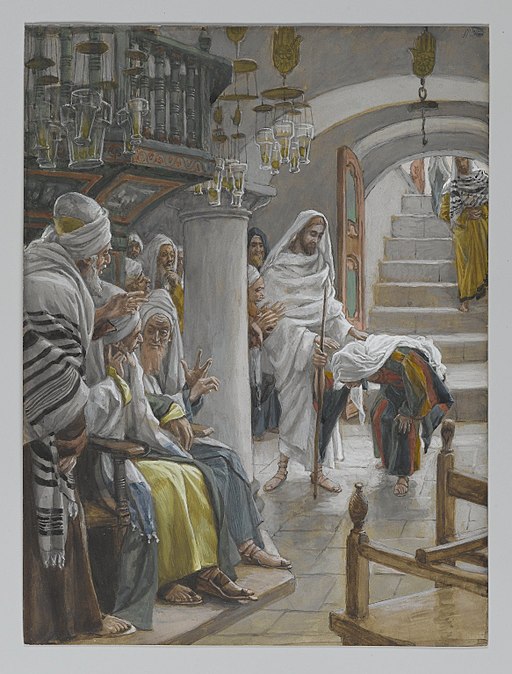
Now we come to our scripture reading. After this incident, Jesus is back at the synagogue teaching on the Sabbath. He routinely attended worship at synagogues, and he was often invited to teach.
A woman was there who had been crippled for eighteen years. She was bent over, unable to straighten herself up. We can imagine living like that would put a strain on her internal organs as well as on her everyday life and relationships. Verse eleven suggests that her condition was caused by a demon, but Jesus didn’t treat her condition like a demonic possession.
It’s interesting that Jesus called her to him. Usually, he healed someone after they demonstrated their faith in some way and/or expressed a desire to be healed. She didn’t ask to be healed; she was simply attending synagogue like everyone else. He must have sensed that this woman had great faith and wanted to be healed. So, he placed his hands on her, and she was immediately healed.
The fact that Jesus healed this woman on the Sabbath outrages the leader of the synagogue. He doesn’t directly reprimand Jesus; he does so indirectly by speaking to the people. My guess is that he has heard stories and knows better than to verbally spar with Jesus. He just wants to make it clear that Jesus violated Torah Law by healing this woman.
In his opinion, Jesus violated the Fourth Commandment to keep the Sabbath day holy. Just as God spent six days creating the world and rested on the seventh, so we should follow His example. Jews are not permitted to work on the Sabbath, and they must also give their servants and animals the day off.
Let’s take a closer look at Jewish Sabbath laws so that we can get a better grasp of them and what they mean to the Jewish people. In 167 B.C., almost two centuries before Jesus was born, Antiochus’ army tried to put a stop to sacrifices at the Temple. The people of Jerusalem revolted and then fled to the desert, but their hiding place was soon discovered by the pursuing soldiers.
The soldiers surrounded the Jews and demanded they surrender. The Jews didn’t give in, but they refused to fight because it was the Sabbath. They wouldn’t even block the entrances to their caves. As a result, one thousand men, women, and children died without resistance.
That gives us an idea of the intensity of the Jews’ conviction that the Sabbath should not be violated. Anyone who unintentionally violated the Sabbath was required to pay a heavy sin offering. Anyone who intentionally violated the Sabbath would be stoned to death.
By the time Jesus was born, the Jews’ conviction around Sabbath Laws had only become stronger. Because of the pagan influences all around them, the Pharisees had taken it upon themselves to keep the Jewish faith pure, and that is why they created the “Traditions of the Elders.”
Now, the problem is that what actually constitutes “work” is an ongoing debate to this very day. It was never clearly defined. We can imagine what the Pharisees and teachers of the law, the “fence makers,” did with this vague area of the law.
Obvious work was banned, but then anything remotely related to obvious work was also banned. For example, a farmer couldn’t plow his field on the Sabbath. Sounds reasonable, right? But then they ruled that no one could drag a chair across the ground because that would create a furrow which is related to plowing.
A Jew could not carry a heavy load on the Sabbath. Sounds reasonable too. But then they decided that no one could wear an extra piece of clothing because that was somehow related to carrying a heavy load.
One dilemma that caused a lot of discussion was what a Jew could do if their house caught on fire on the Sabbath. The Pharisees ruled that a Jew could save only clothing, wearing one piece at a time, but it had to be taken off before going back into the burning house to save another garment. Can you imagine the spectacle that would be?
So, what the leader of the synagogue was essentially saying, “Look people, you have six days out of the week where you can be healed. Woman, you’ve been dealing with this illness for eighteen years, surely you could have waited one more day to keep the Sabbath holy.” Sounds reasonable, right?
The synagogue leader didn’t get away with his indirect criticism. Jesus immediately calls him out on his hypocrisy and the hypocrisy of all those who share his mindset about the Sabbath. They believe it is fine to unbind stable animals on the Sabbath to lead them to water, but it is a violation to unbind this human being, their sister in the faith, who has been bound by her disability for eighteen years?
Like many religious leaders of Jesus’ day and even today, the synagogue leader couldn’t see the forest for the trees. He was so focused on all the trifling rules that had been built up around the law that he lost sight of the main point. His focus on the letter of the law blinded him to the spirit of the law.
His viewpoint was not reasonable; it was cruel. It lacked compassion. The Torah is supposed to reveal to us the holiness of God, and since compassion is one of God’s traits, acts of compassion extended toward others are among the holiest we could do.
Since the time of Jesus, there have been two schools of Pharisaic thought: the School of Shammai and the School of Hillel. The main difference between the two schools is that the School of Shammai was more restrictive in its interpretation of Torah Law, and the School of Hillel was more lenient.
For example, if it is unknown whether a woman’s husband is alive or dead, Hillel ruled that the woman could remarry with even indirect evidence of the husband’s death, but Shammai ruled that witnesses must come forth with direct testimony before she was permitted to remarry. If no witnesses came forth, a woman would be forced to live a widow’s life for the rest of her life. Without a husband to support her, hers would be a very difficult life indeed.
Hillel recognized the cruelty of this. He was more concerned for the welfare of others than with strict interpretations of the law. His views were more popular and usually chosen by the Sanhedrin. But over time, the unity of these two schools began to fracture and the unity of the Jewish people along with it.
The disputes between the two schools started with only a few minor things, but ultimately, they had grown so far apart in their interpretations that it was as if two different Torahs were being taught, and the mutual respect there once was between the two schools had morphed into mutual animosity.
There were many laws that lacked compassion, and those from the school of Shammai often instigated severe punishments for those who challenged them – including Jesus. They were put to shame on this day, and the crowd rejoiced. The crowd was made up of ordinary people who could relate to the woman who had suffered for so long. They had all been suffering for a long time under the rigid authority of the Romans, and some of their own people were adding to the burden with their own brand of it.
So, what can we learn from this scripture reading today? How does it relate to our times? I believe we have a similar problem in today’s world. Within our Christian institutions, there has always been a conflict between the more restrictive ones and the less restrictive ones.
Lately, it seems that there are two totally different Bibles being taught and two totally different stories about Jesus being told. Just as in Jesus’ time and culture, Christian unity has fractured, and there isn’t much mutual respect remaining between the opposing sides.
Why does religion become oppressive? Well, people take religion very seriously. It’s a deeply-cherished part of our identity. Think of how all-encompassing your Christian identity is. It touches every aspect of who you are. So how people define Christianity and view Christians is important to us.
But as with all things in life, we need a proper balance. It’s good to take religion seriously, but there is such a thing as taking it too seriously. Religion is good. Religiosity is not good because it creates repressive religious systems.
In Mark 2:27, Jesus said, “The Sabbath was made for man, not man for the Sabbath.” Rules are intended to serve us, not the other way around. The Sabbath was meant to remind us to rest, not to burden us. What was meant to be a reminder of the nature of our compassionate God has been corrupted with cruel rules by those who take religion way too seriously.
Communion was meant to remind us of the love of God our Father, of our unity in Christ, of our belonging in the family of God. It has been corrupted with cruel rules by those who take religion way too seriously.
The Bible was written to guide our understanding about the nature of God and who we are in Christ. It has been corrupted, used to create cruel “fences” meant to exclude others at best and persecute them at worst, by those who take religion way too seriously.
I believe that Christians who practice extreme Christianity have Christ more in their heads than in their hearts. For them, Christianity is all about beliefs, not action. For them, the word “Christian” is another identity that must be properly defined and defended. Their perspective is very limited – so is their life and the life they wish to force on others.
Like the prodigal son’s older brother, they make slaves of themselves, imagining God to be like an employer whose orders they must follow, orders they themselves make up. Then they expect special privileges based on their perceived superiority. Just like the Pharisees and teachers of the law in Jesus’ time, if they are in positions of power, they set up systems to oppress those who don’t follow their rules.
But if we have Christ in our hearts, we know that Christ is unlimited and therefore undefined. When it comes to our true nature, we need no definitions. Christ knows who Christ is. We’re the ones who have forgotten who we are, and we rely on Christ, not human definitions, to tell us who we are.
Before Jesus healed the crippled woman at the synagogue, all she could see was dirt and other people’s feet because she was bent over and couldn’t straighten herself out. Her perspective was bound like this for eighteen years. It was extremely limited.
Extreme religion does the same thing to people’s perspective of God, themselves, others, and the world. In addition to freeing the woman, Jesus was also trying to free the Pharisees and teachers of the law from their limited perspective and anyone today who suffers because they take religion to the extreme.
We are not called to take our religion to the extreme. We are called to take our religion to the streets. We are not called to sit in a pew on Sunday mornings, listen to someone talk about Jesus, and pass judgment on the rest of the world. We are called to go out into the world every day of our lives and extend love and compassion to those in need.
With all the noise in today’s world made by those who have more Christ in their heads, it can be tempting to doubt what we know to be true in our hearts. In this time of spiritual warfare, it is therefore important to wear your spiritual armor.
As Saint Paul advised the Ephesians in his letter to them chapter 6, verses 13-17:
“… Take the whole armor of God, that you may be able to withstand in the evil day, and having done all, to stand. Stand therefore, having girded your loins with truth, and having put on the breastplate of righteousness, and having shod your feet with the equipment of the gospel of peace; besides all these, taking the shield of faith, with which you can quench all the flaming darts of the evil one. And take the helmet of salvation, and the sword of the Spirit, which is the word of God.”
And as for us, the Word of God is not some book outside of us; it is the Christ within us. Now is the time for all of us to get Christ out of our heads and into our hearts and start LIVING as the Christ. Now is the time to stop WAITING for the second coming of Christ and start BEING the second coming of Christ.
Let’s pray together: Lord, thank you for setting us free from slavery to human rules and traditions with your simple gospel of love for one another. Help us to shine the light of God’s love and compassion as we deal with people suffering from extreme religious views and those harmed by them. AMEN.
Resources
Donovan, R. “Biblical Commentary (Bible study) Luke 13:10-17.” Sermonwriter.com, sermonwriter.com/biblical-commentary/new-testament-luke-1310-17/
Hensell, Eugene. “Homily Helps: Jesus and the Tradition of the Elders.” Franciscanmedia.org, 30 Aug. 2018, franciscanmedia.org/franciscan-spirit-blog/homily-helps-jesus-and-the-tradition-of-the-elders
“Hillel and Shammai.” Jewishvirtuallibrary.org. www.jewishvirtuallibrary.org/hillel-and-shammai
Leininger, D. “Sermon|Luke 13:10-17|Repressive Religion.” Sermonwriter.com, 2004, sermonwriter.com/sermons/luke-1310-17-repressive-religion-leininger/
“Why Did Jesus Heal on the Sabbath?” GotQuestions.org, www.gotquestions.org/heal-on-the-Sabbath.html
 Rev. Joan M. Kistler