
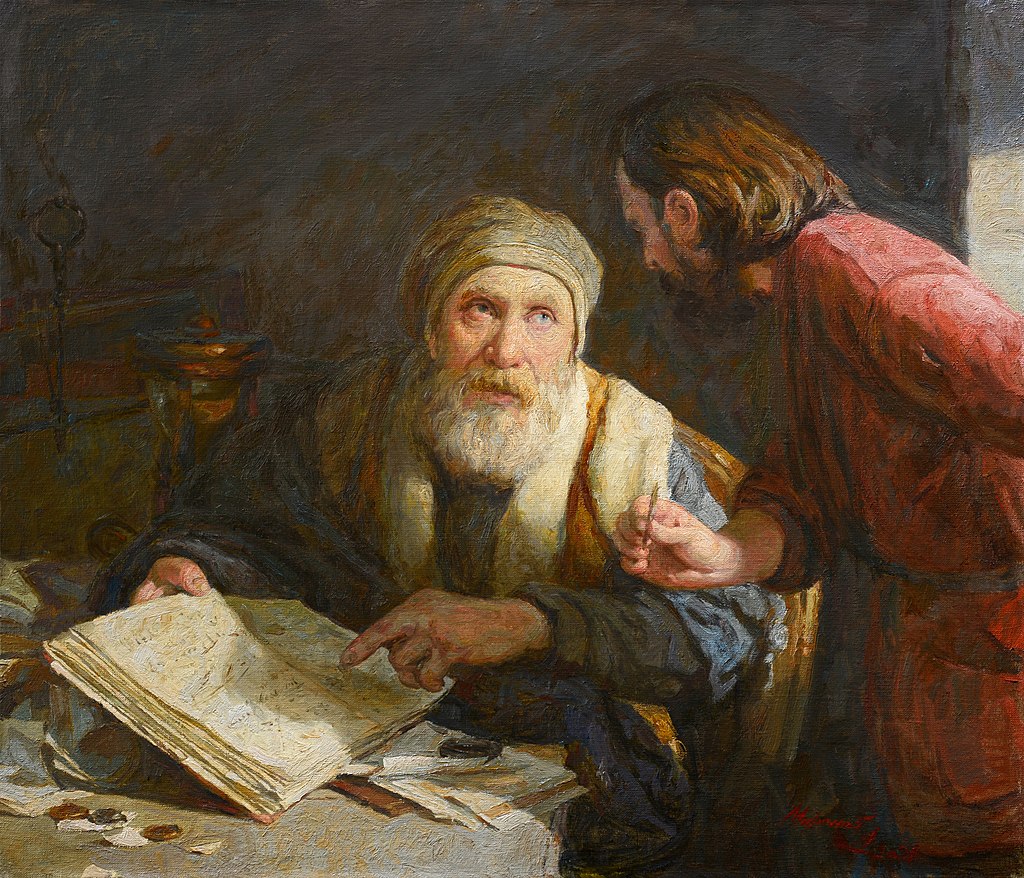
Synopsis: Like the dishonest manager, the Christian church has squandered the master’s wealth to enrich themselves instead of engaging in proper stewardship by helping those in need. We corrupt stewards deserve to be dismissed, so we need to act fast to make friends by using those hoarded riches to identify and help those in need.
Scripture: Luke 16:1-13
I’d like to begin today’s sermon with a pertinent story from Reader’s Digest. A traveler, between flights at an airport, went to a lounge and bought a small package of cookies. Then she sat down and began reading a newspaper. Gradually, she became aware of a rustling noise. From behind her paper, she was flabbergasted to see a neatly dressed man helping himself to her cookies. Not wanting to make a scene, she leaned over and took a cookie herself.
A minute or two passed, and then came more rustling. He was helping himself to another cookie! After a while they came to the end of the package with one cookie left, but she was so angry, she didn’t dare allow herself to say anything. Then, as if to add insult to injury, the man broke the remaining cookie in two, pushed half across to her, ate the other half, and left.
Still fuming sometime later when her flight was announced, the woman opened her handbag to get her ticket. To her shock and embarrassment, there she found her package of unopened cookies!
This story illustrates perfectly the problem we have with sharing. Just as the traveler believed those cookies were hers, we are often of the mindset that what we have is “ours,” and we don’t want to share with others what is “ours.” But it isn’t really ours. It belongs to God, who so graciously shares everything with us, and expects us to do the same with the gifts he has given us.
That’s what today’s scripture reading is all about.
The Parable of the Unjust Steward is one of the most perplexing, if not the most perplexing, of the parables of Jesus. It has been approached in many different ways all generating a variety of meanings and messages, which has been quite an embarrassing and humbling experience for Christian scholars.
Although this parable is not found in Matthew or Mark, most scholars agree that this is an authentic parable of Jesus. Perhaps the writers of Matthew and Mark didn’t include it because it is too shocking and confusing. Shocking and confusing his audiences to make a point was one of Jesus’ specialties.
The wealthy master of a large estate finds out that his steward is squandering his wealth, so he fires the steward. Facing poverty, the steward quickly goes to work to save his own neck before anyone finds out that he’s been fired. He ingratiates himself to his master’s clients by reducing their debt.
But the most astonishing thing of all is that, instead of throwing this guy in jail, the master actually praises him for being so shrewd. So, this parable seems to glorify the actions of this corrupt steward, who looks out for himself at the expense of his master. Why is he made out to be a hero?
Some Christian commentators view the wealthy master as the bad guy, accusing the steward unjustly, and the steward as the hero who makes things right. But this parable is not a commentary on the cruelty of ancient slavery. The steward is guilty as charged. He not only mismanaging his master’s goods; he also embezzled them and cheated his master’s clients.
This parable can be best understood within its first-century Jewish context. Back in Jesus’ time, agriculture was big business, and Jesus’ audience would have understood how it worked. The master owned a lot of land, and his clients were tenant farmers, who paid a portion of their harvest in exchange for the use of the land.
The steward’s job would have involved land leasing, collecting produce, keeping records, receiving income, and paying out disbursements. He probably received a salary as well as commission and gratuities from grateful renters for doing them favors. He occupied a powerful position of authority, basically acting as the POA for the master.
Losing his job, the steward will face poverty, but far worse than that in eastern culture is losing face. He will be put to shame. His prospects were dim, and he knew it. When he falls into the ranks of the poor, he would be not be welcomed among other stewards. He also wouldn’t likely be hired in a similar capacity because news of his dismissal would spread, and he wouldn’t have the money to travel someplace far away.
He realized that he needed to make friends fast, so he acted on behalf of the master before anyone knew he had the authority to do so. Under Mosaic Law, it is illegal for a Jew to charge another Jew interest, but that made commercial transactions unprofitable. So, things like interest and managers’ fees were hidden in the bill, which typically showed only a single charge, usually stated in terms of commodities like oil or wheat.
Scholars believe the steward simply removed these hidden charges from the bill. First, he visited an olive tree farmer, who owed the master 100 jugs of oil. Since the olive oil business was very profitable, the steward’s commission and fees were high – a 50% cut – which he removed from the bill.
Next, he visited a wheat farmer. Wheat being not nearly as profitable as oil, the steward removed a smaller cut of 20% from his bill. We can conclude that he continued applying these discounts for many more farmers over the course of the rest of the day.
Some scholars surmise that the discounts could have equaled around $38,000.00. That’s a lot of money even today. So, we can begin to imagine just how wealthy the master was. The actions of the steward cost the master dearly, but he obviously valued the steward’s shrewdness more than the money he lost, which reveals his kind and generous nature.
When we keep in mind the importance of saving face in eastern culture, this parable makes more sense. Both the steward and the master wish to avoid shame. The steward will be loved because of his actions on behalf of the generous master, who has no choice but to play along with what the steward has done if he wants to save face.
We can imagine that the master’s tenet farmers were all rejoicing the master’s generosity across his entire land. Now, imagine if the master went back to them all and said, “Sorry, it was all a mistake. The steward had been fired and therefore the agreements he made with you are null and void.” The tenet farmers would become very angry and curse him for his stinginess.
Instead, the master decides to keep silent, accepting the praise he is being giving while allowing the steward to bask in the favor he has so shrewdly earned. Really, that was his best option. And the master was highly noble; he didn’t appear to be flustered by it. In fact, he was quite impressed.
Now, the clue to the main point of this parable can be found in verse 8, which reads, “for the children of this age are shrewder in dealing with their own generation than are the children of light.”
What does he mean?
The “children of the light” was what the Essenes called themselves. To them, everyone else was a “child of the darkness.” The Essenes made the people within their communities pledge to hate the children of the darkness and limit interactions with them.
The Essenes also required the members of their community to relinquish all their assets to the community. They called their money the “mammon of righteousness” and all other money the “wealth of unrighteousness.” Financial transactions were forbidden except for simple cash transactions.
Jesus along with many rabbis of the second temple period believed that people were more valuable than money. Financial resources should be put to work for social reform that benefits all. In the pursuit of God kingdom, money should be used to help people, a tool for assisting those in need, not hording it exclusively for oneself or for one’s own community of believers.
But the Essenes created a community of strong sectarian hatred which left no room for charity, a highly-prized Jewish value. In Jesus’ opinion, like the corrupt steward, the Essenes were wasting God’s gifts by hoarding money to enrich themselves. God, our benevolent and just master, would not be pleased.
But what if the Essenes changed their behavior, and started using their wealth to help anyone in need? Then, they’d be behaving properly. Then, the Lord would be pleased because that’s how He expects us to use the resources he has given us. To share His love and make friends.
Life is about investing in relationships.
In verse 10, Jesus says, “Whoever is faithful in a very little is faithful also in much, and whoever is dishonest in a very little is dishonest also in much.” In Judaism, the steward’s dishonest behavior demonstrates the behavior of those who fail to use the gifts God has given them to help those in need.
Jesus and the rabbis rejected Essene separatism and bigotry. They also rejected the Essene doctrine of double-predestination: the idea that God has already determined or predestined both the individuals who would be saved and those who would be eternally damned. Jesus emphasized God’s love for the outsider while their attitude was that everyone outside their circle could “go to hell.”
But there is hope for the Essenes and those like them. This parable also illuminates God’s grace. The parable is funny because the steward outwits the master, but all the people were blessed by his actions, and the master was praised for his noble generosity. The point is that God forgives us, and since God owns everything there is, our generous actions on his behalf doesn’t bankrupt Him at all. It glorifies Him.
Jesus praises the behavior of those who engaged in both business and charity with everyone, calling them the “children of this age.” They did not judge others in the way the Essenes did, separating people into sheep and goats according to their own beliefs, and then using their own judgments to justify treating them with contempt.
Followers of Jesus must reach outside their own communities and self-righteous prejudices. Jesus teaches us through this parable that it is through our non-sectarian interaction with others that we can be made aware of and meet needs, and it is through our non-sectarian generosity that we can win friends, extend God’s grace to others, and glorify Him.
What does this parable have to teach us today?
Well, it’s clear what Jesus is NOT saying. He’s not saying that it is okay to be a con artist or to manipulate events to benefit us at the expense of others. It’s never okay to behave like that even if it’s in the service of God’s Kingdom. Those who use this parable to justify underhanded methods are fooling themselves if they think the Lord approves of such behavior.
In this parable, Jesus compares side-by-side improper and proper use of the resources God has given us. Money is power, and it can be used for evil or for good. Unlike the Essenes, Jesus didn’t view money as something that defiles someone on contact, but he did acknowledge the fact that nothing has the potential to corrupt the heart more than money.
This is why Jesus said, in Matthew 19:24, “It is easier for a camel to go through the eye of a needle than for a rich man to enter into the Kingdom of God.”
Many people are of the mentality that they are “entitled” to do what they want with their resources because they “earned” them – so much so that they would rather let an unused asset rust in the garage rather than giving it away to some less fortunate stranger who could use it.
But that idea is a human one, not God’s. God is our master, and we are the managers on his land. As far as God is concerned, we aren’t “entitled” to anything because we didn’t “earn” anything. Everything we have is His property, which he shares with us. We are expected to share in return.
So, in order to be shrewd in this day and age, we need to be careful how we use money. Are we using it only to enrich ourselves, or are we using to make friends thereby cultivating love, which is the most valuable commodity in the Kingdom of God?
It’s also clear from this parable that Jesus rejected the creation of sectarian communities of wealth. Unfortunately, a lot of Christian churches have become just that. They use their financial resources mostly to help themselves, some of them convinced that this is justified because they are saved and everyone else is going to hell.
Rather than using money to attract people to the church, the Christian church in general has alienated people from the church. Rather than making friends, the Christian church in general has made lots of enemies – both externally and internally. The Christian Church deserves to be dismissed as God’s stewards because we have perpetuated suffering in the world instead of putting an end to it.
So, like the unfaithful steward, the Christian church needs to think fast about our future security. What are we going to do? How are we going to make friends and save face? To answer these questions right and save our necks, we need a completely different mindset from the one that got us into this mess.
In my opinion, we can start by remembering Jesus’ words, “The Sabbath was made for man, not man for the Sabbath.” It is the same with the church. It was meant to serve people, not the other way around.
Life is not about accumulating wealth for ourselves and our small circle; it’s about using our wealth to bring the Kingdom of God to fruition by recognizing and meeting people’s needs. Because in God’s Kingdom, no one is hungry, no one is thirsty, and no one is homeless. There is no suffering or sadness. To use our resources to make this world a reality is what faithful stewardship is all about.
Let’s pray together:
Gracious and loving God, we understand that you call us to be the stewards of Your abundance, the caretakers of all you have entrusted to us. Help us always to use your gifts wisely and teach us to share them generously. May our faithful stewardship bear witness to the love of Christ in our lives. AMEN.
Resources
Inrig, Gary. The Parables: Understanding What Jesus Meant. Our Daily Bread Publishing, Kindle Edition, 1991.
Mueller, Deniray. “Sermon |What are Our Priorities? | Luke 16:1-13.” Saintjohnsworthington.org, 18 Sept. 2016, www.stjohnsworthington.org/priorities-luke-161-13/
“Sermon Illustrations: Stewardship.” thepastor’sworkshop.com, thepastorsworkshop.com/sermon-illustrations-2/sermon-illustrations-stewardship/
Young, Brad H. The Parables: Jewish Tradition and Christian Interpretation. Baker Publishing Group, Kindle Edition, 2012.

 Rev. Joan M. Kistler