Haz clic aquí para leer esta publicación en español.
Dear friends, I’m grateful you’ve been receiving these reflections through WordPress. I’ve also begun sharing them on Substack, where they arrive like letters in your inbox and where we can gather in conversation. If you’d like to join me there, you can subscribe here for free: Rev Joan M Kistler’s Reflections
Building fortresses of wealth commodifies the land—turning homes into investments instead of communities. When property is treated as a financial asset, the meaning of “home” shifts. Instead of being a place to live and belong, it becomes a calculation of resale value, a symbol of status, and a barrier to genuine community.
Many Americans come to Costa Rica and build monuments to their wealth. They live on sprawling properties, behind gates and walls, cut off from their neighbors — especially their Tico neighbors. These places broadcast wealth instead of humble living, and in doing so, they become targets. The walls meant to protect end up isolating, and the fortresses invite the very insecurity they were built to avoid.
Costa Rica teaches a different rhythm—modest homes opening to the street, gardens spilling over fences, children playing in shared spaces, the smell of cooking drifting from open kitchens, and neighbors waving as they pass. Here, the land is not an investment, and a home is not a fortress. They are covenantal places where communities are built and cherished.
Costa Rican homes also have gates and fences—but not to flaunt wealth. They are modest, proactive measures, meant to prevent theft by eliminating temptation. And the gates don’t keep neighbors away. When neighbors see us through our gate, they stop to talk.
At first, this annoyed us—conversations through the bars felt intrusive. But we have gradually become accustomed to it. Because here in our Costa Rican neighborhood, the gate is not a barrier. It doesn’t say, “Keep out!” It says, “Keep safe”—safe for families, safe for neighbors, even safe for those who might otherwise be tempted to steal.
In the United States, wealth often builds walls — gated communities, sprawling estates, and houses treated as financial assets. Fenced-in land becomes a commodity, and belonging is reduced to property value. The monumental replaces the humble.
Humility, though, is what keeps covenant alive. To live humbly is to recognize that land is not ours to hoard, but ours to share. A home is not an investment portfolio; it is a promise of care — a place of belonging, where dignity is lived together.
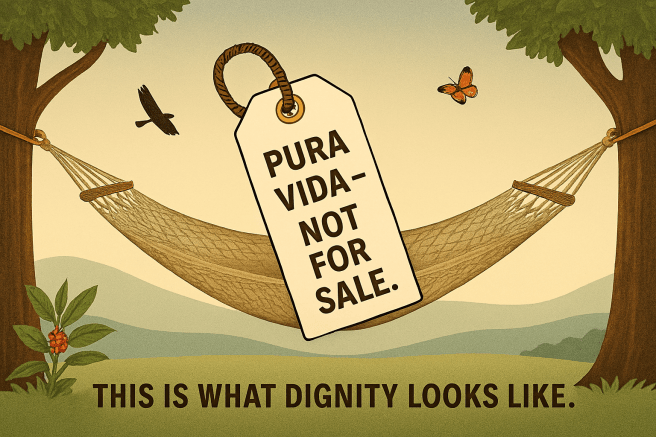
This is what dignity looks like.
⬅️ Previous Post: Belonging Through Commitment
Pura Vida—No Se Vende: Vivir con Humildad, No Monumentalmente

Queridos amigos, agradezco que hayan estado recibiendo estas reflexiones por WordPress. Ahora también las comparto en Substack, donde llegan como cartas a su bandeja de entrada y donde podemos reunirnos en conversación. Si desean acompañarme allí, pueden suscribirse aquí gratis: Reverend Joan M Kistler’s Reflections
Levantar fortalezas de riqueza mercantiliza la tierra — convirtiendo las casas en inversiones en lugar de comunidades. Cuando la propiedad se trata como un activo financiero, el significado de “hogar” cambia. En vez de ser un lugar para vivir y pertenecer, se convierte en un cálculo de valor de reventa, un símbolo de estatus y una barrera para la verdadera comunidad.
Muchos estadounidenses vienen a Costa Rica y construyen monumentos a su riqueza. Viven en propiedades extensas, detrás de portones y muros, aislados de sus vecinos — especialmente de sus vecinos ticos. Estas casas exhiben riqueza en lugar de sencillez, y al hacerlo, se convierten en blancos. Los muros que se levantaron para proteger terminan aislando, y las fortalezas invitan a la misma inseguridad que buscaban evitar.
Costa Rica enseña un ritmo diferente — casas modestas abiertas a la calle, jardines que se desbordan sobre las cercas, niños jugando en espacios compartidos, el olor de la comida saliendo de cocinas abiertas, y vecinos saludando al pasar. Aquí, la tierra no es una inversión y el hogar no es una fortaleza. Son lugares de pacto, donde las comunidades se construyen y se valoran.
Las casas costarricenses también tienen portones y cercas — pero no para ostentar riqueza. Son medidas modestas y proactivas, pensadas para prevenir el robo eliminando la tentación. Y los portones no alejan a los vecinos. Cuando los vecinos nos ven a través del portón, se detienen a conversar.
Al principio, esto nos molestaba — las conversaciones a través de las rejas parecían intrusivas. Pero poco a poco nos fuimos acostumbrando. Porque aquí, en nuestro barrio costarricense, el portón no es una barrera. No dice “¡Prohibido pasar!”, dice “Mantener seguro” — seguro para las familias, seguro para los vecinos, incluso seguro para quienes podrían sentirse tentados a robar.
En Estados Unidos, la riqueza a menudo construye muros — comunidades cerradas, haciendas extensas y casas tratadas como activos financieros. La tierra cercada se convierte en mercancía, y la pertenencia se reduce al valor de la propiedad. Lo monumental reemplaza lo humilde.
La humildad, sin embargo, es lo que mantiene vivo el pacto. Vivir con humildad es reconocer que la tierra no es para acaparar, sino para compartir. Un hogar no es un portafolio de inversiones; es una promesa de cuidado — un lugar de pertenencia, donde la dignidad se vive en comunidad.
Esto es lo que la dignidad parece.
⬅️ Publicación anterior: Pertenencia a Través del Compromiso

 Rev. Joan M. Kistler