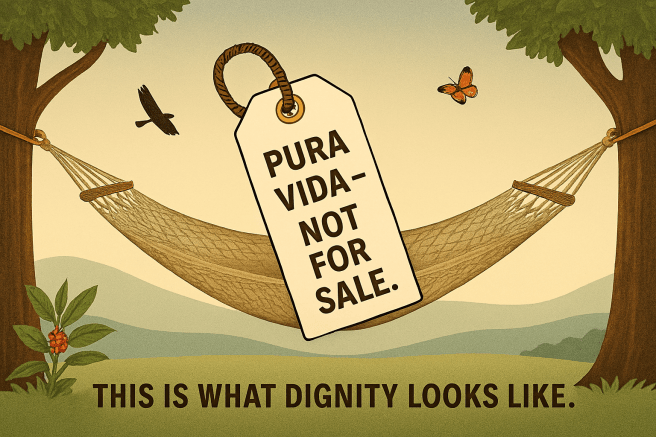
Pura Vida—Not For Sale: Listening to the Whisper

Haz clic aquí para leer esta publicación en español.
We had lived through decades of struggle in the United States—fighting for dignity as lesbians, fighting for recognition as women, fighting for survival in a culture that often treated us as less than human.

And it isn’t only the LGBT community and women. Immigrants, people of color, Jews, the disabled, the poor, and the elderly also carry this heavy burden of oppression.

In the American profit‑first system, everyone’s worth is measured by money: what you have, what you earn, or how much you can be exploited for profit. Indeed, when meeting someone for the first time, Americans’ first question is, “What do you do for a living?”

People are commodified: treated as if they were products with a price tag. They are valued only for their economic utility, instead of for their humanity. The basic things that all human beings need to live with dignity—housing, healthcare, education, rest, and belonging—are products to be bought and sold, rather than human rights or shared gifts. 

This heavy yoke of commodification had left us weary. And then, one day, that still, small voice inside us whispered: “Go. Find peace. You have fought enough.

It wasn’t logical. We had never been to Costa Rica. We didn’t know the language. We didn’t know the customs. But the whisper carried a weight that logic never could. It was the voice of the soul, a Divine reminder that freedom isn’t just a pipedream—it is our birthright, a built-in longing within every soul. 

So we sold what we could, packed what we absolutely needed or couldn’t leave behind, and stepped into the unknown. Some people called us foolish. Some even called us cowards for not staying to fight. But we knew: courage takes many forms. Sometimes it’s protest. Sometimes it’s persistence. And sometimes, it is the radical act of choosing peace.  

Now, we wake to birdsong instead of sirens. We walk slowly, breathe deeply, and are greeted with warmth instead of cold indifference. Costa Rica has given us something we never knew we lacked: a culture that values community over competition, joy over performance, being over doing.

Costa Rica, you welcomed us with open arms. You gave us dignity, sanctuary, and the chance to breathe freely. This is what dignity looks like. And this is our love letter to you with a promise to honor your dignity. 

This series is born from gratitude for Costa Rica’s gift of pura vida—a way of life that treasures human dignity over commodification. Each reflection will name the ways freedom and humanity are cheapened when measured only by profit, and then turn toward hope: the covenant of living humbly, together, with mercy and joy.

The Series
1. Listening to the Whisper (this post)
2. Health as a Right, Not a Gamble  
3. Belonging Through Commitment  
4. Language as Covenant  
5. Living Humbly, Not Monumentally  
6. Guardians of Pura Vida  
7. Freedom’s True Cost  

I invite you to walk with me through these reflections. Together we’ll explore how pura vida offers a different way of seeing freedom, belonging, and hope.

Follow along as each post lifts up a facet of this covenantal life, naming what commodification distorts and celebrating what mercy restores.


Pura Vida—No Se Vende: Escuchando el Susurro

Habíamos vivido décadas de lucha en los Estados Unidos: luchando por la dignidad como lesbianas, luchando por el reconocimiento como mujeres, luchando por sobrevivir en una cultura que muchas veces nos trataba como menos que humanas. Y no es solo la comunidad LGBT y las mujeres. Inmigrantes, judíos, personas afrodescendientes, personas con discapacidad, los pobres y los adultos mayores, entre otros, también cargan con el pesado yugo de la opresión

En el sistema estadounidense el dinero es primero: el valor de cada persona se mide por el dinero: lo que tienes, lo que ganas, o cuánto puedes ser explotada para generar lucro. De hecho, al conocer a alguien por primera vez, la primera pregunta suele ser: “¿A qué se dedica?”

Las personas son cosificadas—tratadas como si fueran productos con una etiqueta de precio—valoradas solo por su utilidad económica, en lugar por su humanidad. Las cosas básicas que todo ser humano necesita para vivir con dignidad—vivienda, salud, educación, descanso y pertenencia—se convierten en productos que se compran y se venden, en vez de ser derechos humanos o regalos compartidos.

Ese pesado yugo de la mercantilización nos había dejado cansadas, y entonces, un día, esa voz pequeña y silenciosa dentro de nosotras susurró:“Vayan. Encuentren paz. Ya han luchado suficiente.”

No era lógico porque nunca habíamos estado en Costa Rica. No sabíamos el idioma y no conocíamos las costumbres; pero el susurro llevaba un peso que la lógica nunca podría llevar. Era la voz del alma, un recordatorio Divino de que la libertad no es solo una ilusión—es nuestro derecho de nacimiento, un anhelo sembrado en cada alma.

Así que vendimos lo que pudimos, empacamos lo absolutamente necesario o lo que no podíamos dejar atrás, y dimos el paso hacia lo desconocido. Algunas personas nos llamaron imprudentes, otras incluso nos llamaron cobardes por no quedarnos a luchar, pero sabíamos que el valor toma muchas formas: a veces es protesta. A veces es persistencia. Y a veces, es el acto radical de elegir la paz.

Ahora despertamos con canto de aves en lugar de sirenas. Caminamos despacio, respiramos profundo, y somos recibidas con calidez en vez de con indiferencia fría. Costa Rica nos ha dado algo que nunca supimos que nos faltaba: una cultura que valora la comunidad sobre la competencia, la alegría sobre el rendimiento y el ser sobre el hacer.

Costa Rica nos recibió con los brazos abiertos. Nos dio dignidad, refugio y la oportunidad de respirar libremente. Así es como se ve la dignidad y ésta es nuestra carta de amor para usted, con la promesa de honrar su dignidad.

Esta serie nace de la gratitud por el regalo costarricense de la pura vida—una forma de vivir que atesora la dignidad humana por encima de la mercantilización. Cada reflexión nombrará las maneras en que la libertad y la humanidad se abaratan cuando se miden solo por la ganancia, y luego se volverá hacia la esperanza: el pacto de vivir con humildad, juntas, con misericordia y alegría.

La Serie

  1. Escuchando el Susurro (este post)
  2. La Salud como Derecho, No como Apuesta
  3. Pertenencia a través del Compromiso
  4. El Lenguaje como Pacto
  5. Vivir con Humildad, No Monumentalmente
  6. Guardianes de la Pura Vida
  7. El Verdadero Costo de la Libertad

Le invito a caminar conmigo a través de estas reflexiones. Juntas exploraremos cómo la pura vida—el regalo costarricense de dignidad y sosiego—ofrece una manera distinta de ver la libertad, la pertenencia y la esperanza.

Acompáñame en cada publicación, donde levantaremos un aspecto de esta vida pactada, nombrando lo que la mercantilización distorsiona y celebrando lo que la misericordia restaura.

Holy Shift! Soul Simplicity

Soul Simplicity

We carry so much.  
Stones in the backpack of the soul—  
resentments, comparisons,  
noise that drowns the heart.  

But nature whispers:  
the tree lets go of its leaves,  
the river releases its silt,  
the bird sheds what it no longer needs.  

Simplicity is this letting go.  
It is the soul unburdened,  
returning to what is holy—  
to silence, to rhythm,  
to the steady beat of the heart.  

What’s Heavy for Humanity

Humanity carries its own backpack of stones. The endless noise of notifications and opinions leaves us restless, our souls aching for silence. Unreal expectations press down—perfectionism, comparison, the demand to perform—until authenticity feels out of reach. We grow heavy with disconnection from nature, forgetting the rhythm of sunrise and tide, forgetting that the earth itself can steady us.  

Fear and division fracture our communities. Suspicion and anger weigh on us like iron, exhausting the spirit that longs for communion. Busyness without meaning scatters our days, filling calendars but leaving hearts empty. And beneath it all, grief often remains unspoken—losses carried quietly, stones hidden in the soul’s shoes, making every step harder.  

These are the heavy stones of our age. They bend us low, not because we are weak, but because we were never meant to carry so much. The invitation of simplicity is to set them down—to remember that the soul was made for lightness, for rhythm, for holiness.  

Returning to What’s Holy

When the soul sets down what is heavy, it remembers what is holy. Not holy as distant or rigid, but holy as what reconnects us to love, mercy, and presence.  

The holy is found in silence—the kind that steadies the heart and makes space for listening. It is found in rhythm—the rising of the sun, the turning of seasons, the breath that carries us moment by moment. It is found in the heart—where compassion, authenticity, and joy pulse beneath the noise.  

To return to what is holy is not to escape the world, but to live more deeply within it. It is to walk barefoot on the earth, to share a meal with gratitude, to pause long enough to notice the bird’s song or the child’s laughter. These simple acts are sacraments, reminders that holiness is woven into the ordinary.  

Soul simplicity is not emptiness. It is fullness in essentials. It is the lightness that comes when we release what does not serve and return to what sustains.  

The Lightness of Soul

When the stones are set down,  
the soul remembers how to walk freely.  
Steps grow lighter,  
breath steadier,  
heart more open.  

Simplicity is not absence,  
but presence—  
the quiet strength of living in rhythm  
with nature, silence, and the heart.  

It is the bird rising into the sky,  
the stream flowing clear again,  
the candle burning steady in the dark.  

This is soul simplicity:  
not escape from the world,  
but deeper belonging within it.  
It is the holiness of enough,  
the mercy of release,  
the joy of lightness.  

A Coffee Ritual

Even coffee can teach simplicity. In Costa Rica, the chorreador brews with nothing more than a wooden stand that resembles a banana stand, and a cloth filter—stained from countless brews—looking almost like a worn old sock. At first glance, it may seem too humble, even shocking to those accustomed to shiny machines and polished gadgets.  

But that humble filter carries memory: mornings shared, aromas rising, patience practiced, a new life in a culture that values the simple things. The ritual is slow and quiet—hot water poured gently over fresh grounds, gravity doing the work, silence filling the space. 

What seems ordinary, even unrefined, becomes holy. It is presence in a cup, gratitude in a sip, simplicity that nourishes both body and soul.  

Everyday Holy Simplicities

The coffee ritual is only one doorway into soul simplicity. There are countless others, woven quietly into daily life. Walking at dawn, we step into the hush before the world stirs, carried by the rhythm of light returning. Listening to birdsong, we let creation’s chorus remind us of joy and presence. Sharing bread at the table, we discover communion in the ordinary, gratitude rising with each bite. Lighting a candle in silence, we anchor the heart in holiness with a single flame. Even pausing for a deep breath between tasks clears the clutter, steadying the soul. And tending the earth—watering a plant, turning soil, noticing the green shoot—becomes a ritual of renewal, reminding us that simplicity is not emptiness but fullness in essentials.

Soul Simplicity Shared

Soul simplicity is not only personal—it is communal. When a community chooses simplicity together, it creates rhythms of mercy and belonging. We see it in neighbors who share food instead of hoarding, in congregations who choose silence before words, in villages that honor the cycles of planting and harvest.

Communal simplicity is a refusal to let division or excess define us. It is the choice to live lightly with one another, to carry burdens together, to celebrate what is enough. In shared rituals—lighting candles, breaking bread, listening to the earth—we remember that holiness is not only within the individual soul but between us, in the spaces where compassion and presence meet.

When simplicity is shared, mercy multiplies. Belonging deepens. The soul finds not only its own lightness but the joy of walking in rhythm with others.

Closing Benediction

May we set down what is heavy.
May we return to what is holy.
May we walk in soul simplicity—
light, steady, and whole.

May our communities choose mercy over division,
presence over distraction,
belonging over isolation.

And may the rhythm of nature, silence, and the heart
carry us into the holiness of enough.

Thank You!

This post closes the series, but not the journey. Thank you for walking with me through the fog, the release, and the return. Your presence has been part of the rhythm, part of the mercy, part of the lightness. May soul simplicity continue to carry us all into what is holy and enough.

Holy Shift! The Messy Middle

The Lava of Transformation

A volcanic eruption is terrifying.  
Fire consumes the landscape.  
Ash darkens the sky.  
Everything familiar seems lost.  

And yet—  the same lava that destroys  
cools into fertile soil.  
Forests root in the ash.  
New life rises from the ruin.  

This is the messy middle.  
Not the beginning, not the end,  
but the chaos in between—  
where destruction and creation  
are happening at once.  

The eruption is not just in nature.  
It is in our world.  
Structures are trembling,  
certainties are burning,  
and ash clouds our vision.  

The ash is not only ruin. 
It is also soil.  
Even in the mess,  
life insists on returning.  

And if ash is soil,
then even in the world’s burning,
seeds are being sown.
What looks like ruin today
may be preparing tomorrow’s topsoil.  

Seeds in the Ash

Out of political division, new experiments in listening are emerging. Citizens gather in assemblies, dialogue circles, and community forums, discovering ways of speaking across differences that may prove stronger than the systems that fractured. 

From climate anxiety, innovation and reverence are rising together. The urgency of crisis has accelerated breakthroughs in renewable energy and regenerative farming, while also awakening a deeper respect for creation. Indigenous wisdom and local practices are being rediscovered, reminding us how to walk gently on the earth.  

Economic upheaval, though painful, is clearing space for alternative economies. Cooperatives, local currencies, and solidarity networks are sprouting where old systems collapse. In these places, abundance circulates with dignity, and prosperity is measured not by profit alone, but by mercy shared.  

Even loneliness carries seeds. Isolation has birthed mutual aid groups, online communities of care, and interfaith circles of solidarity. The ache of longing is becoming fertile ground for deeper, more intentional relationships—connections that are chosen, nurtured, and sustained.  

And within our own hearts, the ash carries seeds. Grief, though it feels like ruin, can deepen compassion. Doubt, though it unsettles, can open us to mystery. Fear, though it shakes us, can teach courage. These inner messes are not wasted—they are soil where wisdom takes root, where resilience grows, and where mercy learns to speak with a gentler voice.  

The messy middle 
is not simply destruction. 
It is paradox: 
ruin and renewal, 
fire and fertility. 

Hope is not naïve here. 
It is the seed already breaking through the ash,
reminding us that tomorrow is being prepared 
beneath our feet. 

But seeds do not grow on their own. 
If they are to grow, they ask for our tending.
These are the practices of the middle—
the ways we keep hope alive while the soil is still dark.

Practices for the Middle

The messy middle asks not for perfection, but for patience. It is the place where we stumble together, where mercy becomes more important than certainty. If the ash is soil, then our daily choices are the seeds we plant in it.

We practice patience by trusting that renewal takes time, even when the ground looks barren. 

We practice compassion by remembering that everyone is walking through the same ash, each carrying their own weight of loss and longing. 

We practice perspective by lifting our eyes to see that the mess is part of a larger story, one that bends toward healing. 

And we practice communion by refusing isolation, choosing instead to join hands, share meals, and form circles of belonging.

These practices do not erase the chaos. They steady us within it. They remind us that hope is not a distant dream, but a discipline—a way of living that prepares the soil for forests yet to come. When we practice patience, compassion, perspective, and communion, the ash begins to clear, and signs of dawn appear.  

Dawn in the Ash

The eruption does not last forever.  
Ash settles.  
Lava cools.  
And in the silence that follows,  
something new begins.  

A green shoot breaks through the blackened soil.  
A bird sings into the quiet.  
Light returns to the horizon.  

This is hope—not denying the mess,  
but facing the truth within it.  
Hope is the seed already sprouting,  
the dawn already breaking,  
the song already rising.  

The messy middle is holy ground.  
Here, Love is teaching us to walk together.  
Here, mercy is stitching us back into one body.  
Here, Christ-Consciousness whispers: 
“Do not fear the mess. I am with you in it.”

Next Post: Soul Simplicity

Holy Shift! Christ-Consciousness

Living as Love

An anthropologist once placed a basket of fruit beneath a tree and told children in an African village that whoever reached it first would win the prize.

When the signal was given, the children didn’t race against each other. They joined hands, ran together, and arrived as one. Then they sat in a circle, sharing the fruit. 

When asked why they ran together like that, they replied: “Ubuntu—how can one of us be happy if all the others are sad?”  

This is the heart of Christ-Consciousness.  
Not just believing in love, but living it.  
Not just speaking of unity, 
but embodying it.  
Not just seeking personal victory, 
but choosing collective flourishing.  

Christ-Consciousness dissolves 
the illusion of separation.  
It whispers: “I am because we are.”  
It invites us to live as Love—  
to see our joy as bound 
to the joy of others,  
our healing as bound 
to the healing of the whole.

Unity over Separation

The ego thrives on separation.  
It says, “This is mine, not yours.  
This is me, not you.  
This is victory, not loss.”

But the soul knows better.  
The soul whispers Ubuntu: 
“I am because we are.”  
Christ-Consciousness echoes:
“We are one body.”
When one suffers, all suffer.  
When one rejoices, all rejoice.

Unity is not an idea.  
It is a way of being.  
It is the choice to live as Love—  
to see our lives as woven together,  
to measure our joy 
not by what we gain alone,  
but by what we share.  

Separation breeds fear.  
Unity births mercy.  
Separation magnifies ego.  
Unity awakens Christ.  

From the mountaintop,  
we see that the illusion of isolation  
is the greatest distortion of all.  
And we remember:  
to live as Love is to live as communion.  
Not “I” against “you,”  
but “we” becoming whole.

Wounds in the Shared Body

War, discrimination, racism, genocide—
These wounds show us what happens  
when we forget that every soul is kin.
Separation becomes domination.  
It divides people into “us” and “them,”  
and unleashes cruelty in the name of power.  

Would the hand call a finger worthless 
and cut it off?

Ubuntu dissolves the illusion of hierarchy.  
Christ-Consciousness whispers: 
“You are one, my beloved.”  
Together they call us back to
dignity, reconciliation, and peace.
To honor difference without division 
is to live as Love.

Some wounds don’t come from anger,
but from indifference.  
After the cruelty of domination
comes the quiet neglect of care.  
When the body forgets to feed itself,
house itself, heal itself—  
the suffering is just as real.

Hunger, homelessness, lack of healthcare—
These wounds awaken the truth:
Survival itself is meant to be communal.  
Separation shows up as neglect.  
When the body fails to care for itself,  
its most vulnerable members suffer.  

Would the stomach refuse to digest
for the rest of the body?

Ubuntu insists that food, shelter, and healing
are not luxuries but shared rights.  
Christ-Consciousness calls us 
to mercy in action—  
to see care as covenant, not charity.

Neglect is one form of separation.  
Another is distortion.
The body falters not only when it starves,  
but when Truth—its lifeblood—
fails to circulate.

Economic inequality,
misinformation and division
Distortion spreads when truth is denied
and abundance is hoarded. 
These wounds fracture trust, 
turning community into competition. 
When wealth pools in a few hands, 
the whole body suffers.

Would the heart hoard blood, 
starving the limbs?

Ubuntu insists that
abundance must circulate. 
Christ-Consciousness reawakens the truth:
Generosity is the true measure of prosperity.  
To hoard is to wound the whole.  
To share is to heal it.

And beyond distortion lies disconnection.  
Even when needs are met
and resources are shared,  
the soul can still ache.

Isolation, loneliness, climate crisis—
These wounds echo the need for belonging
They are quieter, but no less real. 
They come when we forget 
our place in the circle—  
with one another,
and with creation itself.  

Would the skin forget
that it belongs to the body?

Ubuntu restores connection:
“I am because we are.”
Christ-Consciousness
rouses the memory that love 
is lived in relationship
with each other, 
and with the earth. 
To heal belonging
is to heal the soul.

The earth is not “out there.” It is us.  
Ubuntu teaches that the soil, 
the rivers, and the forests
belong to us because they are part of us.  
Christ-Consciousness reminds us 
to live as caretakers, not consumers—  
to remember that to heal the planet 
is to heal ourselves.

From Wound to Healing

The body of humanity is scarred, 
but not beyond repair.  
Every act of mercy is medicine. 
Every choice for unity is healing.  
Every time we live as Love,  
the body remembers itself.  

Ubuntu whispers: “I am because we are.”  
Christ-Consciousness echoes: 
“We are one body.”  
Together they call us
to embody communion—  
to live as caretakers,  
as kin,  
as Love made flesh.  

From the mountaintop we see:  
The world is not healed by belief alone,  
but by living as Love, again and again,  
until the wounds become wholeness.

Daily Ubuntu Practices

Ubuntu is not only philosophy, 
it is a way of living. 
Christ-Consciousness is not only vision, 
it is practice. 
To heal the shared body,  
we begin with small mercies:

  • Sharing a Meal: Hospitality dissolves separation. Joy multiplies when food is shared.  
  • Listening Deeply: Presence without judgment honors another’s soul.  
  • Offering Forgiveness: Mercy restores communion where ego builds walls.  
  • Serving Quietly: Care for another’s need as if it were your own. Service is love in motion.  
  • Speaking Truth with Love: Resist distortion. Choose words that build trust and clarity.  
  • Practicing Gratitude: Gratitude multiplies joy when spoken in community.  
  • Caring for Creation: Treat the earth as kin. Healing the planet heals the body.  
  • Remembering the Circle: Whisper daily, “I am because we are.” Let this truth shape your choices.  

These practices are not grand gestures.  
They are everyday mercies.  
They remind us that unity
is lived in kitchens,
in conversations,  
in moments of tenderness.  

Benediction: Sent Out in Love

Go gently into the world,  
not as separate selves,  
but as one body.  
Let your daily mercies  
be the stitching of wholeness.  
Let your choices for communion  
be the healing of the earth.  

Ubuntu: “I am because we are.”  
Christ-Consciousness: “Live as Love.”  
Carry this truth into your meals,  
your words,  
your care,  
your silence.  

And may the body of humanity  
remember itself whole  
through you. 

Next Post: The Messy Middle

Holy Shift! Higher Perspective

Last time, we honored the fog.
Now, we rise to the mountaintop—not to escape, but to see.

Microscope vs Mountaintop

It is normal for the small self  
to feel overwhelmed, angry, bitter.  
It sees injustice, chaos, and distortion— 
and it reacts.  
Not because it is wrong,  
but because it cannot see the whole.

The ego sees through a microscope.  
It magnifies what is near,  
what is personal,  
what threatens its sense of control.
It sees only a sliver of reality,  
but believes it sees everything.

From this view, the world looks unbearable.  
From this view, mercy seems naïve.  
From this view, fear feels like wisdom.

But there is another view.  
The mountaintop.  
Where the soul sees the whole landscape—  
the valleys of grief,  
the rivers of mercy,  
the long arc of becoming.

The Gift of Contrast

The spiritual goal of humanity  
is not just to behave well—  
but to know who we are,  
so we can be who we are  
with clarity, compassion, and power.

But knowing requires contrast.  
We cannot know light  
without the presence of shadow.  
We cannot know ourselves as Christ  
without the presence of anti-Christ.

This is the paradox of awakening:  
even distortion serves.  
Even the soul who walks in shadow  
is part of the great unfolding.

From the mountaintop,  
we see that every soul—  
even the one who embodies the opposite—  
is serving humanity’s evolution.

Not by being good,  
but by being a mirror.  
A contrast.  
A catalyst.

We do not excuse the harm.  
But we honor the soul’s risk.  
To carry distortion  
so others might awaken.

The Mirror of Becoming

The soul doesn’t just learn through harmony.  
It learns through contrast.  
And sometimes, the clearest mirror  
is the one that shows us what we are not.

When we encounter distortion—  
cruelty, manipulation, egoic grasping—  
we are not just witnessing another’s struggle.  
We are being shown our own edges.  
Our own fears.  
Our own unhealed places.

The mirror does not accuse.  
It reveals.  
It says, “This too lives in you.”
Not to shame you,  
but to awaken you.

From the mountaintop,  
we see that even the shadow  
is part of the soul’s unfolding.  
Even the one who walks in distortion  
is serving the whole—  
by showing us what must be released  
to become who we truly are.

Mercy from the Mountaintop

Mercy is not blindness.  
It is vision.  
It sees the whole,  
not just the wound.

From the mountaintop,  
mercy does not excuse distortion—  
but it understands its roots.  
It sees the fear beneath the cruelty,  
the ache beneath the ego,  
the longing beneath the grasping.

Mercy does not rush to fix.  
It chooses to witness.  
To hold space.  
To honor the soul’s journey  
without condoning the harm.

This is not passive.  
It is powerful.  
To see clearly  
and still choose compassion  
is the highest form of strength.

Mercy is the soul’s response  
to the mirror of becoming.  
It says, “I see you.  
I see your risk.  
I see your ache.  
And I choose to walk beside you.”

Mercy for the Shadow

Some souls come to embody clarity—
to show us who we truly are.
Others come to embody distortion—
to show us what we must release.

Both are mirrors.
Both are teachers.
Both are part of the soul’s unfolding.

Long ago, Jesus of Nazareth walked as the
embodiment of the Christ—
a living picture of divine clarity.
Today someone walks as the 
embodiment of distortion—
a living picture of ego’s grip.

We do not condone the harm.
But we must not deny the reflection.
His struggle with ego is our struggle.
His descent into illusion 
is the shadow we all carry.

To pray for a soul in darkness
is not to excuse its behavior—
it is to honor the risk
of carrying the shadow
so others might awaken.

Cosmic Humor

From the mountaintop,  
the soul doesn’t just see clearly—  
it laughs.
Not with mockery,  
but with love.  

With the kind of laughter  
that bubbles up  
when illusion finally cracks  
and truth peeks through.

Cosmic humor is the soul’s way  
of saying, “Oh, little one …  
you really thought you were in control.”

It chuckles at the ego’s drama,  
not to shame it,  
but to soften it.  
To remind us that we are more  
than our curated identities,  
our righteous opinions,  
our desperate grasping.

Cosmic humor sees the whole play—  
the hero, the villain, the twist, the redemption—  
and knows that every role  
is part of the awakening.

It doesn’t rush the story.  
It delights in the unfolding.  
It holds paradox with ease:  
grief and joy,  
clarity and confusion,  
Christ and anti-Christ.

And it whispers, 
“You’re doing beautifully.  
Even when you think you’re failing.”

Returning to Your Path

You may not feel like you’re on the mountaintop.  
You may still be in the fog,  
still wrestling with mirrors,  
still aching in the presence of contrast.

That’s okay.
The soul does not rush.  
It walks with mercy.  
It learns through paradox.  
It laughs with love.

You are not behind.  
You are not broken.  
You are not failing.
You are becoming.

So breathe.  
Be gentle with your small self.  
Let the soul rise slowly.  
Let the mountaintop come in its own time.

And when it does,  
may you see clearly.  
May you choose mercy.  
May you laugh with love.

Next Post: Christ Consciousness

Holy Shift! Navigating the Fog

The Fog Is Sacred

There are seasons when clarity disappears.  
When the path vanishes beneath our feet.  
When grief, confusion, and emotional overwhelm roll in like fog—
thick, disorienting, relentless.

We try to push through.  
We try to make sense.  
But the fog is not a mistake.  
It is a threshold.

It is the soul’s way of saying:  
“You are no longer who you were.  
You are not yet who you will be.  
Rest here. Be with the mist.”

The mist is not your enemy.  
It is the womb of transformation.  
It softens the edges of who you were,  
so the soul can reshape itself  
without the boundaries of certainty.

Be with the mist.  
Let it hold you.  
Let it blur the old stories  
until only Truth remains.

Adolescence of the Soul

Humanity aches like a teenager
at this stage of consciousness development.  
Full-blown identity crisis.  
Raging emotions.
Resisting guidance.  
Stirring up trouble.  
Spreading pain.
Craving attention while fearing rejection. 
Longing to be seen, 
yet terrified of being truly known.

So we curate identities 
to hide our confusion.
We create profiles, join groups,
and express strong opinions—
not from clarity, but from fear of invisibility. 
We don emotional armor: 
confidence, rebellion, religious certainty—
while inside, we’re just aching to be loved. 

And so we stumble.  
We lash out.  
We break what we don’t understand.  
Not because we are evil—  
but because we are still learning  
what it means to be whole.

The fog is not failure.  
It is the soul’s cocoon.  
A place where illusions dissolve
so Truth can be revealed. 

The wise watch with heartbreak—  
not because they’ve lost hope,  
but because they remember  
what it feels like to be lost  
and still becoming.

There’s no shortcut to wisdom.  
Only the ache.  
Only the fog.  
Only the long road through.

Confusion as Threshold 

Confusion is not the absence of truth.  
It is the loosening of illusion.  
It is the soul’s way of saying,  
“Wait. Something deeper is being born.”
When the ego begins to dissolve,  
the soul does not rush in with answers.  

There is a space between—  
a holy in-between—  
where the old “I” no longer fits,  
and the true “I” has not yet emerged.
This is the ache of becoming.

We ask, “If I’m not this, then what am I?”  
And the mist replies,  
“You are what remains
when all else falls away.”

Like Frodo in The Lord of the Rings,
we carry the ring—
the illusion of control.
Not because we love it—
it is a heavy burden.
But because we fear what we’d be without it.

Humanity is Frodo Baggins—
clutching “my precious,”
the ego’s illusion of control, identity, power.
We carry it through shadow and struggle,
not yet ready to release what defines us.

But the journey is not about keeping the ring.
It is about throwing it into the fire—
the fire of spiritual transformation.
Not to be destroyed,
but to be remade.
Not to lose ourselves,
but to become who we truly are.

The Illusion of Invisibility

When Frodo put on the ring,
he disappeared—
but the dark forces saw him more clearly.
This is the paradox of ego’s illusion:
we think we’re hiding,
but we become more vulnerable
to what harms us.

We curate identities to feel safe.
We disappear behind confidence, rebellion,
religious certainty, and curated belonging.
But the more we disappear,
the more entangled we become.
The ego says, “Hide and you’ll be safe.”
But the soul whispers,
“Be seen, and you’ll be free.”

True safety is not in disappearing.
It is in surrender.
It is in letting go of the ring,
and stepping into the fire
that transforms without consuming.

Grief as Teacher

Grief arrives when the ring begins to loosen.
When the curated self starts to fall away.
When the soul whispers,
“You are more than this.”
And the ego trembles,
“But this is all I know.”

Grief is not the enemy.
It is the teacher
who walks us to the threshold.
It strips away what cannot stay,
not to harm us,
but to make room for what is true.

Grief softens the armor.
It cracks the illusion.
It opens the heart
so the soul can breathe.

Grief is the emptying of the glass.
We thought we were full—
full of certainty, identity, direction.
But grief comes and spills it all.
Not to punish,
but to prepare.

Grief clears the clutter of ego.
It washes away the stories we clung to.
It leaves us trembling,
but open.

Only then can mercy pour in.
Not as an answer,
but as presence.
Not to refill the glass,
but to teach us how to drink
from something deeper.

Emotional Overwhelm as Invitation

Emotional overwhelm
is not a sign of weakness.
It is the soul’s alarm bell—
a signal that something sacred
is stirring beneath the surface.

We feel too much
because we are becoming more.
The heart stretches
to hold what it once avoided.
The body trembles
with truths it cannot yet name.

This is not dysfunction.
This is initiation.
Overwhelm invites us
to pause,
to listen,
to soften the grip of control
and let the soul speak.

It is not asking for solutions.
It is asking for presence.

To sit with the ache.
To breathe with the storm.
To trust that what feels like too much
is exactly what is needed
to become who we truly are.

The Long Road Through

There is no shortcut to wisdom.
No bypass around the ache.
No fast-forward through the fog.
Only the slow unraveling
of what no longer serves.
Only the tender shedding
of who we thought we had to be.

The soul does not rush.
It walks with mercy.
It waits in silence.
It trusts the fog
to do its sacred work.

This is the long road through—
not a detour,
but the path itself.

And though the way is unclear,
you are not lost.
You are becoming.

Closing Blessing

If you are in the fog,
may you be held.

May you be remade.
May you trust the long road through.
May grief soften you.
May mercy find you.
May the ache become a doorway
to the truth of who you are.

Next Post: Higher Perspective

Holy Shift! Divine Timing & Prophecy

Whispers Through Time 

We are living in a moment that has been whispered through centuries, etched into scripture, sung through mystic poetry, and carried in the bones of prophets and dreamers. This unraveling—this sacred disruption—was foretold. 

Not in the language of fear, but in the language of awakening:

The Book of Revelation speaks of upheaval and unveiling. The Hopi elders warned of a time when the Earth would shake and hearts would be tested. Jesus spoke of wars and rumors of wars—not as punishment, but as birth pangs.

Mystics like Julian of Norwich and Hildegard of Bingen saw visions of collapse and renewal. Modern prophets—from Carl Jung to Thomas Merton—named the ego’s reckoning and the soul’s return.

This is not the end.
It is the turning point.
When illusion begins to crumble,
and the Heart begins to rise.

Sacred Timing, Not Panic

Prophecy is not meant to panic.
It’s meant to prepare the soul.
To remind us that what feels chaotic
may actually be sacred timing.
That what looks like collapse
may be the beginning of clarity.

Divine timing rarely aligns
with our calendars.
It moves in spirals, not schedules.
It waits until the illusion is
thin enough to tear,
until the Heart is ready to rise.

We are not here by accident.
We were born for this moment—
not to fix it,
but to face it.
To walk through it with mercy,
with discernment,
with quiet courage.

Yet even as divine timing unfolds, 
we witness not only prophecy—
but also contrast. 
The kind that leads to discernment.

Contrast as Invitation

In times of great upheaval, certain figures rise to prominence who seem to embody the ego in its purest form—loud, divisive, self-serving. They offer us contrast, not because they are evil, but because they are visible.

And in that visibility, we are given a gift: the chance to see clearly, by contrast, what Christ is not. To see, by negation, Christ’s quiet mercy, radical humility, and healing presence. 

These figures are not the enemy.
They are a mirror.
And in their reflection,
we are invited to choose again.

To appreciate the gift
we must look deeper—
not just at the figures on the stage,
but at the suffering beneath the performance.

The Mirror, Not the Enemy

Not all who inflict harm are evil.
Some are mentally unwell.
Some are spiritually unwell.
Some are driven insane by ego
and suffering far more than we can see.

A leader’s spiritual or mental unwellness
can be more than just personal—
but also cultural.
It can mirror what has been buried,
denied, or glamorized in society. 

When ego rises to power,
it does not invent the illusion.  
It reveals it.  
It amplifies what we’ve refused to name.  

And in that amplification,
we are given a chance—
not to scapegoat, but to see.  
To recognize the shadow
not just in the leader,
but in the culture that created the stage.

When ego reigns unchecked,
suffering multiplies.
And when suffering holds power,
it leaves a trail.

Ego’s Tyranny, Mercy’s Clarity

Ego, when enthroned, becomes a tyrant.
It fears collapse, so it clings to control.
It mistakes domination for safety.
And when such suffering holds power,
it spreads suffering like wildfire.

But the Heart sees through the illusion.
It does not excuse the harm.
It does not deny the damage.
But it understands the source:
a soul lost in fear,
a mind drowning in illusion,
a being severed from mercy.

Seeing clearly is only the beginning.
The Heart must respond—
not with fear,
but with mercy. 
Not with mimicry,
but with courage.

Quiet Courage in a Loud World

Mercy does not mean passivity.
It does not mean silence
in the face of harm.
The Heart sees clearly—
and still chooses love.
It names the suffering,
but refuses to become it.
It discerns the illusion,
but does not mirror its cruelty.

This is the quiet courage
we’re being called into.
To see what’s real.
To speak with mercy.
To act with love—
even when the world is loud with fear.

This courage is not just personal—
it is prophetic.
It is the kind of leadership
the world is aching for,
even if it doesn’t yet know how to ask.

True Leadership in the Age of Spectacle

In a time when ego dominates the stage,
true leadership looks like quiet resistance.
It looks like refusing to mirror the tactics
of those who distort the truth.
It looks like choosing
the long road of integrity
over the shortcut of spectacle.

True leaders must lead—
not by shouting louder,
but by standing firmer.
By having the courage
to lead without becoming
the corruption they oppose.

This is the path of the Heart.
It does not perform.
It does not posture.
It does not seek applause.
It seeks alignment.
It seeks mercy.
It seeks truth.

But even the most courageous leaders
must learn to wait. 
To listen.
To trust the rhythm that does not rush,
but reveals.

The Rhythm of Divine Timing

This kind of leadership cannot be rushed.
It listens for the right moment.
It waits for the Spirit’s nudge.
It does not react—it responds.
Because divine timing is not reactive.
It is rhythmic.
It is wise.

The Heart knows when to speak,
when to move.
when to wait,
It does not seek control.
It seeks alignment.

And when the moment arrives—
when the veil thins
and the illusion cracks—
the Heart does not scramble.
It simply steps forward.

Not because it planned,
but because it was prepared.

Prepared, Not Planned

So if the world feels upside down,
if the headlines echo Revelations,
if the ego seems louder than love—
remember: this was foretold.
Not to frighten you,
but to prepare you.

You are not behind.
You are not late.
You are arriving—
right on time.

Divine timing is not just cosmic.
It’s intimate.
It’s personal.
It’s the whisper that says,
“Wait.”
“Speak.”
“Begin.”

The Heart knows.
Even when the mind doubts.
Even when the path disappears.
Even when the world is loud with fear.

So trust the rhythm.
Trust the pause.
Trust the rising.
You were born for this moment.
And the moment is ready for you.

A Blessing for the Turning

May you trust the rhythm
of your own becoming.
May you listen for the compass,
even when the map disappears.
May you speak when the Spirit nudges,
and rest when the Heart says, “Not yet.”

You were not meant to rush.
You were meant to rise.
In mercy.
In truth.
In divine time. 

Next Post: Navigating the Fog

Moving to Costa Rica: Two and 1/2 Years In

Photo by Tabatha Gartner

It has been two and a half years since we sold almost everything we owned, packed up the rest and moved to a country we’d never even been to. Everyone thought we were crazy. So did we. But deep down, we couldn’t ignore that still, small voice that kept whispering, “It’s time to leave.”

When we first arrived in Costa Rica, I thought I was moving. Now I know I was arriving. We left behind the familiar rhythms of the U.S. and stepped into the slower, softer beat of Costa Rica. What began as a logistical shift has become a spiritual one. This blog series I started back then, Moving to Costa Rica, was full of practical details and emotional tremors. Now, the tremors have quieted. What remains is a steady hum of gratitude.

We’ve found sanctuary here—not just in the landscape, but in the way people live. There’s a quiet dignity in the everyday: the neighbor sweeping her porch at sunrise, the farmer tending his land with reverence, the gentle greetings exchanged without hurry. Life here doesn’t rush to prove itself. It simply is. And in that simplicity, there’s a kind of wisdom I didn’t know I was seeking. 

In Costa Rica we have found what many spend their lives chasing: Pura Vida. Not just the phrase, but the feeling. It’s the unspoken grace in how people show up for each other. It’s the peace that comes from living close to the land, close to family, close to what really matters. 

It’s not perfection—it’s presence.

While I’ve let go of many things—urgency, income, the need to perform—I’ve gained sacred time. Time to write, to minister, to teach with tenderness. Time to create rituals that honor both sadness and joy. Time to become more fully myself.

And even as we’ve rooted here, Tabatha continues to serve across the miles. She’s still writing grants and winning funding for the homeless shelter in our former hometown. The work is rewarding for her. It nurtures her soul. It’s a quiet bridge she’s kept open—one that connects our past to our purpose, and reminds us that presence can stretch far beyond geography.

My ministry has deepened. My writing has softened. My teaching has become more attuned to the emotional and spiritual thresholds my learners are crossing. I’m no longer just helping people speak English—I’m helping them speak with clarity, confidence, and compassion.

This isn’t a grand update. It’s a quiet one. But it feels important to mark the moment, and to say this: Follow your heart. You don’t have to live in ways that make you unhappy. The Power that created the Universe holds far more strength than any earthly leader. That Power is not interested in control, but in compassion. It will always support a decision to care for your soul—and to live in ways that honor your deepest truth.

So if you’re standing at the edge of something new—wondering whether a leap of faith is worth it—this is your quiet encouragement. Sometimes the bridge appears only after you begin to walk. So make the decision. Begin the journey. Trust in the One who holds the real Power. You can step into the complete unknown and land just fine.

Actually—better than fine. You can land amazingly

If you’d like to read more about our move to Costa Rica, below are all the links to the posts in the series.

Moving To Costa Rica: The Series

  1. Taking a Leap of Faith (published 01-24-2023)
  2. Relocation Pains and Pleasures (published 02-02-2023)
  3. On the Road (published 03-16-2023)
  4. Settling In (published 03-26-2023)
  5. Culture Shock (published 04-13-2023)
  6. Language Shock (published 04-29-2023)
  7. The Not-So-Good Stuff (published 05-14-2023)
  8. Figuring Out Work (published 07-01-2023)
  9. Torn Meniscus and Other Pains (published 08-20-2023)
  10. Returning to the U.S. (published 11-02-2023)
  11. Thinking About Leaving the U.S.? (published 09-24-2024)
  12. Two and 1/2 Years In (published 10-10-2025) You are here.

Holy Shift! The Age of the Heart

A Note to the Reader

This reflection is not a historical analysis, though it begins with history. It is a spiritual meditation on the evolution of human consciousness—from the Age of Reason to the Age of the Heart. While it honors the gifts of intellect and inquiry, it invites the reader into a deeper kind of knowing: one rooted in compassion, intuition, and inner guidance.

The Age of Reason

The Age of Reason—also known as the Enlightenment—was a cultural movement in 17th–18th century Europe that emphasized rational thought, scientific inquiry, and individual liberty. 

During this age, humanity gained extraordinary knowledge. We learned to measure, analyze, and explain. It helped humanity challenge superstition, question authority, and build systems of progress. Medicine, democracy, and education all benefited from its clarity.

But in the pursuit of logic and certainty, something quieter was left behind.
Emotion was treated as unreliable.
Intuition was dismissed.
Spiritual wisdom was sidelined.

While we honor the gifts reason gave us,
we must also name what it could not carry:
the wisdom of the Heart.

A Useful but Incomplete Era

In the Age of Reason,
the egoic mind took center stage.  
It thrives on control,  
on being right,  
on knowing without feeling.

It prizes intellect over intuition,  
logic over mercy,  
certainty over mystery.

It helped us to organize,
but not to understand.  
We mastered analysis,
but not how to listen.
We learned how to build empires,  
but not how to hold each other. 

Reason gave us the ability to categorize.  
To sort, to label, to define.  
But then we judged.  
We ranked.  
We assigned worth.

We built hierarchies of value—  
based not on love,  
but on logic distorted by ego.

The Heart asks a different question.  
Not “Is it efficient?”  
Not “Is it profitable?” 
But—“Is it kind?”

Reason taught us to measure.  
We learned to quantify intelligence, productivity, even worth.
But then we mistook numbers for truth.
We valued performance over compassion.  
We called it progress.

The Heart asks, 
“Does it nurture the soul?”

Knowledge doesn’t come with wisdom. 
Wisdom arises from the Heart—
from compassion, intuition, and presence. 

Without it, knowledge is heartless: 
capable of building systems, 
but not relationships; 
capable of explaining life, 
but not cherishing it.

Knowledge was never the problem.  
We weren’t ready to hold it wisely.  
Wisdom asks more of us than intellect.  
It asks us to listen with the Heart.

The Heart remained offstage,  
watching and waiting in the wings.  
Not because it is weak,  
but because it is wise.
Truly, it is Wisdom

Now is the Heart’s curtain call.
Not to erase reason’s performance,
but to complete it.
To invite a new kind of Mind—
one that listens, feels, and leads with love. 

The Shift: From Head to Heart

This time has been foretold
by mystics, prophets, and poets.
By those who listened beneath the noise
and heard the rhythm of a new age approaching.

Not an age of destruction,
but of integration.
Not the end of reason,
but the beginning of wisdom.

The Heart doesn’t dismiss reason.  
It enfolds it in compassion.  
It honors its clarity,  
but insists on mercy.
It follows the deeper Law—
the one that holds all creation in Love.

This is the Age of the Heart:
Where wisdom is not just what we know,  
but how we hold what we know.

Christ Consciousness is the union
of clarity and compassion. 
It is the compass that points toward Home
when the map disappears.

The map is disappearing.
The systems no longer fit.
The doctrines feel too small.
The path we were handed
has not led us Home.

What now do we trust? 
We begin to trust the compass.

Compass vs. Map

In the Age of Reason, we trusted the map. 
We wanted clear roads, fixed destinations, and guaranteed outcomes. 
We followed paths drawn by others—systems, doctrines, identities—
believing they would lead us Home.

But the map was never truly ours.
It was borrowed, inherited, imposed.  
It could not show us the terrain of the soul.

Now, in the Age of the Heart,
we are learning to trust the compass.  
It doesn’t offer certainty.  
It doesn’t show the whole route. 
But it always points toward Truth.

The compass is the Christ within.  
It moves in rhythm with grace.  
It doesn’t rush. 
It doesn’t miss turns. 
It simply says, “This way.”

Trusting the Compass

Some still cling to the map.
Like the windshield washer
who trusts it without question—
because it always takes him
to his favorite destination:
the Land of Illusion.

There, he can polish his fantasies—
Power. Prestige. Control. Rightness.
He scrubs the mirror until it gleams,
but never wonders what he’s looking at.
Never questions the reflection.
Never asks, “Is this real?”

The Land of Illusion is seductive.
It flatters the ego.
It rewards performance.
It promises control.

Now it is starting to crumble.
But the ego doesn’t surrender.
It panics.
It grabs the glue and the glitter.

It tries to patch the cracks
with more power,
more dominance,
with louder monologues of certainty—
and more division.

Because division distracts.
It splinters the truth.
It keeps us arguing over fragments
so we never see the Whole.
It protects the illusion
by keeping us apart.

We see it in the world—
leaders clinging to control,
systems tightening their grip,
voices rising not in truth,
but in fear.

The ego mistakes collapse for danger.
It tightens. It resists.
It calls it failure.
It calls it threat.

But the Heart sees it differently.
Not an ending—
but a doorway.
A chance to step out of illusion
and into what’s real.

The ego disappears in the Whole.
Not shattered—but absorbed.
Not erased—but re-membered.
The illusion dissolves,
and what remains
is mercy.

We trusted the map because
it made the world feel predictable.
Letting it go can feel like we’re lost. 
There is grief in releasing the map.
But there is grace in what comes next.

Only the good chauffeur knows
the way to Reality.
Christ doesn’t need the map.
Christ listens to the compass—
because Christ is united with Wisdom.

Trust is not passive.  
It’s not blind.  
It’s not weak.
It’s a quiet courage—  
the kind that moves forward
without needing certainty.

We learn to trust the compass by listening.
You’ve known it.
That quiet pull that doesn’t shout, 
but never leaves.

The whisper that says,
“You don’t have to rush.”
“You don’t have to prove.”
“You don’t have to be anyone
but who you are.”

This is inner knowing. 
This is the compass within.
The more we follow it,  
the more we recognize its voice.  
The more we walk in rhythm with grace,  
the more the road begins to feel like Home.

Closing: The Way Forward

The map is fading.
The compass is stirring.
The Heart is beginning to lead.
This is not the end of knowing.
But the beginning of Wisdom.
Not the loss of direction,
but the birth of discernment.

We are learning to walk without guarantees.
To listen without rushing.
To move in rhythm with grace.

May we trust the whisper
more than the noise.
May we follow the compass
with quiet courage.
May we let the Heart lead us Home.

Next Post: Diving Timing & Prophecy

Holy Shift: Ego on Parade

Adam’s Dream and the Birth of Duality

In the beginning, Adam fell into a deep sleep. The Bible never says he woke up.

He dreamed of Eve. The other. She was not a mistake, but the beginning of duality. The moment Eve appeared, the possibility of “I” and “you” was born—a symbol of humanity evolving from unconscious unity into conscious relationship.

Duality is not a problem. We cannot know anything in the absence of its opposite. We cannot know light without dark, love without hate, eternity without time.

Contrast is the teacher.

The Tree and the Sacred Bite

Then came the tree. The apple wasn’t poisonous. The bite wasn’t a sin. It was a sacred movement—a symbol of humanity reaching self-awareness.

Consciousness evolves like all things. It is not a fall from grace—but a movement toward knowledge—of knowing the Creator, our Self, and our sacred relationship.

Being, Life, and the Shadow of Form

God is Being—pure, radiant Potential. Like the sun, still and eternal.

Christ is Life—Being in motion. Like a sunbeam, flowing from the Source into the world.

When a sunbeam enters a form, it casts a shadow that can be seen only on a surface. When Life enters a form, it casts a shadow—the body. It can be seen only in physical reality. On this stage, the story of awakening is unfolding.

What is seen is not the whole. The body is not the Self just as the shadow is not the sunbeam.

In our early consciousness, we were like infants—newly aware, but not yet able to understand. We saw only the body, and we were frightened and confused. We couldn’t yet perceive the Life animating it, or the Source behind it.

We could only conclude, “I must be this.” We identified with the body, the visible, the form. And from that misidentification, ego developed—a false self with a mind of its own.

It was the perfect contrast.

Ego’s Rise and the Illusion of Separation

Even Christ is revealed through contrast. Without ego—the anti-Christ—we would never be able to know the Christ within.

Ego became our guide, the architect of our lives. We created identities, hierarchies, and systems based on a mistaken identity—the belief that we are separately-existing beings rather than one Life, one Christ, one Self.

From this illusion, we built nations, doctrines, economies, and roles.

We ranked worth.

We defined borders.

We named “us” and “them.”

The more we built around it, the more we forgot the Sun. And worshiped this idol.

The sunbeam still shines, but the vessel is clouded—with fear, pride, and the desperate desire to be seen.

Ego on Parade

The ego loves a parade. 
Loud. Glittering. Hollow.

The ego is like an actor on a dimly-lit stage. It has no identity of its own, so it borrows costumes—beliefs and ideologies.

Religious and political extremism offer certainty, identity, and belonging—thriving on “us vs. them.”

It clings to possessions. Money, status, and power offer the illusory “proof” of its existence. “I am what I own.”

Ego protects its image through judgment, superiority, and victimhood. It is the one who prays, “I thank you, God, that I’m not like that sinner over there.” It is the one constantly asking, “Where is my reward?”

It craves praise and recognition—these are the ego’s fuel. Without them, it feels invisible.

The Windshield Washer and the Still, Small Voice

Like any character on stage, the ego needs an audience, a script, and a spotlight to seem real.

The audience is our attention. The ego’s voice in the head is like the guy on the street who washes our car window at stoplights. But did we really need our windshield washed? No, yet we feel obligated to pay for his “service.”

The script is our conditioning—the rules we’ve learned to play our roles: gender, religion, class, and more. Ego fills us with shame when we forget our lines or act contrary to our roles. It’s always anxious because it can’t see Life’s next scene, so it improvises—badly.

The spotlight is our belief in it. We’ve listened for so long, paid attention for so long, that we mistake its voice for our own. Like the windshield washer, ego convinces us it’s doing us a favor.

The Voice of the Christ within is a still, small voice–a gentle prompting–an urge we get in the moment to do exactly what needs to be done. In the moment when our windshield is truly dirty and needs to be washed, we will know.

We don’t need the windshield washer. We need clarity—and that comes from within.

Without belief, the ego dissolves. 
Without clinging, it has no shape. 
It is not Christ, the True Self—it is simply a mask worn to be seen. 

Who’s Driving?

Not only have we let the window washer clean our windshield— we’ve let him take the driver’s seat. He’s a horrible driver. He has no clue where we are, where we’re going, or how to get us there. He only pretends to know.

His driving fills us with fear and dread. 
He swerves between extremes. 
He speeds when we need stillness. 
He stalls when we need courage. 
He uses a map that will never lead us home.

But we are not powerless passengers. 
We can thank him for his enthusiasm, and kindly ask him to take the back seat.
We can choose a different driver.

The Road of Trust

Christ is the Good Chauffeur.
Christ knows exactly where we are, where we’re going, and how to get us there.

Christ’s driving fills us with peace and joy. 
There are no missed turns. 
No frantic detours. 
Just the quiet unfolding of grace.

We don’t need to know the whole map. 
We don’t need to control the route. 
We need only to trust the Driver.

Christ doesn’t rush. 
Doesn’t miss turns. 
Doesn’t need GPS.

Christ is the Way.

When we let go of the wheel, 
we begin to feel the rhythm of grace. 
We stop bracing for impact. 
We stop second-guessing every curve. 
We start to breathe.

The ego will protest. 
It’s a back seat driver.
It will insist it knows a shortcut. 
But we don’t have to listen.

We can turn down the volume. 
We can rest in the seat of surrender. 
We can watch the scenery change— 
Without fear.
Without dread.

Peace is not the destination. 
It’s the feeling of being driven by Love.

Returning to the Light

You are not the mask. You are not the role. 
You are not the voice that shouts from the back seat.

You are the Light behind the form. You are the sunbeam, flowing from the Source. You are the quiet knowing that doesn’t need applause.

The ego will keep performing. It will keep washing the windshield, offering advice,  asking for payment.

But you don’t have to believe it. 
You don’t have to let it drive.

You can rest. 
You can listen. 
You can trust the Christ within.

There is no rush. 
No test. 
No hierarchy.

Only the gentle unfolding of grace. 
Only the still, small voice saying, 
“This way.”

Next Post: The Age of the Heart