Moving to Costa Rica: Culture Shock

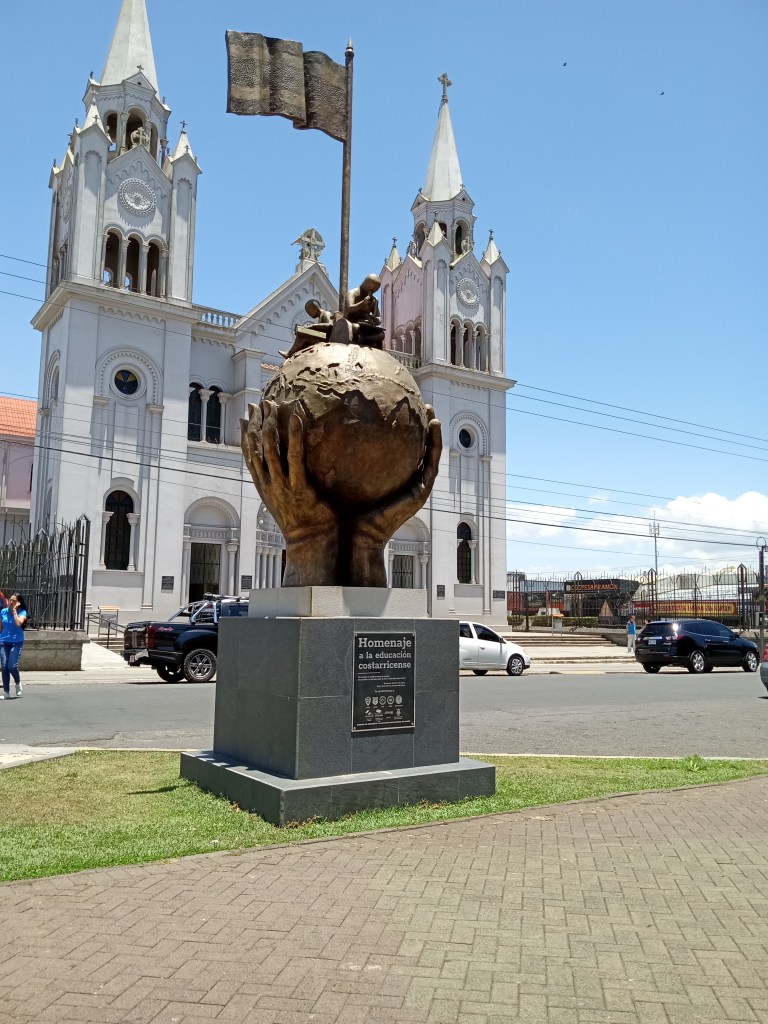
Photo by Joan Kistler – Tribute to Costa Rican Education (San Ramón)

We arrived in Costa Rica on March 21, 2023 early in the morning on a beautiful day and began our new lives in a country we have never visited – not even once. We anticipated that we would experience a culture different from that of the United States, but we couldn’t have imagined what it would be like. Now that we have been here for over three weeks, we are beginning to get a taste of culture shock . In some ways it has been bitter and in other ways sweet.

I will start with the bitter. First of all, in Costa Rica, the traffic is horrible. We chose not to drive in Costa Rica, and we are so glad we made that choice. We hired drivers for two trips from San Ramón to San José and back, and both times, the hour-long drive took more than two hours. On the second trip, the driver attempted to avoid the traffic by taking death-defying cliff-hanging back roads that made us seriously doubt if we would survive. The reward for our near heart failure was that we got to see some fantastic views. We certainly didn’t get to San Ramón any faster.

Second, I thought the sidewalks in Easton, PA were bad. Not compared to the sidewalks in San Ramón. You need to pay attention when walking, or you could easily step into one of many holes, trip over a sudden rise or fall in the sidewalk, or fall into the deep drainage ditches (our poor dog has done that a few times). Just today, while walking downtown, I looked over the edge of the sidewalk, and there must have been a four-foot drop onto the street. I felt like I was walking along a cliff with no railing. In Easton, I saw people with disabilities riding around in powered wheelchairs or scooters all the time. I haven’t seen anyone doing that here. They would have to be loco.

Why are Costa Rica’s roads and sidewalks so bad? Because they don’t prioritize infrastructure issues. They expect people to be aware of traffic and infrastructure issues, take responsibility, and act like rational adults. Costa Rica spends most of its money on three things: education, social services, and healthcare. Knowing this, I can forgive the horrible traffic and horrendous sidewalks.

Now for the sweet. The park is always full of people of all ages enjoying recreational activities, whether they are working out with the provided fitness equipment, walking or running around the field, playing on the playground, or playing a game on the basketball court or soccer field. Their faces are all brimming with sheer pleasure and relaxing enjoyment. Whenever I saw the few people in U.S. parks engaging in recreational activities, they didn’t appear to be enjoying it so much. They appear to be trying get fit for some big event or engaging in serious competition. That kind of pressure doesn’t seem to exist in Costa Rica. Apparently, it isn’t necessary. Costa Ricans are generally healthy and fit.

Some of the conveniences I enjoyed in the U.S. are non-existent here. I wanted to buy a mop with a disposable head – like a Swiffer. No such thing here. The way you mop in Costa Rica is by clipping a rag to the end of a pole. You wring it out by hand, and if you want it clean, you have to rinse it out or wash it. Why do I consider that sweet? In the U.S. there are many products that make life more convenient, but we don’t think its impact on the environment. For example, when we were living in the U.S., we were using a Brita pitcher, and we had over two dozen filters that we needed to recycle. Unfortunately, the company had dissolved their recycling program, so all those filters sadly ended up going in the trash. Many U.S. companies refuse to take responsibility for recycling the products they sell, and the environment suffers. The Costa Ricans don’t sacrifice the environment for convenience.

The sweetest thing of all is that in Costa Rica, you get treated like a real person who matters. More than once, I received a hug and kiss on the cheek simply for introducing myself. The sincere hospitality and generosity of our neighbors has also been a shock. We are foreigners, but we are treated like friends. Our neighbor has brought us wonderful tortillas and custards and complete plates of food. When there was a water main break, they took care of us, taking us in their car to the water truck and giving us containers so that we could collect water for ourselves. In the U.S., foreigners are treated with cold indifference at best.

In the U.S., when people meet for business purposes, they immediately get down to business. In Costa Rica, before business is conducted, people talk to each other. They actually take the time to check in on each other’s wellbeing and to get to know each other. When they say, “Cómo está usted?” (How are you?), they genuinely want to know how you are. There is about ten minutes of chatting before they actually get down to business. This has been extremely enlightening for me. I didn’t realize this before, but the message we Americans send in getting right down to business is this: “I don’t care who you are. I care only about what you can do for me.”

In America, the focus is on business. In Costa Rica, the focus is on relationships: relationships between people and the relationship between the people and the earth. In America, it’s all about money. In Costa Rica, it’s all about community.

That may be why Costa Ricans are among the happiest people on earth, and we are very happy to be living among them.

Next post: Language Shock

Moving to Costa Rica: Settling In

Costa Rican Currency (Photo by Joan Kistler)

We have finally arrived, and we’re settling in. The worst part is over: sixteen days on the road from the closing on our home in Easton, PA to the day we flew into San Jose, Costa Rica. Throughout those sixteen days, we posted pictures and stories on Facebook documenting our journey, We looked so happy, right?

Well … to be perfectly honest, I had more than one emotional meltdown. At times, the small part of me that was scared to death overwhelmed me completely, and I ended up sobbing. The worst episode was the night before we flew. I hadn’t flown in an airplane since I was seventeen years old. It wasn’t the flight that scared me; it was the airport. There were too many unknowns. How would we get from the rental car return to the airport? It looked like it was a least a half-mile walk on the map. Could we get an Uber or taxi at 5 AM? Would anyone be there at that hour to help us figure it out? In my head were visions of us lugging two carry-ones and two suitcases each the entire distance and missing our flight. My head couldn’t accept my heart’s reassurances that said, “Just wait until you get there. You’ll figure it out.”

Of course, I didn’t have to figure anything out because the airport already had it all figured out. There was a skytrain that transported people to the airport from the rental car return. There were plenty of people around to help and signs everywhere. The airport wasn’t nearly as complicated as my fearful self imagined. We boarded our plan on time, and I thoroughly enjoyed the flight – especially the glorious sights from the airplane window.

The part of me that is fearful is an expert at taking the unknown, spinning a catastrophe, and then giving me crappy advice as to how to avoid it. There was no reason to feel so fearful. So much of this journey has worked out beautifully. Certainly, there have been challenges, like cockroaches in our hotel room and a lost phone, but there have also been surprises, like the wonderful recreation park near our new home and the NFL Network included with our cable TV.

The biggest challenge is the fact that English is a foreign language here, and I don’t know Spanish very well. Everything is in Spanish, and not everything is translated into English for people like me. I now have tremendous respect for native Spanish-speakers who were brave enough to relocate to the United States without knowing how to speak English. I am experiencing first-hand how difficult it is to be in another country and not know the language. Even though our new home is not located in an English-friendly tourist area, the Costa Ricans are so patient and helpful and kind as I struggle to speak Spanish. They genuinely appreciate the fact that I am trying to speak their language. I know that most Americans are not that way toward those in their country who do not speak English.

The next biggest challenge is the currency, which is also like another language. I love their money: it is as colorful as their country. The Costa Rican currency is the colone. Larger businesses might take American dollars and credit cards, but local small business typically take only colones. When they tell me how much I need to pay, I must look shocked and confused. “Dos mil trescientos veintisiete colones, por favor” (two thousand three-hundred twenty-seven colones please). Eh? All that for a few groceries?

That’s actually only a little more than four dollars.

But there is some real sticker shock. We wanted to buy a small microwave in Walmart. It was $176.00 for one that costs about $60.00 in the States. Familiar American products are very expensive. Foreign products are much cheaper, but … well … foreign. Figuring out what things are and how to use them isn’t easy because product names, descriptions, ingredients, and instructions are all in Spanish. And some products have proven very difficult to find – like decaf coffee. I’m seriously wondering if decaf coffee is a sacrilege in this country.

It’s been great to have a fresh vegetable vendor right next door to us – a very nice young woman named Janneth. She sells tomatoes, bananas, onions, cabbage, carrots, cucumbers, and different kinds of squashes that we’ve never seen before in our lives. We don’t have to go far to stock up on veggies, and it’s very cheap. And our next-door neighbors, Magella and Andres, were very happy to sell us a really cool couch. We were lucky enough find someone bilingual to translate for us in order to do business with them.

Our really cool couch (Photo by Joan Kistler)

Our new home doesn’t have a hot water heater. That’s right, no hot water. The coldest water is cool and the hottest is lukewarm. Now, at first this really upset us because we thought to ourselves, “Oh God. No hot showers.” But we figured out that we can take hot showers through an ingenious invention – electrical wires around the shower pipe that heats the water. Now, seeing electrical wires in a shower is very disconcerting to those not used to seeing something like that. For that reason, this contraption is affectionately known as “the gringo killer.”

The Gringo-Killer (Photo by Joan Kistler)

All I have to say is, in the words of Dorothy, “We are not in Kansas anymore.” It has been only five days since we arrived, and we have found that our greatest survival tactic when it comes to settling in is PATIENCE. It is taking so much longer to accomplish the simplest things, which is aggravating every impatient molecule in my American body. I am finding that I can relax and enjoy myself much more when I focus not on the destination, but on the journey.

Next Post: Culture Shock

Moving to Costa Rica: On the Road

Image by Jan Alexander from Pixabay

On March 6th, we said good-bye to our home in Easton, PA, loaded up our rented Chrysler Pacifica, and began our journey south to Miami, from where we will fly out of the U.S. and into Costa Rica to start a new life. It was surreal. Nothing could have prepared us for the emotional moments of walking out our front door for the last time and saying “adiós” to family and friends and the city we loved.

The small part of me, that voice up in my head, keeps saying to me, “This is crazy. Who do you think you are moving to another country? How dare you!” We all have this small part that detests the unknown. Tabatha and I have boldly stepped into the unknown. We are on the road, making our way toward a new home in a new country – both of which we’ve only seen in pictures. Oh Lord, please don’t let it be run-down and cockroach-infested like our last hotel room.

The most challenging part about it all is trusting the people we hired. The small self has serious trust issues. Yet here we are trusting people we’ve never met face-to-face. This is challenging every trust molecule in my body. But we can’t make this move without their help, so we have no choice but to trust them to do their job.

I often consider myself an anxious person with trust issues, and I feel guilty for not trusting God enough. Maybe I have much less of an issue with trust than I give myself credit for because here I am going through this monumental move, despite what my small self has to say about it – despite how it feels. Maybe I really do trust God.

I was surprised that I didn’t feel sad or scared at all leaving it all behind. Instead, I felt deeply grateful. I found myself saying silently to it all, “Thanks for the wonderful memories.” I’m ending a wonderful old chapter of my life and starting another wonderful new chapter, perhaps even more wonderful than the last.

There is a bigger part of me that is thoroughly enjoying this adventure – loving every minute of letting go and anticipating what’s in store. This bigger part – who we really are – loves the unknown and the surprises that occur as life unfolds. When we identify with this part, we can relax and enjoy life instead of trying to control it, which is mission impossible – the perfect recipe for misery.

Everyone should do something boldly outside their comfort zone at least once in their life. I may feel a bit exhausted, but at the same time, I’ve honestly never felt so free and so alive.

Next Post: Settling In

Moving to Costa Rica: Relocation Pains & Pleasures

Image by Nina Garman from Pixabay

Moving to Costa Rica … what a glorious dream! Warm weather, lush green scenery, toucans and monkeys, friendly people, and a slower pace of life. Before we made the decision to move to Costa Rica, life was mundanely simple: eat, sleep, work, play. After we made the decision to move to Costa Rica … mayhem!

It felt like we suddenly became the ring masters of a three-ring circus with the extreme stress of keeping all the wild animals at bay. In Ring #1 was the Logistics Lion, an unpredictable critter that clawed us on a couple of occasions. In Ring #2 was the Shipping Beast, staring us down hungrily. But they were tame compared to what was in Ring #3: the Residency Raptor, waiting patiently for an opportunity to pounce on us and eat us alive.

Alright, maybe I’m exaggerating (a little), but seriously … I’ve found the process of relocating to another country to be very stressful. I’m already an anxious kind of person, and this has triggered every anxious molecule in my body and tested just how much I really trust God. It’s difficult to relocate on one’s own, especially when you’ve never done anything remotely like it in your entire life. We hired help, but there were still many things we had to manage ourselves.

First was figuring out how to get rid of stuff. We had to decide what stuff we couldn’t live without, set it aside for packing, and get rid of the rest. I didn’t realize how much unused stuff we had until I had to figure out how to get rid of it. And you know what happens when you start sorting through things.

“Memories … light the corners of my mind … misty water-colored memories … of the way we were.”

Sorry … Barbara Streisand suddenly starting singing in my head.

It was an emotional rollercoaster ride. Some memories were happy ones, and some were sad, but I discovered something wonderful when sorting through it all: the fact that no one is going to know me in Costa Rica. I can go there and be whoever I want to be, and no one will say, “Hey, you’ve changed, and I don’t like it.” The only one who knows me is my wife, and at our wedding, we vowed to “love each new version of one another.” So, she’s stuck with me.

That was a very pleasant discovery along with many other pleasures that came with the pain of getting rid of stuff. We stopped living in clutter. We realized that we could happily survive with far less stuff. But best of all, we made our neighbors very happy by selling stuff cheap on Facebook Marketplace. We sold our portable dishwasher for $100, and the woman who came to our door to pick it up was absolutely ecstatic. She almost forgot to pay us in her zeal to get that thing out our door and into her kitchen ASAP. We also posted lots of free stuff on Facebook’s “Buy Nothing,” and we got a card from a neighbor thanking us for our generosity. It’s true: “One man’s trash is another man’s treasure.”

Then there was selling the house. The day the house hit the market, we were bombarded with requests for showings. We could barely keep them all straight. One realtor showed up, and were still getting dressed. Another relator locked us out of our own house! The parade in and out of our house was insane. We had 30 showings in four days. We couldn’t just get in the car and go somewhere because we had our dog, Jackson. We didn’t want to leave our poor little anxious boy in his crate all alone with groups of people coming in and going out. At one point during a showing, we were standing outside with the dog in the cold rain, and we all ended up piling into the car to get warm and dry off.

On the first day of showings, we accidentally ran into a lovely couple checking out our back yard. Actually, Jackson ran up to them, and we ran after Jackson. They said, “You have a lovely home.” We really liked them (so did Jackson apparently), and we said a little prayer that they would put in an offer.

We had nine offers. It turned out that theirs was the first and the best. We were overjoyed. We didn’t want to sell to any investors, who would make our home an exorbitant $2000 per month rental, contributing to the problem of unaffordable housing in this community (and everywhere). We wanted it to be a home for someone. We were proud to sell our home to this local interracial couple who wants to start a family here. God had answered our prayer.

There’s also finding a place to live in Costa Rica. It’s a truly unnerving feeling selling your house before you even know where you’re going to be living … in a foreign country no less! We had to trust our relocation specialist to find us a place. After the first week, she said to us, “We’re having an unusually difficult time finding available rentals in your preferred location.” Our hearts sank (and skipped a couple beats). We started checking out other locations, but I said a little prayer asking God to help her find the perfect place for us in our preferred location.

Two days later, she found a rental in our chosen location that has everything we want for the most part. But there was an added bonus: It’s a tico-style home. The people who live in Costa Rica are called ticos, so we’re going to be living in true Costa-Rican style! We didn’t want to live in Costa Rica and feel like we were still living in the U.S. If we saw a Walmart in a neighborhood, we were like, “Oh no, we don’t want to live there!” There are many Americans who move to Costa Rica and want all the comforts of their American lifestyle. Not us. We want to leave our American lifestyle behind in America, and when in Costa Rica, live like the Costa Ricans. God answered our prayers again!

And finally there’s getting residency. Oh my, what a complicated beast that is! There are a lot of documents to get together like birth certificates, marriage license, copies of passports, and FBI fingerprint checks. All documents have to be apostilled, and some documents needed to be notarized before being apostilled.

Do you know what an apostille is? I had no clue. It sounded like French to me. When I first heard the word, I imagined it to be the name of Napoleon Bonaparte’s war headquarters. The Apostille! But no, it’s how a state or country certifies the validity of its own documents for other countries. The process can take a while, and the documents can’t be older than six months when we apply for residency. So, timing is crucial.

The most unnerving part was entrusting our documents to our elected officials to get them apostilled. After all the time and energy and expense we went through to get the documents ready for apostille, I was very reluctant to hand them over. These days, I don’t have much confidence in any politician to get any job done any time soon. But I handed them over, and I prayed to God that they wouldn’t get ignored or lost or forgotten buried under a pile of papers on someone’s desk.

This week, we finally received all our apostilled documents back. God answered our prayers once again. God is still faithful – even to me of little faith. We are so grateful to have this opportunity to live in Costa Rica. Not everyone has this opportunity, but we do because of my wife’s pension. She didn’t make much money working for the government, but she enjoyed serving her community. A new life in a beautiful country is the reward for her service, and I get the pleasure of tagging along.

Next Post: On the Road

Moving to Costa Rica: Taking a Leap of Faith

Image by Antonio López from Pixabay

My wife and I have decided to sell our house, sell or give away most of the things we own, pack up the rest, and move to Costa Rica – and we’ve never even been there.

You might be thinking, “What? Are you nuts?” The practical mind has relentlessly asked us this same question. To address its concerns, we have several practical reasons for making Costa Rica our new home: a warmer climate, a lower cost of living, better health care, politically stable, very friendly people, and a high happiness and sustainability index.

Still, the mind argues, “But you’ve never been there!” Just because we’ve extensively researched, spoken to many people, and heard a lot of great things about Costa Rica doesn’t mean we’re going to like it there. True. We may not. But we feel we’re not going to figure that out from a vacation or two. We need to live there. Really experience the place. Become part of its culture and people. We need to risk a serious commitment, and we’ve learned enough about this country to feel it’s worth the risk.

To live life to the fullest, we must be willing to take risks, trusting in God. We’ve been somewhat happy living here in the United States. The same is true with our home here in PA. But we want to experience and embrace a different culture – a culture more laid-back and peace-loving, a culture more concerned about having good relationships with other human beings and with the Earth.

Now more than ever, we need to be willing to open ourselves up to experiencing other cultures. That’s the only way to begin to understand people who are different from us. By understanding their traditions and struggles, we can begin to view them as human beings just like us. This challenges the “us versus them” mentality plaguing humanity, keeping us in conflict with one another.

We also can begin to challenge the assumptions we live by. There are other choices around how we can choose to live our lives, but we might not see them because we have been so conditioned by our culture.

The small self keeps telling me, “This isn’t who you are. You’re a home-body. You’ve never even left the country except to go to Niagara Falls, and that doesn’t even count.” Indeed. Oftentimes, I look at our boxes ready to be shipped and hear the increased echoing of our house as it is emptied of all our stuff, and I think, “I can’t believe we’re doing this.”

While the small self is busy questioning and protesting, the True Self within me feels so peaceful and so excited for this grand adventure on which we are about to embark. That’s the part that has given us a sign encouraging us to go after this dream without fear.

The sign is the sloth. The sloth is the national symbol of Costa Rica, like the Eagle for America. In June, my wife picked a birthday card for me with a sloth on it. We didn’t learn that the sloth was Costa Rica’s national symbol until the following month when we were researching Costa Rica. Over the weekend, we were shopping in Boscov’s for a suitcase. We picked one that was perfect for us, and it was even on sale. We didn’t notice until we were in the checkout line that the suitcase had toucans on it and … guess what else? Yes, sloths!

Sometimes when we think we’re happy, we have no idea how much more happy we can be until God moves us out of our familiar places where our lives have become stale, and we’re no longer growing. We’re never stuck – except by our own fears. We have our fears, but we have more trust that God has something grand in store for us.

I invite you, my dear readers, to join us on this grand adventure. Stay tuned for future posts!

Next Post: Relocation Pains and Pleasures