Three Types of Repentance

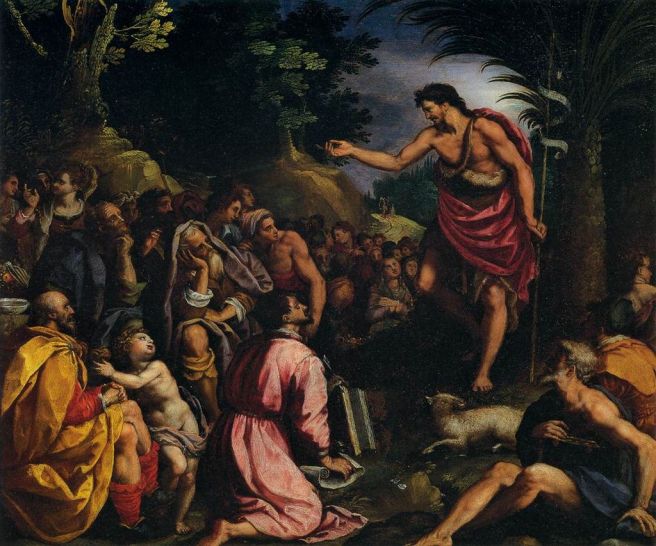
1024px-Alessandro_Allori_-_The_Preaching_of_St_John_the_Baptist_-_WGA0183
Artist: Alessandro Allori (Public Domain)

Synopsis: How do you think people would respond if we hear on tomorrow’s morning news that a guy wearing a black robe, a rope belt, and a reformation-style hat has arrived in Rome, and he is baptizing people in the Tiber River, which runs through Vatican City?

Scriptures: Matthew 3: 1-12 and Ezekiel 34

“Repent for the Kingdom of Heaven has come near!”

This was the message of John the Baptist, a guy who lived over 2,000 years ago in a place far from America, to people of a different faith. How can Christians today relate to him and his message of repentance?

The Gospel of Matthew doesn’t tell us much about John the Baptist until he starts baptizing people. He describes John as eating locusts and wild honey and wearing clothing made of camel’s hair with a leather belt around his waist.

This garb wasn’t unusual for a prophet. In the Old Testament, in the book of 2 Kings, King Ahaziah asked his messengers to seek a prediction from Baal regarding whether he would recover from an injury. His messengers returned stating that they came upon a prophet who told them that the King would surely die because he sought a prediction from Baal, not from the Lord. When King Ahaziah asked what this prophet looked like, they replied, “A hairy man, with a leather belt around his waist.” King Ahaziah said, “It is Elijah the Tishbite.”

When John started baptizing people, it had been 400 years since a prophet had spoken to Israel. But John’s coming was foretold by both the prophet Isaiah and the prophet Malachi. In verse 3, Matthew directly quotes Isaiah’s prophecy from chapter 40, verse 3.

It has been over 500 years since there has been a great reformer of the Christian faith. Imagine if there was a prophecy that Martin Luther would come again to reform the Christian faith and prepare the way for Jesus’ Second Coming. Now imagine hearing tomorrow on the morning news that a guy showed up in Rome wearing a black monk’s robe, a rope-like belt, and a reformation-style hat, and was baptizing people in the Tiber River, which basically runs through Vatican City?

How do you think people would respond?

How many people do you think would flock to Rome just to check out this nut who obviously thinks he’s Martin Luther? Maybe they would have no intention of repenting and no intention of being baptized. They would come just because they were curious – or wanted some entertainment – or wanted to take a selfie with him and post it on social media.

I’m sure many people came to see John for the same reason – except for the selfie part, of course. They may not have been religious Jews; they were just curious and wanted to check out this guy who thinks he’s Elijah come again in fulfillment of some Torah prophecy.

John was weird and did some weird stuff by the world’s standards. That’s because he was not of this world. That’s why he was raised in the wilderness – so he wouldn’t become like everyone else.

If we’re not of this world, we are also weird. I have been called weird. In fact, the person who ended up being the accidental “matchmaker” for Tabatha and I warned Tabatha, “Joan’s coming to the party. You haven’t met her yet. She’s a little weird.”

It used to bother me that people might think I’m weird. But now, I think being weird is a good thing. Look at what it did for John the Baptist. People came to him and heard what he had to say just because he was weird. How many of them ended up repenting and being baptized?

That’s accidental repentance.

Back to our Martin Luther scenario. We’ve said some people would come to Rome to see him out of curiosity. Now imagine seeing the pointy-hats of the bishops from the Vatican approaching the scene and maybe even a gaggle of Protestant ministers with their black robes and stoles. Imagine one of them asking him, “So, are you the reincarnation of Martin Luther?”

How do you think he would respond?

Martin Luther was excommunicated from the church, which also allowed anyone to murder him without penalty. So, we would understand if he might not come right out and say, “Yes, I am!” Many of those bishops and perhaps even some Protestant ministers surrounding him might not see any need for another Reformation. They might be quite happy with the ways things are, thank you very much. Unless, of course, he could solve the problem of fewer butts in the pews and dollars in the offering plate.

In the Gospel of John, when the priests and Levites came from Jerusalem and asked John who he is, John denied being the Messiah or Elijah or the Prophet. He simply alluded to Isaiah chapter 40, verse 3.

He didn’t come right out and say, “Yep! I’m the prophet Elijah come again just like Isaiah’s prophecy said!” We can understand why he wasn’t so straightforward. Elijah was horribly persecuted in his time by Queen Jezebel. She wanted him dead, and he had to run for his life.

Throughout Israel’s history, many of its prophets were murdered by illegitimate and corrupt kings. Unfortunately, this would be John’s fate as well. But first, he needed to fulfill his mission to prepare the hearts of the people to receive the Christ.

John baptized people in the Jordan River, which is about 70 miles long and ran along the eastern border of Israel, about 20 miles east of Jerusalem. A baptism by John in the Jordan River would have been quite symbolic to the Jewish people.

Toward the end of Israel’s forty years of wandering in the wilderness, after the death of Moses and the installation of Joshua as Israel’s new leader, it was at this river that Israel renewed their covenant with God before entering into the Promised Land. Here, at the Jordan River, John was asking people to renew their covenant with God once again.

In Matthew’s gospel, John attacks the Pharisees and Sadducees. The Pharisees and Sadducees, as we know, had a problem with self-righteousness. Since they were the sons of Abraham, they figured that they were already saved. The only people who were baptized in Judaism those days were converts and anyone whose ritual purity had been sullied in some way though, for example, contact with a corpse.

But John’s baptism didn’t have anything to do with cleansing the body; it was about cleansing the heart. To approach John for baptism required people to admit that their hearts were defiled and needed to be cleansed. The Pharisees and Sadducees figured they didn’t do anything that would have required they receive a mikvah (or ritual bath). But John saw how much their hearts were defiled.

Why did the Pharisees and Sadducees come if they weren’t sincere? Well, they had a lot of influence over the people. The Sadducees administered the rites in the Temple. The Pharisees taught Torah law and how to properly follow it – along with a whole heap of “Tradition of the Elders.”

They didn’t like what John was saying. What John was saying is this: “You can follow all the rites and rituals and traditions you want. You can even come here and be baptized, but if it doesn’t lead to a change of heart, if it doesn’t inspire you to love others as you love yourself, then it is worthless!”

That’s phony repentance.

If Martin Luther was in Rome, baptizing people in the Tiber River, how do think the Catholic and Protestant ministers would respond to that message? “You can be baptized, go to church every Sunday, be confirmed, take Communion, serve as a deacon or even be ordained a priest or minister, but if it doesn’t inspire the growth of love in your heart, it’s all worthless!”

I’m sure that some of those who would come to see our reincarnated Martin Luther might be Christians who are sincerely repentant. Most Christians are not oblivious to the sins of the Christian church – and not just sins from long ago, like the Crusades. We’ve recently become aware of some horrible sins committed by some of our religious leaders.

And I’m sure many who came to hear and be baptized by John were truly repentant. We know that the religious leaders of Jesus’ day were more concerned with the letter of the law and their own reputations then they were about planting the seed of love in people’s hearts and properly nurturing that seed. Whole groups of people were ostracized: Samaritans, Lepers, Tax Collectors, Romans, and anyone judged to be “sinners.”

The shepherds turned out to be wolves in disguise. God promised in our reading from Ezekiel chapter 34 that he would come and shepherd the people Himself. John was calling people to repentance to prepare their hearts for the coming of the Good Shepherd. Become like sheep in your hearts, not like wolves. The Good Shepherd will know the difference between the sheep and the wild animals.

John warns the people to “bear fruit worthy of repentance.” It doesn’t matter if someone is a “son of Abraham” if he doesn’t act like it. True sons and daughters resemble their parents. This doesn’t make salvation dependent on good works; it makes good works dependent on salvation. We are not saved unless our hearts have changed, and if our hearts have changed, that will be evident in our good works.

John makes this clear in Luke’s gospel. After John warned the people, they asked, “What should we do?” John replied, “Whoever has two coats must share with anyone who has none; and whoever has food must do likewise.” He told tax collectors, “Collect no more than the amount prescribed for you.” He told soldiers, “Do not extort money from anyone by threats or false accusation and be satisfied with your wages.”

Loving one another as we love ourselves was not a new commandment in Judaism. There’s a Jewish parable called “The Rabbi and the Exceedingly Ugly Man.” It goes like this:

On one occasion Rabbi Eleazer son of Rabbi Simeon was coming from Migdal Gedor, from the house of his teacher. He was riding leisurely on his donkey by the riverside and was feeling happy and elated because he had studied much Torah. There he chanced to meet an exceedingly ugly man who greeted him, “Peace be upon you, rabbi.”

He, however, did not return his greeting but instead said to him, “Raca (which means ‘Empty one’ or ‘Good for nothing’) how ugly you are! Is everyone in your town as ugly as you are?” The man replied; “I do not know, but go and tell the craftsman who made me, ‘How ugly is the vessel which you have made.’” When R. Eleazer realized that he had sinned he dismounted from the donkey and prostrated himself before the man and said to him, “I submit myself to you, forgive me!”

That’s sincere repentance!

The rabbi immediately realized his mistake and was grateful for the correction. He realized he was calling someone made in the image of God – someone like himself – ugly, empty, good for nothing. Some say we can’t love others until we love ourselves. I used to think that, but now I think it’s the other way around. We learn to love ourselves through loving others. That’s why loving one another comes first in the commandment. If we wait until we love ourselves before we love others, we’ll never get there.

John tells the crowd that he is baptizing them with water; he is purifying their hearts for the one coming after him, who will baptize them with the Holy Spirit and with fire. He will fill their hearts with the most powerful force in the Universe – an eternal force that creates entire Universes: The fire of love.

This advent let us rejoice in our weirdness! Accidental repentance can happen when somebody meets one of us weirdos, and they are curious. Their burning question is usually something like, “Why are you always so happy? Why aren’t you miserable like everyone else?” How many of us have been able to share the Gospel with people who really want to know how to get whatever we’ve got?

I have to admit, I am sometimes tempted to be more like others when I’m around people who are very different from me. We all want to feel like we belong, but we don’t have to compromise. We belong to people who are not of this world, people like John the Baptist. Like him, we can be the “voice crying out in the wilderness” that leads people to repentance.

This advent let each one of us envision what our life would be like if our heart was burning with love. I’m not talking about gushy, lovey-dovey, romantic love. I’m talking about agape love – the kind of love that sees every human being as another glorious expression of the Divine within – the kind of love that treats every human being as if he or she has unlimited value. What would that look like?

Now, I’m sure some of us might immediately think of a person or persons in our lives whom we would have trouble loving. What is the mind telling us about why they should be exempt from our love? That’s when phony repentance might be tempting.

And that is the time to choose sincere repentance – to stop believing what the mind says and start believing what the heart says about them. Does what they did matter more than who they are? Does it make “exceedingly ugly” the vessel God has made?

Be careful how you answer because the answer you give will also be true for you. If you believe that they can be good-for-nothing, then you’ll believe that you can be too. If you believe that they can’t be forgiven for what they have done, then you’ll believe it’s possible that you can’t be forgiven.

Finally, this advent, let us consider the areas where we need to repent as a Christian community. As a member of the Christian community, I often feel ashamed of how some Christians ostracize and persecute people for “religious reasons” when Jesus never gave us any reason to treat others that way. How can we repent for them by giving of our time, talents, and resources to serve those who suffer?

John was preparing the people for the Lord’s first coming, where the Lord sacrificed his personal self in order to demonstrate to the world who God is, who we are in relation to Him, and what His Love looks like. We are preparing ourselves and others for the Lord’s second coming – for the Christ to come into hearts that have prepared him room, and from there, rule a Kingdom where the only law is love.

Let’s pray together:

Father, we come to your throne of grace with sincere repentance. Through the Power of Your Holy Spirit, make us aware of what needs to be cleansed in our hearts to prepare room for the Christ’s arrival and the coming of Your Glorious Kingdom. Amen.

Resources:

Deffinbaugh, Robert L. “4. John the Baptist and Jesus (Matthew 3: 1-17), Bible.org,
bible.org/seriespage/4-john-baptist-and-jesus-matthew-31-17

Lose, David J. “Advent 2A: Reclaiming Repentance.” DavidLose.net, 28 Nov. 2016,   davidlose.net/2016/11/advent-2-a-reclaiming-repentance/

Young, Brad H. The Parables (p. 9). Baker Publishing Group. Kindle Edition.

This is Not That

699px-Yin_yang.svg
Yin & Yang Symbol

Synopsis: When the Sadducees try to “stump” Jesus with a scenario that would surely prove the Pharisees’ belief in the resurrection ridiculous, Jesus teaches them a lesson on duality. 

Scriptures: Luke 20:27-38

Peace be with you from Our Lord and Savior Jesus Christ.

When I was a kid, I remember my pastor joyfully talking about how he believed the Lord’s second coming would happen in the year 2,000 – and how utterly terrified I felt. I remember calculating that I would be only 32 years old in that year, and I found it eerie that I would be around the same age Jesus was when he was crucified.

I was also angry. I thought to myself, “It’s no problem for the pastor to believe Jesus will return in the year 2000; he’s old! He’s ready to retire!” I wanted to go to college and become a teacher, and I was afraid the Lord would come before I was ready. I had lots of plans for this life.

I felt like a Sadducee. Like me, they didn’t want to believe. The Sadducees were Jews back in Jesus’ time who did not believe in a future age where the dead would be raised. In our gospel reading for today, they went toe-to-toe with Jesus about this, and we can learn a lot from his response.

Jesus had already made his triumphant entry into Jerusalem, and he caused quite a stir. People were asking, “Who’s this guy everyone’s yelling “Hosanna!” over? Jesus immediately cleansed the Temple by driving out the merchants and money-changers. Then people started asking, “Who does this guy think he is?” No one knew his true intentions because no one understood his spiritual mission of redemption.

While Jesus was in Jerusalem, he frequented the Temple, from where he taught whoever would listen – even those who stood around hoping for a way to discredit or condemn him. The chief priests and scribes saw Jesus as a serious threat to the survival of their nation, so they were trying to get him to say something that would justify arresting him.

One day, while Jesus was teaching at the Temple, the chief priests, scribes, and elders came and asked him, “What gives you the right to drive out the Temple money-changers?” In his usual style, Jesus answered their question with a question: “Did the baptism of John come from heaven, or was it of human origin?” After responding that they didn’t know, Jesus said, “Well then, I’m not going to answer your question.”

Then he told the Parable of the Wicked Tenets, where he spoke out against the chief priests and scribes. He identified himself as the beloved son of the vineyard owner and them as the wicked tenets who killed the son and lost the vineyard.

The chief priests, scribes, and elders were enraged by this, so they started sending spies to try to trap Jesus by asking him questions that might get him into civic or religious trouble if he didn’t answer right. First was a question about paying taxes, which they thought would force Jesus between a rock and a hard place.

Because if Jesus answered, “don’t pay taxes,” he’d get in trouble with the Romans. If he answered, “pay taxes,” he’d lose credibility with the Jews, who hated paying taxes to their Roman oppressors. After asking his questioner whose head is printed on a denarius and receiving the obvious answer, “the Emperor’s,” Jesus brilliantly responded to give to the Emperor what is his and to God what is God’s.

That brings us to today’s scripture reading. The Sadducees now take the opportunity to question this master because they have a theological ax to grind with the Pharisees.

The Sadducees and Pharisees differed in their theological viewpoints. The Sadducees believed in following the Law as found in the Torah and only as found in the Torah – the first five books of the Bible. They considered anything else immaterial, including the Pharisees’ many “Traditions of the Elders,” which the Sadducees felt served only to complicate the lives of the Jewish people.

Jesus agreed with the Sadducees on this point. In Matthew chapter 15, the Pharisees and scribes came to Jesus in Gennesaret and asked him, “Why do your disciples break the tradition of the elders? For they do not wash their hands before they eat.” Jesus responds by accusing them of ignoring God’s commandments in favor of their traditions.

Later in Matthew chapter 23, Jesus says to his disciples and the crowd in Jerusalem, “The scribes and the Pharisees sit on Moses’ seat; therefore, do whatever they teach you and follow it; but do not do as they do, for they do not practice what they teach. They tie up heavy burdens, hard to bear, and lay them on the shoulders of others; but they themselves are unwilling to lift a finger to move them.”

The Sadducees didn’t believe in the resurrection. They believed that the only life we have is this world right here and now, and it’s our responsibility to follow God’s Laws. If we don’t, we suffer. That’s all there is to it. There’s no “other world” of a future time where God will bring dead people back to life and bring justice down on their oppressors.

Luke clearly points out the hypocrisy of those asking Jesus this question about the resurrection when they themselves do not believe in the resurrection. They are simply trying to “stump” this master teacher with their brilliant scenario that they think surely makes the Pharisees’ doctrine of the resurrection ridiculous.

If Jesus is stumped, then their theological position denying the resurrection is bolstered. Their scenario probably wasn’t new to the Pharisees. We can image them rolling their eyes: “Oh, for crying out loud! Here we go again. “‘Now there were seven brothers ….’”

The Command the Sadducees are referring to can be found in Deuteronomy 25:5-6. The purpose of the Mosaic law commanding the brother of the deceased to take his widow as a bride was to protect the nation by ensuring that every family and tribe would continue. No one’s family name would be lost.

We can understand how important it was for the Jews since it was believed that the Messiah would be born of a woman from the tribe of Judah, of the line of David.

It seems the Sadducees felt that Moses didn’t believe in the resurrection of the dead because of this law. They figure he must have believed that the only way to be “immortal” (in a non-literal sense) was to keep the family name alive through descendants. If he believed in the resurrection of the dead, why did he create this law?

The Sadducees didn’t believe that the Kingdom of God would arrive at some future time; it’s here now. If it’s here now, then it’s not any different from now. So, people would get married just like they do now, and if the dead are resurrected, that would create quite a problem for a woman had to choose a husband from among seven brothers.

It seems like a logical argument on the surface, but Jesus quickly points out the flaws.

Their first is an application error. They are applying a law from “this age” to “that age.” This is Not That. Jesus essentially says to them, “People die in this age, so they must get married and have children to carry on the family name. People don’t die in that age, so getting married and having children isn’t necessary. Moses created the law for this age, not for that age.”

Their second error is confusion about natural law, which lead to them making their first error. It’s clear that we live in a world of duality – of opposites – of this and that. If there’s “this age,” then there has to be “that age” because it’s impossible for anything to exist without its opposite. Its opposite must exist at the same time, so the Sadducees were correct on this point: the Kingdom of God (that age) is here right now, existing simultaneously with this age. How is that possible?

In the Taoist religion of the East, there a wonderful symbol that expresses this idea: the Yin and Yang symbol. Yin exists relative to Yang and vice versa: light is light relative to darkness. Without darkness, we can’t experience light because we need light as a reference point. Yin and Yang also transform into each other; day turns to night and night to day in never-ending cycles. These opposing forces complement each other nicely because they are in perfect balance.

We westerners might have trouble relating to an eastern symbol, so I brought a symbol we can better relate to: a coin. This coin contains a this and a that. Two opposites – heads and tails. Heads is not tails and tails is not heads. They are opposites; yet, they exist at the same time – united in one object.

We can think of this age as “heads,” and that age as “tails.” Heads is this age of time – and tails is that age of eternity. They are total opposites, yet they exist simultaneously. We experience whichever side is up. The other side is hidden, but that doesn’t mean it’s not there.

I don’t agree with the Sadducees that “that age” does not exist. They are ignoring the fact that in a dualistic world, if there’s a “this,” there must be a “that.” If there is this age, there must be that age. If we must marry and have children in this age of time because we die, then we must not need to in that age of eternity because we don’t die.

This is Not That.

Another error the Sadducees made is to focus only on the parts of the Scriptures that bolster their argument and not looking at the Scriptures as a whole. Common mistake, right? Jesus says in verses 37-38, “And the fact that the dead are raised Moses himself showed, in the story about the bush, where he speaks of the Lord as the God of Abraham, the God of Isaac, and the God of Jacob. Now he is God not of the dead, but of the living; for to him all of them are alive.”

The Sadducees didn’t believe in angels or Spirits. According to them, there is no such thing as a spiritual world: what you see is what you get. We know more now then the people of Jesus’ time. Science has revealed to us that everything in the universe is made up of either matter or energy, and just like day and night, they transform into each other in never-ending cycles.

In this age of time, we experience ourselves as this body made of matter but on the flip side, in that age of eternity, we experience ourselves as something like energy. If we’re part of this never-ending cycle of transformation, from flesh to spirit and from spirit to flesh, maybe that’s why to God, we are all alive.

Everything in creation is subject to the law of duality – the balancing of opposites. Within us, we have two opposites: we have our human nature and our spiritual nature, and one transforms into the other in never-ending cycles.

Sometimes we exist on the heads side, in the world of time and form, and we have a human nature. Inevitably, we transform and enter the tails side, the world of eternity and spirit, where we have a totally different nature because …

This is Not That.

Jesus proved the Sadducees wrong, and some of the scribes responded, “Well said, teacher!” They must have been scribes who believed in the resurrection. I wouldn’t be surprised if the Pharisees were also very happy with Jesus’ response, thinking to themselves, “Finally, he agrees with us on something!” Truly, Jesus argued with the Pharisees quite a bit throughout the New Testament.

But neither the Sadducees nor the Pharisees were totally right or totally wrong. When it comes to the Great Mystery of Life, we humans have many philosophies, but no one has it exactly right. We have only ideas that may be closer to the truth than others, but until something proves our theories correct, we simply don’t know. That’s why we need faith.

We certainly do know and understand more now than people did back in Jesus’ time. Yet, the more we learn, the more we scratch our heads and realize how much we don’t know about the Great Mystery of Life. Nevertheless, we love to debate what we think we know.

That’s why Luke included this debate in his Gospel. It’s critical to the gospel message because if there is no resurrection, then Jesus didn’t resurrect from the dead, and there’s no salvation. Yet throughout the Old and New Testaments, God promises salvation for people of faith who wait on him.

The Sadducees believed that it is our human responsibility to follow God’s laws in order to live right. There are people today, like the humanists, who also believe that it’s up to us to save ourselves by following natural laws.

I believe they are correct. God gave us this world of duality to help us learn how to properly balance these opposing forces. That is our responsibility. Most people’s energy is too focused on the “heads” side – this age, the world of form, the world of time, our human nature. The problems we experience in this world reflect this imbalance.

The two things that keep us stuck on the heads side are fear and desire. We cling to this age because we fear death, believing that this is all there is or because we desire the things of this world.

If we are part of this never-ending cycle of transformation, then we don’t need to fear death. We don’t die; we transform. But that doesn’t mean that we shouldn’t take care of our bodies. We are all here for a purpose, and we can’t fulfill that purpose very well unless we keep our physical vehicle healthy.

As humans beings we also naturally have desires, but it’s our responsibility to keep our desires properly balanced. We must be willing to let go of everything that belongs to this age.

The Buddhists are really good at teaching letting go. Richard Rohr is an American Franciscan friar ordained to the priesthood in the Roman Catholic Church in 1970. In his YouTube video, “How Buddha Helps To Be a Better Christian,” he talks about how helpful it was to humanity that the Buddha essentially said, “I don’t know the nature of God, so I’m not going to debate about that.”

His refusal to dwell on the nature of God freed him to focus on something more practical. He observed how we humans process our life experiences. He observed what goes on up here (head) and in here (heart). He concluded that we suffer because we are attached to this transient world, and he provided a way to find balance.

We can use his insights to become more self-aware, which can make us better Christians. We can use Buddhism to discover how to let go and find balance. Don’t worry: we can safely practice Buddhism and keep our doctrines, but we might understand them in a new way.

We must be ready to let go of everything that is of this age to prepare for that age. You see, Mother Earth is part of this never-ending cycle of transformation too. And one day, she will pass from this age into that age. I don’t believe it will happen by some cataclysmic event; it will happen slowly over time.

She is transforming now, as gently as she can, with as little loss of human life as possible because she wants to take us all with her. But we have free will, so it is our responsibility to choose to let go. Perhaps the ones who can let go are the ones Jesus was talking about when in verse 35, he said, “those who are considered worthy of a place in that age.”

May we all be worthy by being ready to let go.

Let’s pray together: Lord, you taught us to be in this world, but not of it. Help us to learn this lesson deeply now as we prepare ourselves to let go of this age and resurrect into a new age. Amen.

Resources

Deffinbaugh, Bob. “One Bride for Seven Brothers (Luke 20:27-40).” Bible.org, bible.org/seriespage/63-one-bride-seven-brothers-luke-2027-40

Rohr, Richard. “How Buddha Helps to be a Better Christian.” YouTube, www.youtube.com/watch?v=TZS9bvxVp6Y

The Parable of the Little Fish

Nature Reef Marine Coral Underwater Ocean Fish[Image Link Referral]

Once upon a time, in a place called Ocean Paradise, there lived a little fish. And the little fish swam within Ocean Paradise as happy as can be, for the Lord of the Ocean had given him everything that he could ever want.

One day, a long, skinny friend swam up to him and said, “Did the Lord of the Ocean really give us everything we could ever want?”

And the little fish said, “Of course! What more could we want than this Ocean Paradise?”

The long, skinny friend asked, “Do you know what water is?”

And the little fish said, “Water? Never heard of it.”

The long, skinny friend said, “Only the Lord of the Ocean knows. It must be something very precious for him to keep it a secret from us.”

The little fish thought for a moment and said, “But the Lord of the Ocean promised us everything. Why would he keep something so precious a secret from us?”

The long, skinny friend said, ““Perhaps the Lord of the Ocean has deceived us! Perhaps he hasn’t really given us everything, and he’s keeping the precious water for himself!

Suddenly, the happy little fish was no longer happy.

So he said, “It’s not fair! I want water too!”

The long, skinny friend said, “I will help you find it, but we have to hide from the Lord of the Ocean. If he finds out what we’re up to, he will become very jealous and angry. He will destroy us!”

Terrified, the little fish swam and he swam and he swam as fast and as far as his little fins could carry him – so fast and so far that he swam right out of Ocean Paradise.

Marooned on dry land, he couldn’t breathe, and he couldn’t move. Suffering terribly, he thought, “The Lord of the Ocean must have found out my plan! He is angry with me, and he is trying to destroy me!”

The little fish flipped and flopped and wiggled, desperately trying to save himself, until he was completely exhausted. Finally, he cried out, “Lord of the Ocean, please have mercy on me and save me!”

Just then, a great wave engulfed the little fish, lifting him up, and carrying him home.

At that moment, the little fish learned the secret of the water. He learned that he had always had this precious thing all around him. It was the breath of his life – the very thing in which he lived and moved – he just never knew it – until now.

And that’s how the little fish became the wisest and the happiest and most serene fish in Ocean Paradise.

The End.

The Cure for Spiritual Leprosy

Synopsis: If we believe that we are nothing more than these physical bodies and personalities, we are suffering from spiritual leprosy. In the story of the ten lepers, Jesus points to the cure. 

Scriptures: Luke 17: 11-19

Peace be with you from Our Lord and Savior Jesus Christ.

A story is told of a man who was lost in the woods. Later, in describing the experience, he told how frightened he was and how he had even finally knelt and prayed. Someone asked, “Did God answer your prayer?” “Oh, no,” the man replied. “A guide came along and showed me the way out.”

Like this man, many people are blind to the blessings that God showers upon us every day. Sooner or later, they all end up with a case of spiritual leprosy. In our gospel story for today, the Lord points to the cure.

At this point in Luke’s Gospel, Jesus has been making his way toward Jerusalem where he would complete his mission to glorify God. In Luke chapter 9, he began preparing his disciples for his death and resurrection in Jerusalem. After Peter proclaimed Jesus to be the “Messiah of God,” Jesus ordered them not to tell anyone, but then he said in verse 22, “The Son of Man must undergo great suffering, and be rejected by the elders, chief priests, and scribes, and be killed, and on the third day be raised.”

He didn’t yet say that this will all take place in Jerusalem, but later in Luke chapter 13, he hints at it. In verses 32-33, after some Pharisees warned Jesus that Herod wanted to kill him, Jesus says, “Go and tell that fox (Herod) for me, ‘Listen, I am casting out demons and performing cures today and tomorrow, and on the third day I finish my work. Yet today, tomorrow, and the next day I must be on my way, because it is impossible for a prophet to be killed outside of Jerusalem.’”

It won’t be until Luke chapter 18 that Jesus tells his disciples straightforwardly that his final destination is Jerusalem. In verse 31, he says, “See, we are going up to Jerusalem, and everything that is written about the Son of Man by the prophets will be accomplished.” We also read there that the disciples didn’t understand what Jesus was saying because that knowledge was purposely hidden from them.

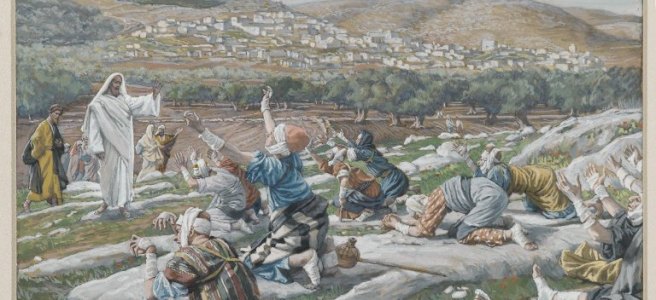
Backing up to our gospel story for today, in Luke chapter 17, we read that Jesus is traveling along the border of Samaria and Galilee with his disciples on his way to Jerusalem. Samaria was sandwiched between Galilee, where Jesus lived with his family as a child, and Judea, where Jerusalem was located. He enters a village, and there he is approached by ten leprous men.

They kept their distance, as they petitioned him saying, “Jesus, Master, have mercy on us!” Jewish law actually required them to keep their distance, wear torn clothing, keep their heads uncovered, and cover their lips and shout, “Unclean! Unclean!” wherever they went to warn others to stay away.

As we know, back in ancient times, illnesses were unfortunately considered God’s punishment for sin. This was certainly the case with leprosy. It was a horrible disease that, in its worst forms, slowly ate away at a person’s flesh. It wasn’t uncommon for a severely diseased finger or toe to just fall off – and sometimes an entire hand or foot.

The milder forms of the disease, where the skin was simply discolored, typically lasted no more than a few years and often cleared up on its own. But the worst type could take from nine to thirty years and eventually killed its victim.

If this physical suffering wasn’t bad enough, the social ostracism made the experience of the illness even worse. Jewish law cut them off from society totally – even from their own families. The Jewish historian Josephus reported that leprous men were treated as if they were already dead.

There were ten of them, and we know one of them was a Samaritan. We can be fairly certain that the other nine were Jewish, given where Jesus was traveling. It’s interesting to note that the Samaritan was welcome among the band of leprous Jews. Since they were all considered “dead men,” I guess they figured there wasn’t any point in feeling superior.

Jesus tells them to go and show themselves to the priests. According to Jewish law, the only way they could be integrated back into Jewish society is if they were declared “clean,” and the only way to be declared clean was to be examined by a priest.

Interesting, right? Since they were unclean because of sin, not because of illness, they needed to be examined by a priest, not a physician. They did have physicians in ancient times; in fact, Luke, the author of this gospel, was a physician.

Along the way to see the priest, they were all miraculously healed. But only one of them came back to Jesus, praising God with a loud voice – the Samaritan. Jesus asks about the other nine, pointing out that only the foreigner properly expressed gratitude for his healing.

What cure does the Lord point to in this story?

First, the leprous men call Jesus “Master.” They acknowledge Jesus’ authority. Whenever we need healing of any kind (physical, mental, emotional, and/or spiritual), we should remember the Lord’s words in Matthew 28:18: “All authority in heaven and on earth has been given to me.” The Power of Christ within us has the authority to make us whole according to the Will of God, so we shouldn’t hesitate to pray to the Lord for healing.

In her daily devotional, Trusting God Day by Day, Joyce Meyer writes, “God will do one of two things if you have a problem: He will either remove the problem (which is always our first choice!) or He will give you the strength, the grace, the ability to go through the problem. I know we don’t like the going through part, but if that is what God chooses, we need to trust Him.”

To trust in God’s Will takes spiritual maturity. It takes trusting that God loves us and knows what is best for us. And it takes accepting the fact that Life is not designed to make the personal self happy. The personal self might think we need a certain challenge in our life like we need a hole in the head, but that challenge might be just what we need to grow spiritually – and that’s why we’re here.

The leprous men asked Jesus for mercy. When we ask for grace, we’re asking to get something we don’t deserve. When we ask for mercy, we’re asking to not get something we do deserve. In asking for mercy, these men were asking to be spared from death. In Romans chapter 6 verse 23, Paul writes, “the wages of sin is death … but the free gift of God is eternal life in Christ Jesus our Lord.”

I like how Luke calls them “leprous men,” not just “leapers.” He’s pointing to their underlying humanity concealed by their leprous condition.
Our underlying spiritual Essence is concealed by our physical bodies and personalities, which are really “dead things” – because they are temporary.

Now, some ministers will argue that this human nature is the consequence of our “original sin.” I personally don’t believe that. Our human nature is what it is. It is neither good nor bad. Without our human nature, the Divine within would have no physical form or personality with which to experience life.

And there are so many humans on this earth with so many different forms and with such a variety of personalities that I’m sure the Divine is having a grand time experiencing all of them and deeply appreciates our human nature.

But our human nature is a dead thing without God’s life-giving power.

We’ve forgotten this in our modern world, but those of the ancient world were keenly aware that without God, we are dust. King David wrote in Psalm 103 “As for mortals, their days are like grass; they flourish like a flower of the field; for the wind passes over it, and it is gone, and its place knows it no more. But … the steadfast love of the Lord is from everlasting to everlasting.”

Ancient people like David and Paul knew they were dead things, but they also knew that God loves them eternally. Do we know that? You can really tell who knows it and who doesn’t especially at funerals. You can see the fear in the eyes of those who wonder if what’s lying in that coffin is all they really are.

They are suffering from spiritual leprosy.

When we ask for mercy, we are asking the Holy Spirit to cure us – to remind us of the Truth. We are dead things – yes – but that’s not all we are. We are infinitely more than that. Each one of us. The Divine is the same in us all – one Consciousness experiencing life through a variety of forms. When I look at you, I see myself looking back at me.

The leprous men trusted Jesus. It took a lot of trust for them to come to him. There was no cure for leprosy at that time. If they had gone to a physician, he probably would have said, “Oh man, you guys have leprosy. Sorry, I can’t help you. There’s no cure for that. So, you know, just stay away from me OK?”

There are some illnesses today that we don’t understand, so we treat the afflicted in much the same way. People with diseases like fibromyalgia, multiple sclerosis, mental illness, even cancer are often treated like lepers in our society – and even some people who aren’t sick like the poor and the homeless – as if poverty and homelessness were some infectious disease or contagious karma.

Jesus says, “I don’t care what disease you have or what your situation is; there’s always a chance for new life if you trust in God.” And the “trust test” was for them to make “a journey without evidence.” To go to the priests before there was any proof that they were healed.

To “act as if.”

Luke doesn’t record whether the ten lepers engaged in any discussion on their way to the priests. We can imagine any of them to say, “Why are we going to the priests? We aren’t healed, and if we aren’t healed, then this is a useless journey.” And maybe an optimist among them replied, “Maybe, but what do we have to lose?”

When Jesus states, “Your faith has made you well” in verse 19, the Greek word used is “pistis.” It doesn’t mean adherence to a religion or set of doctrines. It means trust. So, a better translation of Jesus words would be, “Your trust has made you well.”

The mind is a tricky thing. We often resist the healing God is offering us because we have a negative attitude. We keep complaining about what’s wrong instead of expecting healing. When we stop resisting healing in this way and start “acting as if,” the results can be miraculous.

Finally, one of the leprous men returned to Jesus, praising God. It might appear that Jesus is drilling the Samaritan about why his buddies haven’t shown up to give thanks – like some ministers drill family members about why other family members aren’t in church.

It also might seem rude that Jesus calls the man who returned “this foreigner,” but in Greek, the term simply meant “otherly-born,” or non-Jew.

But he isn’t speaking to the Samaritan because he says, “Was none of them found to return and give praise to God except this foreigner?” He is asking this question of the crowd that was following him to Jerusalem – a crowd that probably consisted mostly of Jews.

It was a rhetorical question: a question asked not to get an answer, but to create a dramatic effect or to make a point.

Praising God is built into every aspect of Jewish life – Jews praise God for everything even for little things that may seem quite trivial to us – yet only this non-Jew took the opportunity to praise God for something as monumental as a miracle.

Jesus’ question could be re-phrased, “Isn’t it ironic?”

Certainly, we might like to identify more with this grateful Samaritan and to pass judgement on those other ungrateful schmucks. What reasons might they have had for not returning to praise God?

Maybe one thought the disease had finally just cleared up on its own, so there was no one to thank but his lucky stars. Maybe another didn’t make the connection between Jesus’ words to go show himself to the priests and his healing, like the lost fellow in our story who didn’t make the connection between his prayer and the guide showing up.

Maybe another figured that God owed him one because he had a hard life. Maybe another didn’t want to go back to Jesus because – as much as he was happy to be healed – he didn’t really want to do what it took to follow Jesus. Maybe some of them were too busy planning their homecoming parties. Maybe the other nine didn’t want to walk back with a despised Samaritan.

Maybe we see a glimpse of ourselves in some of these schmucks.

In the business of our lives, it’s so easy to forget to thank God for our blessings. But the more we do that, the more we deny the power of God as the foundation of our lives, and the more we slip into spiritual leprosy, and the more we begin to wonder if we are nothing more than these “dead things,” and the more we feel separate from others.

So, you see, God doesn’t need us to praise Him. We need it.

We need it because we need constant reminders of who we are – in the busyness of our lives – because it’s so easy to get swallowed up by the illusion of our personal selves and this world – and forget who we are – to lose the knowledge of our salvation. We can’t actually lose our salvation, but we can forget.

So every day of our lives, let us be grateful to our merciful God, who has healed our spiritual leprosy through the knowledge of salvation given to us through the selfless service of Our Lord Jesus Christ and who reminds us of our salvation through the Power of His Holy Spirit, so that every day of our lives we may arise and go out and do the good work that He has given us to do.

Let’s pray together: Lord, when we need healing, may we remember Your Cure: to come to You, to act “as if,” and to return to give thanks to God, so that we may never forget the saving knowledge that because you love us eternally, we are so much more than our human nature. Amen.

Resources

Chuek, Michael. “Where are the Other Nine?” ethicsdaily.com, 22 Nov. 2012, ethicsdaily.com/where-are-the-other-nine-cms-20240/.

Cole, Steven J. “Lesson 79: How to Respond to God’s Blessings (Luke 17:11-19).” Bible.org, bible.org/seriespage/lesson-79-how-respond-god-s-blessings-luke-1711-19.

Davis, D. Mark. “Cleanse, Cure, and Make Whole.” leftbehindandlovingit.blogspot.com, 6 Oct 2019, leftbehindandlovingit.blogspot.com/2013/10/cleanse-cure-and-make-whole.html.

Meyer, Joyce. Trusting God Day by Day (p. 338). FaithWords. Kindle Edition.

Mitchell, Kristen L. “Proper 23C: Faith that Makes Us Well.” modernmetanoia.org, modernmetanoia.org/2016/09/26/proper-23c-faith-that-makes-us-well/.