The Peace of Zechariah

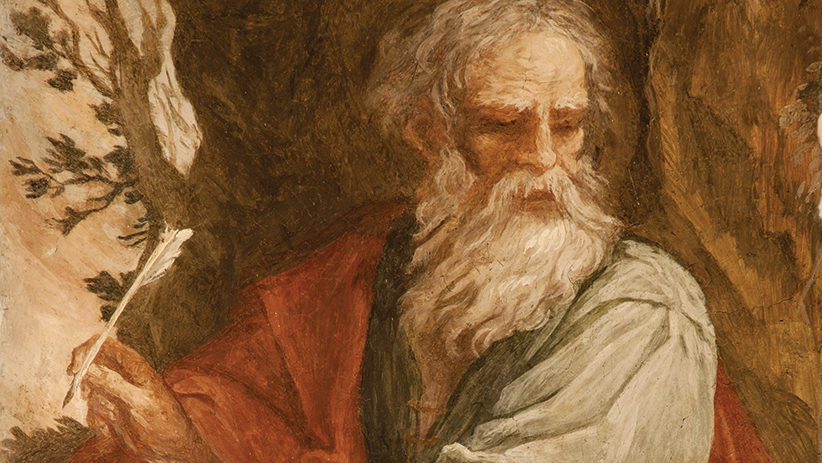
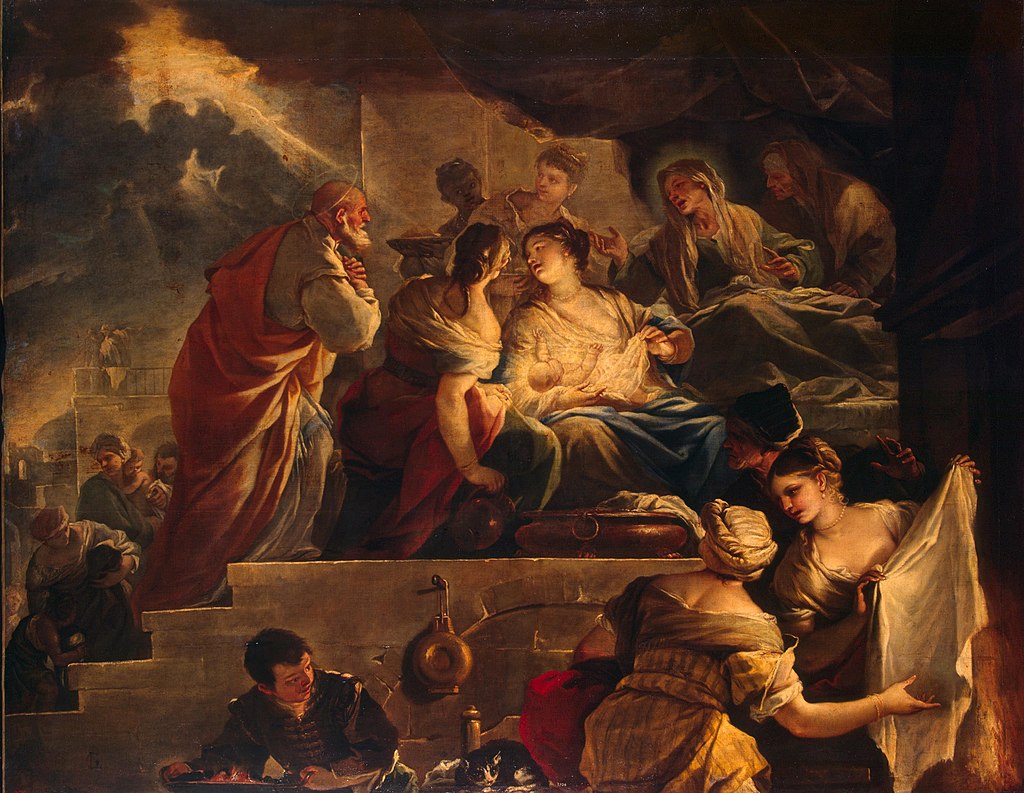
Luca Giordano, Public domain, via Wikimedia Commons

Synopsis: During turbulent times, it is tempting to believe that God is no longer in control and that our dreams are lost. Zechariah believed his dream of having a son was lost, but he ultimately learned to be at peace by trusting God no matter how impossible things may appear. How can we learn his lesson and enjoy the peace of Zechariah?

Scripture: Luke 1:68-79

When we look out there at what’s going on in our country and in our world today, we can understand why many people are embracing a variety of doomsday scenarios. Even for us Christians, it is difficult to remain calm, keep the faith, and trust that God is in control. The coming of the Christ into the hearts of all seems to be an impossible dream in stormy times like this.

How do find peace in these times? That’s what our scripture reading is all about. It’s about a man who found peace after he experienced firsthand the awesome power God to make what he thought was impossible, not only possible, but real. In his arms, he was holding his “impossible son.”

Let’s review the story leading up to our scripture reading for today – a story I’m sure many of you know well. The gospel writer Luke tells us Zechariah was a priest and his wife, Elizabeth, was a descendent of Aaron, the brother of Moses and founder of the priesthood. They were both righteous in the eyes of God, but they had no children because Elizabeth was barren.

One day when Zechariah was offering incense to the Lord in the sanctuary, he saw a vision of an angel, who told him that Elizabeth would give birth to a son, and he was to be called John. The angel told Zechariah many wonderful things about his future son – that he would be great in the Lord’s sight, filled with the Holy Spirit from conception, and turn many back to God with the spirit and power of Elijah.

Zechariah questioned the angel’s news because Elizabeth was barren, and they were both elderly. The angel introduced himself as Gabriel, a messenger sent from God. Then he tells Zechariah that, because he did not believe the Lord’s words, he will be mute until they are fulfilled. Shortly thereafter, Elizabeth conceived and spent five months in seclusion.

Then Elizabeth’s cousin Mary came to visit her. Mary had also been visited by an angel, who told her that she would conceive by the Holy Spirit and give birth to the Son of God, whom she was to name “Jesus.” The child in Elizabeth’s womb jumped at the sound of Mary’s greeting.

Elizabeth, filled with the Holy Spirit, exclaimed a blessing over Mary and the child in her womb and also wonder as to why the mother of the Lord would visit her and make the child within her womb leap for joy. Mary stayed with Elizabeth until she gave birth, then she returned to her home in Galilee.

After eight days, it was time for the child to be circumcised. People thought the parents would name the child after his father, Zechariah, but Elizabeth said, “No, he is to be named John.” The relatives couldn’t figure out where the name John came from since no one in the family was named John.

So, they asked Zechariah what he wanted to name the child. He asked for a writing tablet and wrote, “His name is John.” At that moment, his tongue was loosened, and he began to prophesize. And that brings us to our scripture reading for today, known as Zechariah’s song.

Zechariah first praises God for being faithful to his covenant with the people of Israel. He is looking back into history – a long history of subjugation and slavery. The people languished in Egypt under the heavy yoke of slavery for over 400 years. God sent Moses to free them, and he led them to the Promised Land, the land of Canaan.

But once they were in Canaan, they often sinned against the Lord. The Lord warned them to repent through many prophets, but they ignored the prophet’s warnings and persecuted the prophets. As a result, Israel was defeated in turn by the Philistines, the Assyrians, the Babylonians, and the Romans.

Their glory days under King David and King Solomon were short-lived, but now, God was promising them a Savior from on high who would set them free from their enemies once and for all and whose kingdom would have no end. Zechariah professes that he can see through his prophetic eyes this Savior coming out of the house of David. The time was coming when the people of God would be able to live in peace.

Zechariah ends his song by praising God that his “impossible son” John would be the one to prepare the way for God’s promised Savior.

I think it is safe to say that Zechariah learned an important lesson – a tough one, but a very good one, because in the end, he found peace. How can we learn from his lesson and enjoy the peace of Zechariah?

Well, first of all, an angel of the Lord announced that his wife Elizabeth would give birth to a son, and Zechariah responded by speaking words of doubt. We can’t blame him. The observable facts made it appear to be impossible indeed. Not only were they both quite advanced in age, but Elizabeth had always been barren. A double-whammy!

The angel’s response to Zechariah’s doubt was basically, “Look dude, I’m coming to you with a message straight from God Almighty and telling you that you’re going to have a son, okay?” At that point, Zechariah would no longer speak words of doubt – because he couldn’t speak at all. He was struck mute.

Doug and I were talking a few weeks ago about how today’s video games are a good metaphor for life – especially the open world role-playing ones. I enjoy playing a game called Skyrim: The Elder Scrolls. In this game, I can create my character down to the slightest detail – such as the thickness and placement of the eyebrows – or eyebrow. Yes, you can even create a character with a unibrow! My current character’s name is Xena. She does not have a unibrow, in case you were wondering.

Anyway, this game takes place in a world called Skyrim on a continent called Tamriel. Through Xena’s travels and interactions, I can experience the many different regions and cities in Tamriel, and I can interact with its many different citizens – characters of different races, religions, political affiliations – and some with very strange personalities.

Through Xena, I can make all kinds of choices throughout the game, for good or evil, and experience the consequences of each choice. But no matter what, I can’t make a choice that would alter the basic plot. For example, there are certain characters in the game that never die no matter how much they are attacked because they are an important part of the story. They are called “essential characters.”

So, while players of these games enjoy a great deal of free will, they can’t do anything to alter the basic plot or destroy the game itself. That’s smart, right? How foolish it would be for the game designers to create a game that allowed players to either mess-up the plot or destroy the game itself?

I think we can trust that God is at least as intelligent as these game designers. He designed Life in such a way that gave his created characters a great deal of free will, but he did not give them the power to mess up his plan or destroy Life itself.

I think that’s what the angel was trying to explain to Zechariah. John was an essential character in God’s plan, so John was going to show up at the appointed time – no matter how impossible it seemed. God, in his infinite mercy, put a lid on Zechariah’s words of doubt because he didn’t want John’s pure soul to hear them or subject Zechariah’s wife, Elizabeth, to hearing them.

You know how painful it is to be around negative Ned’s and Nancy’s. Whenever they speak their negative thoughts, you get a sinking feeling in your gut. That sinking feeling is literally your soul recoiling from the doubtful words because it knows that nothing is impossible with God.

To have the peace of Zechariah, we need to strike mute any words of doubt. Don’t give voice to them. Now, it’s natural to have thoughts of doubt. We can’t control the thoughts we have. But we can choose not to give them a second thought, and we can certainly control whether they come out of our mouths.

Zechariah began his song by reviewing the times God saved Israel from their enemies and his trust in God to save them from all their enemies. The Jews of his time believed that their foreign enemies were the Romans, the Samaritans, and the gentiles. Domestically, the Pharisees might have viewed the Sadducees as their enemies, and the Zealots, of course, were radical terrorists who believed that anyone who didn’t support their cause was the enemy.

Who are our enemies? If we were to go to the Stroud mall or the Crossings to ask people this question, they might say our foreign enemies are China, North Korea, and Al-Quaeda, and our domestic enemies are home-grown terrorists, and depending on who you talk to, Democrats or Republicans. We’re not much different today from the Jews of Zechariah’s time. They believed their enemies were “out there” – just as many do today. We have always been wrong about this. Our true enemy has never been “out there.” It has always been “up here.” (point to the head)

We truly do have a split mind – the Mind of Christ and the mind of me – the angel on the sitting on the right shoulder, and the devil on the left. The mind of me is our true enemy because it contains all of the false ideas we have about who we really are. Our Lord drove a stake right into the heart of the mind of me through his death and resurrection. Because of our Lord’s brave and loving sacrifice, the mind of me has been slowly losing its domination of the human mind.

The mind of me clings to its false identities and to the same-old-same-old. It hates change of any kind because it is afraid of the unknown. It’s afraid of the unknown because it doesn’t trust life. It doesn’t trust life because life doesn’t cater to it. Life doesn’t cater to it because Life caters to the soul. But the mind of me has no clue that the soul even exists. What a quandary! No wonder it’s always so frustrated!

The Mind of Christ knows who we really are and the true purpose of Life: the growth of the soul. Now, the soul can feel enslaved under certain conditions – a job we hate, a bad relationship, or even a false notion we might hold about ourselves. We might hear the cry of the soul for change, but the mind of me will convince us to ignore it – usually by filling us with fear – or shame.

If we ignore the soul’s cry for too long, the soul will find a way to forcibly liberate us from the situation. Something unexpected will happen, and we’ll be forced out. It’s usually a painful experience for the personal self, but we often realize later down the road of life, perhaps even many years later, that it was the best thing that ever happened to us. It set us free in some way so that we could continue to grow.

Can you remember a time in your life when you were stuck? Maybe you didn’t even know you were stuck at the time. But then something out-of-the-blue happened, and you were set free? And then later down the road, you realized that you ended up in a far better place in life because of it? That was God keeping his promise to save us from our enemies.

Now I want you to enlarge that experience beyond the individual soul and realize this same experience can happen to the collective soul of humanity. The soul of humanity is enslaved in many ways. The soul of humanity is stuck in many places that are not good for the collective whole. For starters, we are stuck when it comes to getting along with one another, and we are stuck when it comes to ensuring that everyone’s basic needs are met.

The soul of humanity has been crying out for a long time, and I believe that God’s answer to that cry is now moving quickly toward fulfillment. The old systems that have enslaved us – that have kept us stuck in these harmful places – are crumbling. This process is very frightening and painful for the personal self – especially those who are enslaved by the mind of me. Things will eventually change for the better for everyone, but in the process, we may experience some turbulence.

To have the peace of Zechariah, we must trust that God will save us and ultimately all of humanity from our true enemy. We are all in a good place for these stormy times. We are becoming more and more aware the mind of me and the true purpose of life. But most people have no idea that they are enslaved by the mind of me, so life is very frustrating – perhaps even meaningless – to them.

Can you imagine how difficult their lives must be? Let us have compassion for them and forgive them instead of judging them to be the enemy. We can also have compassion for ourselves and forgive ourselves in our struggles with the enemy too.

Zechariah ends his song with the words, “By the tender mercy of our God, the dawn from on high will break upon us, to give light to those who sit in darkness and in the shadow of death, to guide our feet into the way of peace.” God’s way is the way of peace. The enemy’s way is the way of conflict. We can’t have both. That was John’s message. He prepared the way by saying to people, “It’s time to make a choice. Which way do you choose?”

Those who came to John to be baptized had not only chosen God’s way of peace but also were already living that way for some time. They had made a commitment, and they convincingly demonstrated to John that their commitment wasn’t just words. Otherwise, John would not have baptized them.

We must be willing to make the same commitment – to “turn the other cheek,” a teaching which really means to listen to the voice of peace, not the other voice, the voice of conflict, that devil that wants you to strike out at life. Turn the other cheek and listen to the angel, the voice inside your heart.

To have the peace of Zechariah, we must have unwavering commitment to God’s path of peace. We must have peace with life by accepting the fact that life always goes our way – always – it always grows the soul. The mind of me will grumble. Just notice the grumbling with the understanding that the mind of me will never get it. Don’t agree with it, and don’t disagree with it. Just don’t give it a second thought.

To walk God’s way of peace, we must love the Mind of Christ more than the mind of me. We must be willing to sacrifice the desires of personal self for the desires of the soul – for the desires of the soul of Life. And we must have unwavering trust that no matter how things appear, God is in control.

When we can live this way 100% of the time, we enter into the Kingdom of Heaven. The Kingdom of Heaven is much closer than we think. Yes, we don’t have to wait until we die to experience heaven or wait for all of humanity to accept the Christ into their hearts. We can experience the bliss of heaven now because it is within us. The door is waiting to be unlocked, and the key is peace.

Let’s pray together: Lord, we are willing to walk God’s way of peace. We desire the key to the Kingdom of Heaven. Be with us in our struggles with the enemy. Fill us with unwavering trust that God is in control and moving us ever closer to freedom.

Resources

McLarty, Philip. “Sermon| Luke 1:68-79| Zechariah’s Song.” Sermonwriter.com,  sermonwriter.com/sermons/luke-168-79-zechariahs-song-mclarty/

West, Audrey. “Commentary on Luke 1:68-79.” Workingpreacher.org, 6 Dec. 2009, www.workingpreacher.org/commentaries/revised-common-lectionary/second-sunday-of-advent-3/commentary-on-luke-168-79-2

Drinking the Father’s Cup in Peace

Mihály Munkácsy, Public domain, via Wikimedia Commons

Synopsis: Humanity is facing many changes – personally and collectively – and some of these changes have been very challenging. How can we learn to accept what life brings our way with composure and peace? Jesus shows us how in his response to his arrest.

Scripture: John 18:33-37

There are many changes going on in our lives today – both personally and collectively – and some of these changes have posed serious challenges for many. People are feeling a great deal of fear and the result is bad behavior and much suffering. How can humanity learn to respond to life’s changes, especially the challenging ones, more calmly?

How Jesus responds to his arrest provides the perfect example of how not only to navigate life’s changes with composure but also how to face a very weighty challenge with peace.

John chapter 18 opens with Jesus being arrested in a garden outside the city, during which Peter cuts off the high priest’s slave’s ear. Jesus tells Peter, “Put your sword back into its sheath. Am I not to drink the cup that the Father has given me?”

Jesus was initially questioned by Annas, the former high priest, who still held people’s respect. While Jesus was inside, Peter was outside at the gate, standing around a charcoal fire with court slaves and police. Three times they asked Peter, “Hey, aren’t you one of his disciples?” Peter denied it each time.

Annas questioned Jesus about his disciples and his teachings. Jesus responded that he has done everything out in the open, so why does he need to ask? One of the police struck him across the face for being snarky, but Jesus objected saying, “Why do you strike me for telling the truth?”

Annas then sent Jesus to be questioned by the reigning high priest, Caiaphas. John’s gospel doesn’t tell us how Jesus’ meeting with Caiaphas went, but we know from Matthew’s gospel that Caiaphas found Jesus guilty of blasphemy, so they took him to Pilate.

The Jews refused to enter Pilate’s headquarters so that they would not become ritually defiled before the Passover. So, Pilate came out to them. Pilate asked them of what they were accusing Jesus. They had no real charge to present to Pilate. Instead, they insisted that they wouldn’t be bringing Jesus to him if he wasn’t a lawbreaker.

Pilate encouraged them to judge Jesus according to their laws, but didn’t Caiaphas already take care of that? Yes, Jesus was found guilty and had been sentenced to death. But the Romans didn’t allow Jews to carry out death sentences, so they brought Jesus to Pilate, hoping he would carry it out for them.

Do you catch the irony in this? They didn’t want to enter into Pilate’s court because they didn’t want to become defiled before the Passover. Yet, here they were, seeking to put an innocent man to death. That’s why Jesus called them “whitewashed tombs.” (Matthew 23: 27-28).

And that brings us to our scripture reading for today. Pilate is scuttling back and forth between the accusers and the accused. He’s trying to figure out what to do with Jesus since his accusers aren’t helping him much with their extremely vague accusations.

He has gone back inside his headquarters to question Jesus. He asks him, “Are you the King of the Jews?” That’s a legitimate question. Since Caesar is technically the ruler of the Jews, for Jesus to call himself king would be treason, punishable by death. I’m sure that Pilate, looking at this man so humbly standing before him, seriously doubted that he had such ambitions, but he had to ask.

Not surprisingly, Jesus responds to the questioner with a question: “Do you ask this on your own, or did others tell you about me?” He wasn’t being snarky here. Since Jesus never called himself King of the Jews, he needed to know where Pilate was coming from. Did Pilate wonder if Jesus believed himself to be a king, or did he simply hear others call him one?

It is clear from Pilate’s response that he is frustrated. We can’t blame him. He still doesn’t understand why the Jews have brought Jesus before him in the wee hours of the morning. He replies, “I am not a Jew, am I? Your own nation and the chief priests have handed you over to me. What have you done?”

Jesus sorts out what Pilate is worried about, so he explains that if he were a political king, his followers would be defending him. If he had wanted to start a rebellion, he certainly could have. Although he had only a small band of disciples, he had many followers.

His instructing Peter to put away his sword at his arrest should have made it clear to all witnesses that he did not condone violence and had no intention to lead a rebellion. His kingdom is a spiritual kingdom, one not of this world, and thus no threat to Rome. Pilate responds, “So you are a king then?” Since Jesus didn’t deny being some sort of king, Pilate is seeking additional assurances.

In the synoptic gospels, Jesus simply responds, “So you say.” Here in John’s gospel, Jesus says this also, followed by an explanation of the meaning of his kingship, which makes sense since John’s gospel is more concerned with theology and philosophy than with history.

What follows is the theological and philosophical meaning of Jesus’ kingdom as John understood it. Jesus responds, “For this I was born, and for this I came into the world, to testify to the truth. Everyone who belongs to the truth listens to my voice.”

What “truth” is Jesus referring to? Well, humanity has been trying to figure that out for a couple thousand years now. I’ve been trying to figure it out my whole life, and I’ve pondered it many different points of view. Along the way, I’ve been sharing my journey with you. I call it a journey because it is evolving. I am not your authority on this. You are your authority. You are on a journey also.

So, having said that, here is where I’m at currently on my journey. I believe Jesus was born into this world to testify to the Truth that we are not only these bodies. We are a three-part being consisting of body, mind, and soul. The body and mind make up the personal self. The personal self is temporary.

The soul is the part of us that is connected to God and all of Life. God is Pure Being, and Life is God’s expression through the Christ, who is the very soul of Life. Our soul is part of the Christ and is therefore forever joined with the Christ. This part is eternal just as Life is eternal.

Because Life is eternal, it is always changing – always evolving into higher, more functional levels. Life informs itself about what it needs to continue to evolve from the process of life. It is a perfect system: Life informs and sustains Life through Life.

The soul knows everything that Life needs to continue evolving. When we understand this, then we can drink the Father’s cup in peace. We can respond to life’s changes – especially the challenging ones – with more composure in three key ways.

First, we accept ourselves as we are and where we are at all times. Like Jesus, we were born into this world for a life-enhancing purpose, and we were flawlessly created for that purpose. When we understand this, we stop trying to “fix” ourselves because we trust that we are exactly who and where Life needs us to be at every moment. Life brings us exactly what we need to guide us toward the achievement of our purpose.

If we’re not where we need to be, we need not worry. Life will nudge us back in sync quickly and painlessly as long as we know how to go with the flow. But that is the challenge. The personal self isn’t so good at “going with the flow.” That’s because it has no idea of the soul and its purpose. All it cares about is how things affect its own little world. That’s why we hear it up here in our heads constantly grumbling about life. Listening to that voice is the main cause of human pain and suffering, not change.

We have free will, so we are allowed listen to that voice and go rogue – to choose to go against the purpose for which we were created. But when we go against life’s plan, we experience pain and suffering – and not just us, but all of life. We are each cells in the Body of Christ, so when one cell goes rogue, it negatively impacts the whole body in some way – until it is healed.

We are working on raising our level of consciousness, becoming more aware of who we are, so that, by tuning into the Voice of Christ in our hearts and tuning out that other voice in our heads, we can live our lives with more peace and joy and less anger and fear. We may think we are doing this work to heal only ourselves. But in reality, our work helps to heal the collective human mind. So, if that’s all we’re doing, that is enough to change the world for the better.

Next, we accept others as they are and where they are at all times. If we were brought into this world for a life-enhancing purpose, then so was everyone else. Then everyone else is exactly who and where they need to be at every moment. And they are also allowed to go rogue if they choose to. When we accept this truth, we stop judging others, and we don’t feel as threatened by people.

You see, when we know who we really are, we no longer feel the need to protect ourselves psychologically – to protect the personal self’s temporary stash of worldly identities established though things like wealth, status, culture, religion, etc. People who don’t know who they really are feel the need to protect these identities at all costs because they have no other identity – as far as they know.

For this reason, the personal self is very paranoid, and we can clearly see its paranoia playing out in this story. Jesus was no real threat to anyone, but he was crucified because his teachings posed a psychological threat to powerful people. To this very day, his teachings cause us to question the justice of social hierarchies and to recognize the corruption at the top levels.

If Annas and Caiaphas had taken the time to follow Jesus, to actually get to know him and his ministry by first-hand experience, they could have discovered the Truth and found peace. They could have been healed. They could have lived under God’s rule instead of men’s. Instead, they chose to believe what they wanted to believe, and they viciously protected their small selves. That’s how people get “crucified” every day.

When we are aware of the human mind’s tendency to protect the personal self’s illusory identities, we are far less likely to view everyone as a villain involved in some conspiracy against us. We become more willing to give people the benefit of the doubt and to take the time to actually get to know them instead of believing everything we hear.

Finally, and most importantly, we accept that no matter what happens, everything works for good. Every event in life must somehow elevate life – even events that seem horrible from our limited human perspective.

You see, we tend to judge the events of life as “bad” or “good” depending on how they affect the personal self. We don’t have the perspective or wisdom to see how life’s events ultimately serve all of Life – and that is by design.

For that reason, we shouldn’t judge anything that happens. When we can approach the events of life non-judgmentally, then we can be at peace with whatever happens to us, as Jesus was: non-resistant, allowing life to proceed as life must, even when facing the worst scenario imaginable.

Some Christians have pointed their fingers at Jews calling them “Christ killers,” and others have defended the Jews saying the Romans killed Jesus, not the Jews. But I believe the truth is that it was nobody’s fault. It was Jesus’ decision to drink the Father’s cup, and all of the events of the day were arranged by Life to support that decision.

In the Garden of Gethsemane, Jesus faced the personal self’s fear of annihilation. If I could summarize the gist of Jesus’ prayer, it would be this: “Father, if Life can still be elevated without my personal self being elevated on a cross, then please save me now!”

But there in the garden, Jesus came to full acceptance of what life needed from him in order to evolve. That was the cup the Father was giving him. Jesus had free will just like all of us. He could have gone rogue. Who would have blamed him? But instead, he said, “Ok, I’m willing to drink it.”

That is why after telling Peter to put away his sword, he commented, “Am I not to drink the cup that the Father has given me?” He understood that in order for all of life to evolve, humanity’s level of self-awareness needed to rise. Humanity needed to become aware of its unity with Christ, the Soul of Life.

And Jesus, our beautiful Savior, would bring that awareness to humanity. It would be an absolutely grueling experience for his personal self – for his body and mind, but the soul – the soul of Life, which includes the soul of all humanity, would be enormously served.

Indeed, what a friend we have in Jesus. Our beautiful Savior would make the greatest sacrifice for others the world has ever seen – and in making that sacrifice he would demonstrate the greatest outpouring of the Father’s love the world has ever seen. His monumental sacrifice in loving service to all of Life is why Jesus Christ is King.

So, this advent, as we reflect on the birth of our beautiful savior, his purpose for coming into this world, and his choice to drink the Father’s cup in peace – a heroic decision born out of pure love for all humanity – let us also be willing to drink the Father’s cup in peace as we await for the promised arrival of Christ the King into the hearts of all.

Let’s pray together: Lord, we can’t thank you enough for the tremendous sacrifice you made to bring to humanity the awareness of its unity in Christ. In appreciation for this monumental act of love, we are willing to lovingly accept ourselves, one another, and the events life brings. We open our hearts to love. Amen.

Resources

Donovan, R. “Biblical Commentary (Bible Study) John 18:33-37.” John 18:33-37 – Sermon Writer.

Lake, Gina. “How to Heal Humanity and Transform the World – Gina Lake Channeling Jesus.” YouTube, www.youtube.com/watch?v=-05btloovyA&list=WL&index=3&t=760s

Marsh, M. “The Truth Does Not Belong to Us – a Sermon on John 18:33-37.” 22 Nov. 2015, The Truth Does Not Belong to Us – A Sermon on John 18:33-37 – Interrupting the Silence.

A Time to Mourn – with Hope

Josef August Untersberger, Public domain, via Wikimedia Commons

Synopsis: How can we bear witness to all the sins of our society and still have hope? We can do it by following the example of Our Lord, who bore witness to the corruption in his society yet maintained his trust in God ‘s promise that despite all the pain and suffering we may face, there will be a happy ending.

Scripture: Mark 13:1-8

One of the most well-known passages in the Bible is the one from Ecclesiastes 3, known as “A Time for Everything.” It’s so well-known because in the 50’s Pete Seeger turned it into a song called “Turn, Turn, Turn.” In verse 4, the song goes, “a time to weep and a time to laugh; a time to mourn and a time to dance.”

In our scripture reading for today, Jesus had borne witness to the ills of his society, and he sensed destruction coming. So, he said to his disciples, “Sorry guys, it’s not time to smile; it’s not time to cheer. It’s time to weep; it’s time to mourn.”

It’s becoming impossible for us today not to bear witness to the sins of our society. Advances in media technology have made us privy to everything that is wrong with America. It’s like a voice constantly screaming in our faces. Many of us can probably sense some form of destruction coming as much as we don’t like to think about it.

So perhaps, like Jesus, it would be helpful to all of us to find a way to name and grieve the wrongs to which we bear witness. Terri Wilkins from Red Letter Christians has done just that by writing an article called “A Time to Mourn.” I would like to read some of it to you as a present-day example. (Click link to article listed under “Resources”)

I know we don’t like grief. We don’t like to be sad. But as much as we dislike grief, grief is transformative. We must grieve before anything can change, but let us not become so mired in grief that we forget that there is hope.

That’s what today’s scripture reading is all about.

Jesus entered Jerusalem and immediately had several negative encounters with the religious leaders in the city. He cursed a fig tree as a form of commentary on the unproductive Jewish religious system of his day, which largely failed to inspire the growth of spiritual fruit within its adherents.

He cleanses the temple, calling it a “den of thieves,” full of moneychangers and merchants who in essence robbed travelers coming from outside Jerusalem through low currency exchange rates and high prices for “temple-approved” sacrificial animals.

He recounts Israel’s rejection of the prophets and the Son in the Parable of the Wicked Tenets, predicting that Israel, like the wicked tenets, will lose the vineyard to others. Then, in a shocking statement, he declares that by rejecting him, they are foolishly rejecting the very cornerstone upon which faith is built.

What Jesus says so clearly denounces the religious leaders that they want to kill him, but they are afraid to attempt it because of his popularity with the crowd. So, they try to whittle away at his credibility, first by questioning his authority and then by asking a variety of questions intended to trap him.

As always, Jesus cleverly evades their efforts to trap him and once again clearly denounces them at the end of chapter 12 stating, “Beware of the scribes, who like to walk around in long robes, and to be greeted with respect in the marketplaces, and to have the best seats in the synagogues and places of honor at banquets! They devour widows’ houses and for the sake of appearance say long prayers. They will receive the greater condemnation.”

And that brings us to our scripture reading for today. As Jesus is leaving the Temple with his disciples, one of them comments on the massive stones and magnificent buildings. It appears that it is this particular disciple’s first time visiting Jerusalem, and according to the synoptic gospels, Jesus entered Jerusalem only once during his year-long ministry.

It’s not surprising that this disciple was impressed by the massive Temple complex. It was the glory of the Jewish people. Located at the top of a mountain, it was as big as a stadium and as tall as a modern 15-story building. Its huge marble stones weighed as much as 500 tons each. The stones were adorned with gold on the outside, so the Temple shone brilliantly in the sun.

Notice the contrast between this disciple’s comments about the Temple’s lovely exterior and Jesus’ comments about the corruption within. That golden glory was maintained by not only the exploitation of worshippers taking place in the Temple courts, but also by offerings from people like the poor widow, who gave everything she had to live on.

Jesus predicts that very soon every one of those gold-adorned stones will be thrown down, but there is hope: the Son of Man will come and put all things right. Jesus’ prediction of the destruction of the Temple isn’t the first. Jeremiah made the same prediction six centuries earlier, and it happened! The entire city was destroyed by King Nebuchadnezzar of Assyria in 587 B.C.

Jesus’ prediction will come true in 70 A.D. In response to a Jewish rebellion, the Romans will build great fires at the base of the walls, and the intense heat will cause those huge golden-marble stones to crumble and collapse under their own weight. The entire city will be destroyed.

When people in powerful positions don’t like a message, they often shoot the messenger. So just as Jeremiah was persecuted for making his ominous prediction, Jesus’ prediction will be shared with the religious authorities and used as evidence to prove that he is a dangerous subversive who needs to die.

Certainly, Jesus’ prediction makes the disciples nervous, so they ask the Lord what signs to look for, so they can be prepared. Instead of giving them actual signs, Jesus names events that we must endure before the end comes – trials like wars, rumors of wars, earthquakes, and famines.

He can’t be more specific because only the Father, the author of this play called “Life,” knows when the Son of Man arrives in the script.

Can Jesus’ words to his disciples be comforting to us today when many are wondering, “Is this it? Is this the end times?” Well, I like to think of it this way. When we’re in the middle of watching a TV series or reading a book, it’s really annoying when someone who has seen the whole series or read the whole book tells us how it ends, right? We call them “spoilers.” Well, God is not a spoiler! He’s not telling anyone how his play will end.

Imagine being an actor in a play where you don’t know what the next line is going to be, or even the next scene, and you really have no idea what the next act will contain and no clue how it’s going to end. There’s no human-authored play in the world like that! Only God can create a play like that. And he has! It’s called “Life,” and guess what? We’re all actors in it! What fun!

Whether we find it fun or terrifying depends on how much we trust the playwright. Jesus is giving us a very cryptic preview of the end. It’s like those “final episode” previews we see on TV; it’s just enough to keep us in suspense without giving away the ending. Jesus is saying, “Look, the ending might feel scary and painful, but don’t worry. There will be a happy ending.” If we trust the Lord’s words here, then we can relax and enjoy the play a lot more, right?

What we experience in the midst of the play, what happens in the scenes and in the acts, might be scary and painful, but Jesus instructs us to think of them as “birth pangs.” Just as a mother suffers from fear and pain before the birth of the new life she will bring forth, there will be fear and pain before the happy ending, before the coming of the Son of Man, and the new life all of humanity will bring forth.

In verse 5 where Jesus says, “Beware that no one leads you astray,” the word “beware” is from the Greek word “blepete” (bleh-pet-teh), which means to be carefully discerning. Jesus is urging his disciples to be on the lookout for false prophets and messiahs. We know from the historian Josephus that many messianic pretenders arose in the first century after Jesus’ death.

Is Jesus’ warning useful to us today? I believe it is. There have certainly been modern-day religious leaders who have claimed to be the messiah and have led people astray, such as Jim Jones and David Koresh. But more recently, there have emerged entire Christian movements who, like the Zealots of Jesus’ day, seek to turn Jesus into a political messiah who applauds their sacrificing of others to serve their political agendas.

And there are Christian movements who, like the moneychangers and merchants at the Temple, seek to make Jesus a messiah of consumerism who encourages acquiring more and more wealth while shouldering no obligation to help those in need.

You see, if people don’t like who Jesus really was, they will turn him into someone more to their liking – someone who conveniently endorse their corrupt values.

It is so easy to be led astray this way, and many have been. That is why we struggle with so much divisiveness even within families. Jesus himself was estranged from his family. They thought he was crazy. Perhaps that’s one reason he chose Capernaum as the home base for his ministry, not his hometown of Nazareth.

This potential for family estrangement for the sake of the gospel is why Jesus said to his disciples in Mark chapter 10:29-30, “Truly I tell you, there is no one who has left house or brothers or sisters or mother or father or children or fields, for my sake and for the sake of the good news, who will not receive a hundredfold now in this age—houses, brothers and sisters, mothers and children, and fields, with persecutions—and in the age to come eternal life.”

So, no matter what we see happening, we must say to ourselves, “the end is not yet.” We must not try to figure out when the end is. That’s yet another way many are led astray. We must remain calm and keep the faith, knowing that the end will come in God’s perfect timing. The Christ will come into the hearts of all, and great change will occur, but until then, I believe we must wait until all the things in which we have misplaced our faith fail utterly and completely.

Just as the people of Jesus’ time misplaced their faith in people and buildings to lead them back to God – such as religious authorities and the Temple – events of recent times have made it clear we, too, have misplaced our faith in many of our religious authorities and institutions. They have failed to lead us back to God.

Just as the people of Jesus’ time placed their faith in a political Messiah to bring Israel back to God through the defeat of the Romans, hoping that Jesus would fulfill that role, events of recent times have made it clear that we have misplaced our faith in many of our elected leaders. They have failed to lead us back to God.

Who or what will lead us back to God? Nothing out there. No people or institutions. Jesus demonstrated what will lead us back to God by sacrificing his personal self for the sake of others. He showed us who we really are when the personal self is stripped away – the Christ – who has never left God. We return to God and usher in the Kingdom of Heaven when we return to our Self (with a capital “S”) and do what comes naturally and effortlessly in that state: loving one another.

Yes, the labor of giving birth to the Christ within our hearts is scary and painful, just as going through physical labor can be. Watching the events of today happening scene-by-scene in the news can lead us to despair when we forget to think of them as birth pangs heralding the happy ending. However terrible, the events of the day are not the final act! The Christ will arrive! The time to laugh and dance is coming!

Let’s pray together: Lord, like you we grieve the sins of our society and sense destruction coming. Give us the courage to mourn with hope – to stand firm in the faith, trusting God’s promise of a happy ending: the coming of the Christ into the hearts of all, and the birth of a new way of life. Amen.

Resources

Donovan, R. “Biblical Commentary (Bible Study) Mark 13:1-8.” sermonwriter.com, Mark 13:1-8 – Sermon Writer.

Powery, Emerson. “Commentary on Mark 13:1-8.” workingpreacher.org, 15 Nov. 2015, Commentary on Mark 13:1-8 – Working Preacher from Luther Seminary.

Wilkins, Terri. “A Time to Grieve.” redletterchristians.org, 18 Oct. 2021, A Time to Grieve – Red Letter Christians.

Ultimate Security

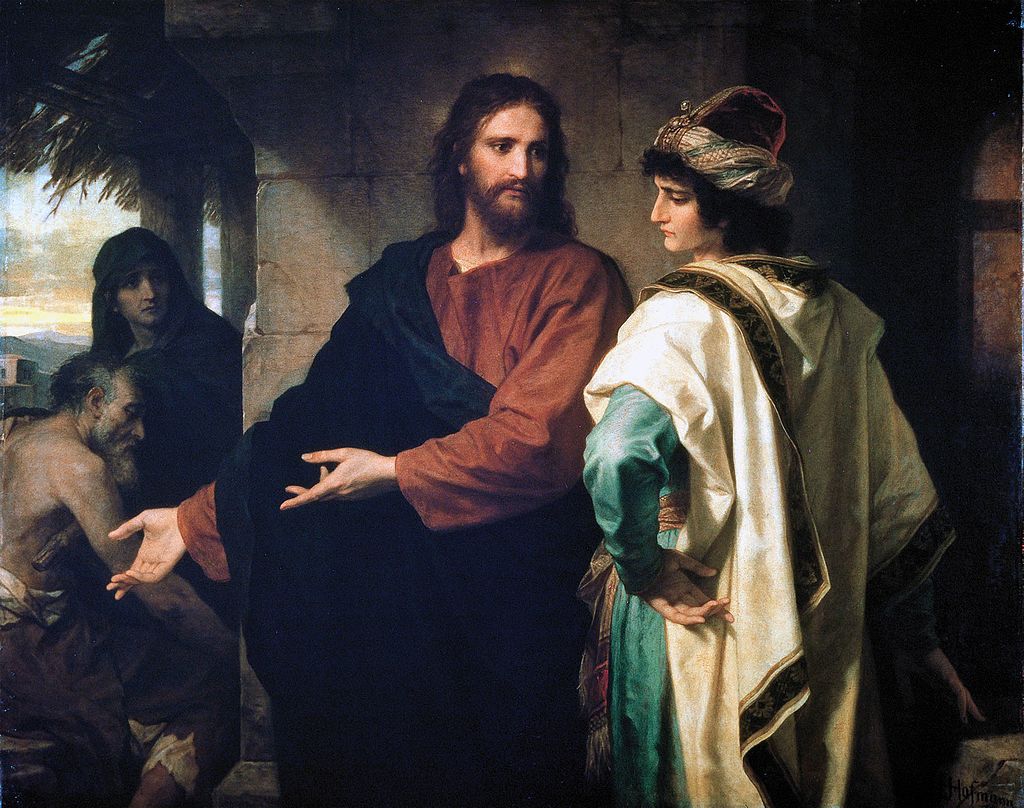
Heinrich Hofmann, Public domain, via Wikimedia Commons

Synopsis: Why is it so hard for a rich man to enter into the Kingdom of God? Jesus teaches us that it isn’t wealth itself that is the problem; it is our attitude toward our wealth that can cause us to feel estranged from God.

Scripture: Mark 10: 17-31

In today’s world, security is big business. People spend a lot of money on security. They buy insurance policies, contribute to IRAs and 401Ks, and invest in the stock market. They buy virus protection programs for their electronic devices and put security systems in place to protect homes and businesses. For example, there’s a company called Ultimate Security Systems, Inc. Its by-line is “Your one-stop shop for all your electronic security needs.”

Most people don’t lack knowledge of the things the world offers to help alleviate our anxiety about the future. However, what they do lack is the knowledge of what will help alleviate our anxiety about the future forever – of where our ultimate security lies – the one-stop shop for all our security needs.

That is what our scripture reading for today is all about. First, some context. Jesus went up a mountain with Peter, James, and John. There these three disciples witnessed Jesus transfigured and his speaking with Moses and Elijah. They return to the other disciples, and Jesus begins to prepare them for the last stage of his journey – Jerusalem and the cross.

On the road to Capernaum, the disciples had a heated discussion about who was the greatest among them. To deal with their pride, Jesus taught them that the greatest in his kingdom is humble like a child and welcomes the lowly. He also warned them of the grave cost of causing those who are vulnerable to fall into sin and of ignoring the sin within themselves.

Jesus left Capernaum and entered into Judea, where he is tested by the Pharisees with a question about divorce. People were also bringing children to Jesus to lay his hands on them and bless them. The disciples protested, but Jesus was indignant when he heard about it.

He told them, “Let the little children come to me; do not stop them; for it is to such as these that the Kingdom of God belongs. Truly I tell you, whoever does not receive the kingdom of God as a little child will never enter it.”

That brings us to our scripture reading for today. Jesus is now in Judea, and he is setting out on a journey toward Jerusalem. A man kneels before him and asks him, “Good teacher, what must I do to inherit eternal life?” Unlike the Pharisees, this man is not asking this question to test Jesus. His words and actions demonstrate that he has a lot of respect for Jesus, so we can safely assume his question is sincere.

Jesus reminds the man that no one is good save God alone. He then lists the commandments, but notice that all of them are the ones concerning our relationships with one another, not the ones regarding our relationship with God.

The man responds that he has obeyed those commandments since his youth. What do we think of this man? Is he lying, or self-deceived? Is he a hypocrite? The text tells us that Jesus gazed at him and loved him, so perhaps we should love him too. Perhaps he was “blameless with respect to righteousness under the law” as Paul states about himself in his letter to the Philippians.

The man is obviously a devout Jew. He keeps the commandments – at least the ones related to human interactions. But what about the ones that Jesus didn’t list – the ones about our relationship with God? Was it truly God alone he worshipped, or were there idols hidden in his heart?

Jesus’ challenge made the answer to that question clear, and the man walked away very unhappy. His relationships with other people were good, but his riches had gotten in between him and God.

Jesus’ comment on how hard it is for the wealthy to enter into the Kingdom of God leaves the disciples perplexed. To drive home his point, Jesus uses a shocking exaggeration: It’s easier for a camel to pass through the eye of a needle! We all know how small the eye of a needle is and how huge a camel is.

Why are the disciples so shocked? Well, they lived in a culture that associated wealth and power with divine favor. It’s that hard even for those who are the most blessed? If it’s that hard even for this man, an obviously law-abiding, socially-responsible Jewish citizen, who then can be saved?

Jesus’ response is perfect. “For mortals it is impossible” (We can’t earn our own way into the Kingdom of God), “but not for God; for God all things are possible” (We get there only through God’s grace).

You see, the man’s question itself revealed that he felt estranged from his Heavenly Father. Imagine if your children came to you and asked, “What must I do to earn my inheritance?”

They don’t have to earn it, right? They are entitled to it because they are your children. If they are asking you that question, you’d have to wonder if they had somehow forgotten who they are or if they believe that you have disowned them for some reason.

We are God’s children. We don’t need to earn the gifts God has graciously given us. He gives them to us simply because we are his children, and he loves us. The Kingdom of God is our inheritance, and that includes eternal life. All we need to do is remember who we are and God’s love for us. If we feel estranged, it is certainly not because God has rejected or abandoned us.

There’s nothing wrong with being wealthy, but if our wealth is more important to us than our relationship with God, then our attitude is keeping us estranged from God – not the wealth itself.

Peter asserts that he and the rest of the disciples had left everything behind to follow Jesus. Now, they were not rich like this man. Many of them were quite poor, like Peter, barely surviving as fishermen.

But whether they realize it or not, as followers of Jesus, they are now really living by God’s grace. They do not need worldly wealth because they are no longer estranged from their Heavenly Father and their ginormous family. All of Creation belongs to them, so they literally have everything they need: people (brothers and sisters; mothers and children) and things (houses and fields).

They will also face persecution because they reject the world’s values, but they will be the first to inherit eternal life because they are the last on the totem pole when it comes to who the world values. The world admires arrogant rulers, not humble servants.

What does this teaching have to say to us today? As with many of Jesus’ teachings, they are timeless, so this teaching is just as relevant today as it was in Jesus’ time.

Our relationship with God is just as important as our relationship with others, so if we somehow feel estranged from God, we can’t experience the bliss of our union with God.

We are a three-part being: body, mind, and soul. When we come into this physical existence, the soul takes on a body and a mind. Some call it the body-mind, and it’s written as “body dash mind.” The body-mind is what makes up the personal self: the body and what I call “the mind of me.”

The personal self is like a thread in the Tapestry of Life – a beautiful tapestry that expresses Who God Is. Think about how thin a piece of thread must be in order to fit through the eye of a needle. The thicker the thread is, the harder it is to fit it through there. If the Kingdom of God is like the eye of a needle, and the body-mind is like a thread, then if the body-mind is too thick, it won’t be able to fit through.

What makes the body-mind too thick? In short, anything that causes us to identify more with the personal self than with Who We Really Are. Those who practice Buddhism call these things “attachments.” The Buddha taught that attachments are the root cause of all our suffering. I believe Jesus is teaching the same timeless wisdom here.

The man in our scripture reading for today was attached to his wealth. Wealth gives us the ability to enjoy many worldly pleasures and material things. I’m sure this man didn’t want to give up the lifestyle that he had grown accustomed to. This is a bodily type of attachment. What would he do with himself if he wasn’t so busy indulging his desires and taking care of all of his accoutrements?

This man’s wealth not only kept him attached to pleasures and possessions, but it also kept him attached to his status. This is a mental type of attachment. Who would he be if he were not a rich man? If he was as poor as a pauper? He would be a nobody. He would be nothing – so he feared.

To better understand this rich man’s spiritual plight, imagine that you are an actor or actress. You are wearing a costume, and you are on a stage. You are acting in a play. Imagine that in this play, you are a very rich person. You are wearing very lavish clothing and jewelry. You are decked out like royalty!

And not only that, you also live a huge castle with a grand courtyard, and you get to go to feasts and eat and drink until you are about ready to explode. You get to take baths in luxurious hot tubs. You can have anything you want; people wait on you hand and foot.

As a good actor or actress, you really get into this role. You even do your best to think like this rich person with all his or her wants, needs, and fears. You take on the attitude of this rich person so that you can do a good job on stage. You want to do a good job expressing who this character is. That is your job, after all.

Now, imagine that this play is going on non-stop for many years, and because of that, you never really give yourself the chance to “get out of character.” Even when you step off the stage, you still feel the need to act, think, and feel as this character does. Over time, the memory of who you really are fades away.

That is the spiritual problem the rich man in our story has, and Jesus recognized this. The man is just playing the part of a rich man in God’s play so that God can experience what it is like to have and do all these things through him.

But since he has never taken the time to “get out of character,” he has forgotten who he is at the core of his being – without the costume and jewelry and other elaborate props. He has forgotten who he is without the “storyline” of a rich man’s life.

Jesus basically said to that man, “Step off the stage, leave all the props behind, take off your costume and jewelry, drop your storyline, and follow me. That is the only way to inherit eternal life – to experience the core of your being.”

If he had accepted Jesus’ challenge, he finally would have been free to find God within himself. The personal self can keep us quite busy if we let it – so busy chasing after all our worldly desires that we never have time to look within and find God there. We never “detach” from the world long enough to experience who we really are at the core of our being – within the eye of the needle.

But how do we make ourselves thin enough to slip through the “eye of the needle” – to step off the stage so that we can experience the core of our being?

Some believe that only in death are we able to detach from the personal self. Neale Donald’s Walsch, the author of Conversations with God, wrote a fascinating book called Home with God: In a Life that Never Ends. In this book, Neale has a conversation with God about death.

According to Neale’s book, we go through three stages when we die. The first stage is when we release our identification with the body. This happens when we come to the realization that we have indeed died, but we’re somehow still alive.

The second stage is when we release our identification with the mind. We experience our idea of the afterlife until we get to the point where we say to ourselves, “Surely, there must be more to the afterlife than this.”

That is when we come to the realization that we create our reality with our minds, but we are not the mind. Once we release our identification with the mind and our ideas about the afterlife, we experience the afterlife as it really is – which is, of course, far better than any limited ideas we held about it.

The third stage is when we release our identification with the soul – yes, the soul. The soul is not destroyed; it is simply reintegrated. We melt into the light of God, and we remember our total unity with God. We experience untold bliss in this moment, and we can stay here for as long as we want.

When we re-emerge, all three parts are integrated – body, mind, and soul as one.  At this point comes the Holy Inquiry. It’s the most important question of our existence. The question is this: “Do you want to stay?” Do you want to stay in the spiritual world, or go back to the physical world? If we feel there is something incomplete about our last life, we can return to it. If we choose to stay, we can enjoy the spiritual world for as long as we wish.

But every soul eventually decides to be reborn into physicality and to continue to experience its divinity in whatever way, shape, or form the soul chooses. That is what God does; he makes himself known through his infinite expressions, and as much as our personal self grumbles about life, the soul finds it a great joy to be able to experience its divinity in grander ways for all eternity. That is what soul growth is all about, and soul growth is what life is all about.

So, if we believe that we must die in order to experience release from the body and mind, then that is what we experience. But the truth is that we don’t have to believe that. We don’t have to wait until death. We can do it while we are still experiencing the body-mind in physicality.

How can we do that?

Well, some of you have may have already experienced it – at least for a moment. You may have felt yourself melt away and joined with All That Is. If not, that’s OK. All that matters is that you are willing to experience it. If you are willing, then by God’s grace you will have that experience because there is nothing God wants more than for you to return to him.

We set up the blockades – not God. Our blockades are fear-based. We are afraid of God because we have been taught many mistaken ideas about God. That is one of the reasons why Jesus came – to teach us that we don’t have to be afraid of God. In God lies our ultimate security – not in our bank accounts.

We need not fear having nothing because God gives us everything we need. All we need to do is ask, believe, and receive. And we need not fear being a nothing because in God we are literally everything. Everything there is! We have everything because we are everything!

Since the blockades exist in the mind, we can’t think our way back to God. That doesn’t work, trust me. Because I am a thinker. I analyze everything to death. The hardest thing for me is to stop thinking so much, and that’s the fastest way to experience the core of our being – to just live in the moment.

This sounds so easy, but it’s not so easy for humans because we are so addicted to the mind of me. We believe the mind of me is a good guide, and the mind of me does everything it can to pretend to be a good guide. But don’t be deceived: it is like a wolf in shepherd’s clothing.

Most of the things the mind of me has us worrying about and imparting its “marvelous” advice about are illusions. They are about a future which isn’t here yet and can’t be known. The Mind of Christ is the life expert; it guides us in the present moment. We can deal effectively with what is actually showing up, but we can’t deal with illusions.

So be willing, don’t think about it too much, and live in the present moment. That is how we can open ourselves to experiencing the core of our being – our unity with God – and the peace, love, and joy of our ultimate security.

Let’s pray together: Lord, we are willing to experience the core of our being by dropping the attachments that are causing us to feel estranged from our Heavenly Father. Make these attachments known to us, and give us the grace to live in the present moment. AMEN.

Resources

Vitalis Hoffman, Mark G. “Commentary on Mark 10:17-31.” workingpreacher.org, 11 Oct. 2015, http:\\www.workingpreacher.org/commentaries/revised-common-lectionary/ordinary-28-2/commentary-on-mark-1017-31-7

Walsch, Neale Donald. “Home with God: In a Life that Never Ends.” Atria Books, 2006.

No Rest for the Unweary

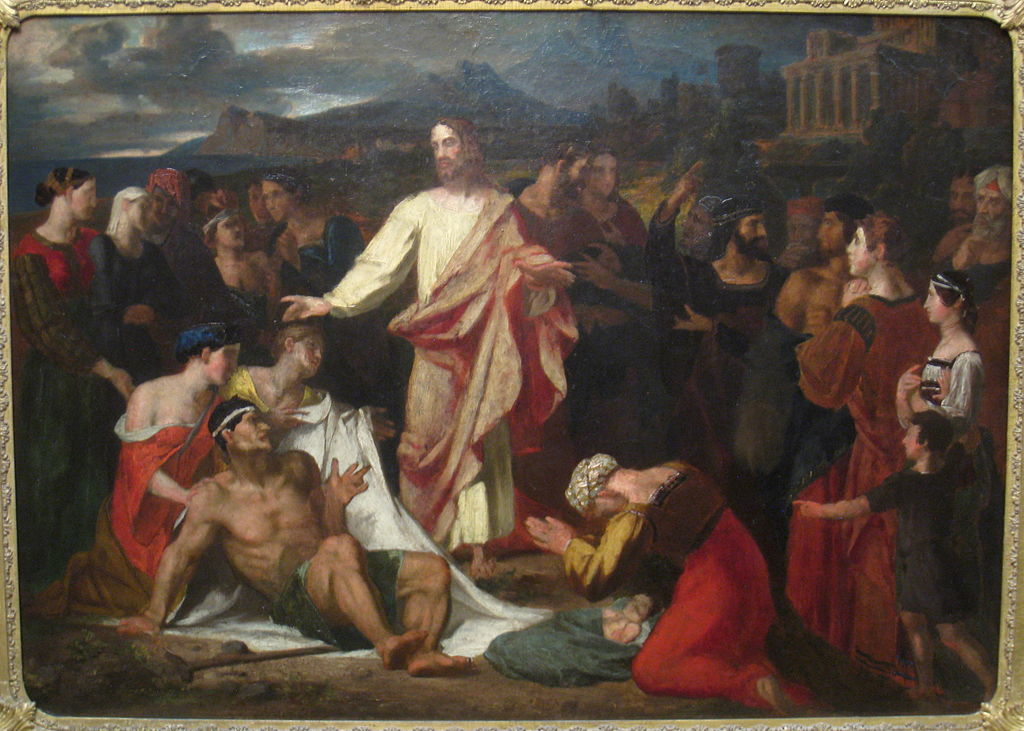
Washington Allston, Public domain, via Wikimedia Commons

Synopsis: How can we serve humanity like Jesus did when we are worn out? When we are disheartened by all the trouble in the world and overwhelmed by so much need? Jesus lived in times much like ours, yet he served humanity so tirelessly and so loyally that people thought he was out of his mind. How did he do it?

Scripture Reading: Mark 6: 30-34; 53-56

In spite of people suggesting that things have going “back to normal,” many are still in pain as a result of the events of recent years. Not only are some feeling the pain of the loss of loved ones and jobs, but all of humanity has been fed heavy doses of fear and hatred from a variety of sources for quite a long time.

This has caused many to embrace indifference at best and animosity at worst. Those of us in this room may be in pain too, and we may be tempted to protect ourselves by closing our hearts. We might feel it’s time to take care of ourselves and forget about others for a while. We’re just too tired. Worn out. We may want to just stick our heads in the sand because living in this world has become too painful.

Jesus lived in times much like ours. His world was full of corruption and greed. His world was full of hypocritical religious leaders. They talked about loving God and one another, but they didn’t practice it. They didn’t demonstrate it through their actions.

How do I know? Because when Jesus actually demonstrated it, people thought he was out of his mind.

How is it possible be like Jesus in times like this? When we’re feeling so tired and worn out? When there is so much trouble in the world that it is disheartening? When there is so much need that it is overwhelming? I believe our scripture reading for today provides the answer.

Our reading comes from Mark’s gospel, the most chronological of the four, meaning that the events are told in the order that they actually occurred in time. Mark focuses a great deal on Jesus, the servant. It’s an action-packed gospel. Much of what we read in Mark is about Jesus healing people and performing other miracles.

In the previous chapter, chapter 5, Jesus and his disciples came to the other side of the sea, to the country of the Gerasenes. There, he drove out a legion of demons within one man and healed a woman who touched the fringe of his cloak and a young girl who was at the point of death.

Chapter 6 begins with a lot of drama. First, Jesus is rejected at the synagogue in his own hometown because they thought they already knew him. They probably thought, “Who does he think he is, the Messiah? Hah! He’s just Jesus, Joseph the Carpenter’s son.”

That is what judgment does. It blinds us to the truth about people.

Then Jesus gave his disciples the authority to cast out demons, and he sent them out two-by-two, ordering them to take nothing with them but a staff, their sandals, and one tunic – no bread, no bag, no money, no extra tunic. The disciples went around the villages, proclaiming for all to repent, casting out demons, and healing people by anointing them with oil.

Finally, we read about the death of John the Baptist at the hands of Herod, well – actually it was his wife Herodias who was behind it. She trapped Herod with an oath he had made. When the disciples heard about it, they came and took John’s body and laid him in a tomb.

That brings us to our scripture reading for today which begins with verse 30, “The apostles gathered around Jesus, and told him all that they had done and taught.” Notice that Mark uses the word “apostles” here rather than “disciples.” The word “apostle” means “one sent” as messenger, authorized agent, or missionary. It would become an official title for Jesus’ 12 disciples after his resurrection.

Jesus and his disciples were so busy with people coming and going that they didn’t get a chance to eat. This is common theme in Mark’s gospel. Jesus – the servant – so dedicated to his work of caring for the needs of those who came to him that people thought he was out of his mind.

Jesus was not a workaholic, and he was not a slave driver. He knew when he and his disciples needed to rest, so he suggested that they find a deserted place where they could all rest.

Well, that didn’t really happen. It’s not easy to get away when there is such great need. Jesus and his disciples got in a boat to go to a solitary place, but the crowds saw where they were going and rushed to arrive there first.

It’s easy to view people with needs as a nuisance. We feel we don’t have the time, energy, or resources to serve them. But there is no better use of our time, energy, or resources than to help others. In fact, God put us on this earth to help others – to be his hands and feet in this suffering world. Nothing gives us more energy and joy than fulfilling our purpose. We just don’t know that.

But Jesus knew that. When Jesus saw the crowd, he wasn’t like, “Oh, come on! We need to rest! Leave us be!” He saw them as sheep without a shepherd. Sheep are helpless without a shepherd. The shepherd guides them and protects them from predators. And if a sheep ever ends up on its back, the shepherd has to pick it up and place it on its feet because sheep aren’t able to “right” themselves.

If it were not for the Good Shepherd, we would die because we aren’t able to live “right” by ourselves. Humanity is suffering not because the shepherd is absent. He’s there for every one of us, but there are too many people who don’t know him or who know him, but don’t follow him. Instead, they use him as an object of worship, or to glorify themselves, or to obtain material possessions, or to justify their hateful behavior.

Now, this Sunday’s lectionary curiously skips over verses 35-52, where Jesus feeds the five thousand and walks on water. Instead, it focuses on what happens immediately before and after these two events. What’s the point of this scripture split? We shall see.

We read in verse 53 that after they crossed over, they landed in Gennesaret, which was a small, fertile plain located on the west side of the Sea of Galilee. Capernaum, Jesus’ home, sat at the northern edge of this plain.

We read that the people recognized him, and brought people to him for healing, and he went all throughout the region healing people. I read verses 30-56, and the only time Jesus was able to rest was recorded in verse 46-47, where we read that he went up on a mountain to pray into the evening.

Can you imagine the energy in the air at that time – people’s immense faith and anticipation that Jesus can and would heal them – that he would free them from whatever it was that was keeping them from living their lives to the fullest? And he could! He was capable of doing that for them, and so he did. He served and served and served as if he somehow had an inexhaustible source of energy.

How did he do it, and how can we do it too as tired and worn out as we may feel right now? Well, first, let’s be clear. Jesus was out of his mind – out of the mind of me. He was operating out of the Mind of Christ. To the Christ, people’s call for love is irresistible. To respond to that call is as natural to the Christ as breathing is to us humans.

Many people believe that our strongest human instinct is survival, but the survival instinct is simply built into the physical brain. Since we are not really physical beings, our strongest instinct is actually spiritual: to express our Divinity. We express our Divinity by extending Love. That is one of the purposes for which God created us, but our human programming – the mind of me – often blocks that expression.

Now, I’m not saying that we “should” or “ought” to do anything. The “shoulds” and “oughts” come from the mind of me also. It’s the mind of me trying to tell us what to do and making us feel guilty if we don’t do it. It wants to control us so badly that it will even resort to disguising its ulterior motives as something spiritual.

The Christ will not tell us what we “should” or “ought” to do. If we truly get an impulse from the Christ to help someone, we will respond effortlessly and joyfully. We will not need to force ourselves to do it out of any sense of guilt or obligation.

We will also find no scarcity of time, energy, or resources to answer the call. That is why Jesus instructed his disciples to go into the villages with nothing but a staff, the sandals on their feet, and the tunics on their backs. It’s like he was saying, “I dare you to trust God to provide for your daily needs.”

Let’s go back for a moment to those skipped verses: the story of Jesus feeding the 5,000 and walking on water. What did Mark mean when he writes in verse 51-52, “Then he got into the boat with them and the wind ceased. And they were utterly astounded, for they did not understand about the loaves, but their hearts were hardened.

The answer is the point of our split scripture reading. When we are doing what it is that God created us to do – when we live fearlessly day-by-day, when we serve others in gratitude, we realize that we need not fear scarcity or the unknown. We need not fear running out of resources or energy or time or being faced with calamity without help. God is here for us and lovingly supplies all our needs.

Why wouldn’t he if we are doing what he created us to do?

Jesus didn’t have much time to eat or rest, but he obviously didn’t need it. Even though there was practically no rest for him, he was unweary. That’s because God supplies unlimited energy and resources to empower the Christ to do what Christ does – extend love. This is the lesson the Lord was teaching his disciples – and us.

That time of great trouble coupled with great need was the perfect time for Jesus Christ to come into the world the first time and do his work. We live in a time of great trouble and great need, so it’s the perfect time for the second coming of Christ and the arrival of the Kingdom of Heaven.

When Jesus came the first time, most people were not awake. That is not the case this time. People are awake; they just don’t know it. They think they are crazy because the rest of the world doesn’t appear to think or feel like they do. The truth is they do; they just don’t have the courage to act differently from everyone else. They don’t have the courage to speak and demonstrate the Truth.

I recently read a post from someone I knew when I attended the Unitarian Universalist Church of the Poconos years ago. She made a suggestion on her community’s Facebook group. She suggested that two single-stall park bathrooms be labeled for both male and female use instead of having one for men only and one for women only. 

Certainly, that would eliminate the difficulties transgender individuals face under those circumstances, and that’s important. But that’s not the only issue. You know how it is, ladies. There’s often a line for the women’s bathroom, but no one in the men’s bathroom. So, there you are, a woman who really needs to go, standing right next to an empty bathroom that you’re not allowed to use.

It was a practical suggestion, but people in the Facebook group attacked and ridiculed her. She was shocked. I was not because the same thing often happened to me when I posted a suggestion on the Easton community page. All I suggested was that people try to be a little more patient with others and stop obnoxiously honking their horns at people for the slightest little thing – like not stepping on the gas pedal the nanosecond the light turns green.

It is not easy to be different. It takes courage. I know there are more people out there who are like us then there are like those hecklers. They are just afraid of the hecklers. They are afraid to be ostracized. What they don’t know is how much they are loved by God – so who cares what silly humans think?

Jesus warned us that we would be persecuted, so we shouldn’t be surprised when we are. That’s the price we pay for picking up our cross and following Jesus. If we are really doing that, then we should not be acting like everyone else. Being heckled is proof that we’re doing what Jesus called us to do.

Because you see, it is what we do that will startle people into seeing the Divinity within themselves. That is what Jesus did. His actions said to people, “You see, you have the same power, the same potential within you to change the world for the better if you choose.”

There is another purpose why God created us beyond extending love. That reason is to be co-creators with Him. God gave us the free will to create whatever we choose – but now, because of all the ugly stuff that is being revealed, much of humanity is crying out to God, “Please God, help us change. This is not the life we wanted to live. This is not the life we wanted to create.”

We created out of ignorance, out of a lack of awareness, out of being asleep. The mind of me is what caused this sleep, and it works hard to keep us asleep, so it’s so important for us to be aware of it so that we can stay awake, and not keep falling back into the sleep of our default human programming.

We have turned our creative power over to others instead of claiming it for ourselves. We do have the power to create the life we want if we chose to act out of our Divinity. First, in our personal lives, we need to follow the promptings of the Divine to change the way we are living our lives. If there is something that isn’t working for us spiritually, we will know it by experiencing discomfort.

So, if we’ve started to feel some discomfort when we eat certain foods, or visit certain people, or watch certain TV shows, or read certain newspapers or magazines, or engage in certain habits, it means that these activities are no longer good for us. It’s important to notice that and make changes so that we can be better aligned with our True Self.

We can make deliberate choices around the foods we eat, the people we surround ourselves with, and the media we consume. We can make deliberate choices about how and where we spend our money, where and what kind of health care we receive, and many other lifestyle choices. Once we make those deliberate choices, then we do what we need to do to create the life we want. We have that power.

We also have the power to create the kind of world we want if we choose. We may think that we are just one person, so how can we create global change? Jesus was just one person. So was Mahatma Ghandi. Mother Theresa. Martin Luther King, Jr. and many other remarkable individuals who changed the world because they had the courage to act out of their Divinity – to not be like everyone else.

The mind of me is afraid of change, but the Mind of Christ embraces it. So let us ignore the mind of me’s fear embrace the Mind of Christ’s courage by answering the call and extending love to those crying out for love. Yes, those hecklers and anyone else who behaves badly are crying out for love because they are frightened.

Let us create the life we want to live – a life in alignment with our Divine Self – our True Self – beginning with our personal lives, making whatever changes we need to make so that our light can shine brighter in this world. Let people think we’re out of our minds. Let them heckle us. Let them ostracize us.

Eventually, they will see themselves – their True Self – reflected in our loving eyes and in our loving actions and in the loving ways in which we chose to walk on this earth.

Let’s pray together: Lord, we are willing to take up our cross and follow you. We are willing to put our trust in God to provide for our daily needs. Help us to release our fears, open our hearts, and answer the call for love.

Resources

Life Application Study Bible. Zondervan, 2011.

John 2021

Source: https://teachingcatholickids.com/st-john-the-apostle/

Scriptures: 1 John 3:1-10

Synopsis: When the apostle John wrote his first epistle, times had been tough for his audience of first-century Christians. He wrote the letter to give them assurance, encouragement, and warnings. Times are tough for us twenty-first century Christians as well. If John were alive today to write us a letter, what would it say?

Our scripture reading for today comes from First John. Now, John also wrote the Gospel of John, but our reading comes from the first of three letters he wrote. These letters, and others like them in the New Testament, are known as epistles.

Some epistles are written by other authors in the name of apostles. But first John is believed to have been written by John himself somewhere between 85-90 AD. John is known as “the disciple Jesus loved.” He was one of the sons of Zebedee. Jesus, during his crucifixion, asked John to take care of his mother, Mary. He, his brother James, and Peter were the Lord’s closest confidants.

John wrote this letter to several gentile congregations in order to reassure them in their faith. Times were tough. Both Christians and Jews had been suffering under heavy Roman persecution. The Romans had captured Jerusalem and destroyed the second Temple. By the time John wrote this letter, he was the only apostle left; the others, including the apostle Paul, had all been martyred.

As an elder statesman in the church, John addresses his audience as “dear children” and opens his letter with his credentials: He experienced Jesus for himself. He saw Jesus heal, heard him teach, watched him die, met him arisen, and saw him ascend. He witnessed Christ revealed through the man Jesus. You see, John also wrote this letter to counter a false teaching going around that Jesus was not the Christ.

What’s in this letter for us? Do we need assurance? Do we need encouragement? Do we need to be “set straight” on certain matters of belief? Times have certainly been tough for us nationally and globally. Nationally, we’ve experienced political and social strife. Globally, we’ve lost many lives due to the pandemic, and many are grief-stricken. And we’ve heard so much conflicting information that it’s hard to know what to think. If John were alive today, in 2021, to write us a letter, what would it say?

Christians often think that if God really loves us, life should be easy. But just as life wasn’t easy for John’s audience of first-century Christians, it’s not easy for us twenty-first century Christians. When we’re suffering so much, it’s tempting to doubt God’s love for us.

But just as John assured his audience, I believe he would assure us that God loves us because we are his children. That is who we are whether we know it or not, or whether we accept it or not. Our worth is firmly and forever established through our relationship with God. We don’t have to do anything to earn it. God’s Love has been given to us as freely.

Those of you who have children – would you make them earn your love? Of course not. You give it to them freely because they are your children. If you, as imperfect human beings, would love your children unconditionally, why do we doubt God’s love for us?

Christ is God’s Image – the face of God. Every human being is part of God’s Image, which he judged to be good. There is a wonderful story called “The Vessel” in the Talmud. The Talmud is the central text of Rabbinic Judaism and the primary source of Jewish religious law and Jewish theology.

The story begins like this: Once Rabbi Elazar son of R. Shimon was coming from Migdal Gedor, from the house of his teacher. He rode along the riverside on his donkey, and was feeling happy and elated because he had studied much Torah.

There chanced to meet him an exceedingly ugly man, who greeted him, “Peace be upon you, my master!” R. Elazar did not return his salutation but instead said to him, “How ugly you are! Are all the people of your city as ugly as you?” “I do not know,” said the man. “But go to the craftsman who made me, and say to him: How ugly is the vessel which you have made!”

You see, we can’t reject any part of God’s Image without rejecting God. People who do not know or accept this truth do not know Christ. They believe worth is earned through the accumulation of wealth, power, or fame – or through belonging to the “superior” gender, race, religion, culture, or whatever.

No matter how much wealth, power, or fame they have, and no matter what “elite” group they belong to, they still don’t feel good about themselves. That’s because what they choose to believe doesn’t change the fact that our worth is established through our relationship with God only.

Anyone who considers himself or herself to be inferior or worthless does not know Christ. Anyone who considers another human being to be inferior or worthless does not know Christ. If we know who we are, then there is no doubt that we are worthy – no doubt that we are all are equally loved by God.

If we believe that all are worthy and equally loved by God, then we can accept that whatever happens in our lives is for our good. If we are all children of God, then God’s grace must be involved in our national and global lives as well as in our personal lives.

We know from the life of Our Lord that God may not deliver us from suffering; suffering is sometimes necessary for healing and new life.

Jesus suffered because he cared. He knew the reason why we suffer – because we sin. But he didn’t say, “Not my sin – not my problem.” He took on the sins of the world. His heart broke for the suffering of humanity ensnared in sin. Our hearts should be breaking too, but with compassion, not with judgment, or helplessness or hopelessness.

In John chapter 16:33, Jesus said, “I have said this to you, so that in me you may have peace. In the world you face persecution. But take courage; I have conquered the world!” We can have courage and peace while our hearts are breaking because he who conquered the world lives within us.

John writes in verse 2, “What we will be has not yet been revealed. What we do know is this: when he is revealed, we will be like him, for we will see him as he is.” Similar to what Paul writes in 1 Corinthians 13:12: “For now we see only a reflection as in a mirror; then we shall see face to face. Now I know in part; then I shall know fully, even as I am fully known.”

What do these verses mean? I believe they mean that we will see Christ in all his glory when all of humanity has become like him. We will see him literally face-to-face – in our own face and in the faces of others – glowing out of the loving eyes of every brother and sister on this planet just as they see Christ glowing out of our loving eyes.

This should motivate us to purify ourselves. I believe these past few years have been like a crucible for humanity. When gold is purified, it is burned in a crucible over a very hot fire. We are purified in the same way. Through stress. And we’ve had lots of it.

And that brings us to a subject we don’t like to talk about: sin. I believe John would tell us the same thing he told his first-century Christian audience: Don’t fool yourself. We all struggle with sin. I love what James wrote in his letter in chapter 4, verse 8: “Draw near to God, and he will draw near to you. Cleanse your hands, you sinners, and purify your hearts, you double-minded.”

Here is the rest of that story “The Vessel.” Realizing that he had done wrong, R. Elazar dismounted from his donkey, prostrated himself before the man, and said to him, “You are right. Forgive me!” But the man replied, “I will not forgive you until you go to the craftsman who made me and say to him, ‘How ugly is the vessel which you have made.’”

R. Elazar kept on walking after him until he reached his city. The residents of the city came out to greet him, saying, “Peace be upon you, O Teacher! O Master!” Said the man to them, “Whom are you calling ‘Master’?” Said they, “The person walking behind you.

“Said he to them: “If this is a ‘Master,’ may there not be any more like him in Israel.” “Why?” asked the people. Said the man: Such-and-such he has done to me. “Nevertheless, forgive him,” said they, “for he is a man greatly learned in the Torah.” “For your sakes I will forgive him,” said the man, “but only if he does not act this way anymore.”

Soon after this, R. Elazar entered the study hall and taught: “A person should always be pliant as the reed, and let him never be hard as the cedar. And for this reason, the reed merited that of it should be made a pen for the writing of the Torah.”

R. Elazar was proud of himself for studying much Torah, just as there are many Christians today who are proud of their knowledge of the Bible. But what good is that knowledge if it doesn’t deepen our love of God or lead us to the knowledge of Christ?

The man R. Elazar called ugly didn’t let him off the hook with a simple “I’m sorry.” He needed to make a commitment to change. We must make that commitment also. We can’t have our cake and eat it too. We can’t love God and our sins. If we want the world to be a better place, we must start with ourselves.

If there were a false teaching for John to confront today, it would be the lie that some people’s lives don’t matter – whether it be women, people of color, incarcerated people, poor people, members of the LGBT community, immigrants, etc.

Every human life matters. No one’s life matters more than another’s. Every human being deserves to enjoy the gifts of Creation God gave us out of his love for us – for all of us. We all deserve equal opportunities and access to an enjoyable, fulfilling life. We should fight for it not only for ourselves, but for others because they deserve it too.

John writes, “Little children, let no one deceive you. Everyone who does what is right is righteous, just as he is righteous.” In Judaism, righteousness refers specifically to helping others. A righteous person does whatever he or she can to help those who are in need.

In Matthew 7:15-20 Jesus said, “Beware of false prophets, who come to you in sheep’s clothing but inwardly are ravenous wolves. You will know them by their fruits. Are grapes gathered from thorns, or figs from thistles? In the same way, every good tree bears good fruit, but the bad tree bears bad fruit. A good tree cannot bear bad fruit, nor can a bad tree bear good fruit. Every tree that does not bear good fruit is cut down and thrown into the fire. Thus, you will know them by their fruits.”

Anyone who ignores the needs of others or works to limit people’s access to life’s basic resources does not know Christ no matter what religious beliefs they claim.

John writes, “Those who have been born of God do not sin, because God’s seed abides in them; they cannot sin, because they have been born of God.” What does John mean? I believe he means that if we are like Christ, we would never sin. However, most of us are still in the process of becoming like Christ.

We all struggle with areas where temptation is strong and habits that are hard to break. If we ignore these areas, we are choosing to keep our distance from God. But if we are trying our best to be more like Christ, we do not intentionally sin. We do not cherish certain sins and continue to commit them.

John calls sin “lawlessness.” As a Jew, John recognized the Torah as law. In Matthew chapter 22:36-40, we read that a Pharisee asked Jesus, “Teacher, which is the greatest commandment in the Law?” Jesus replied: “‘Love the Lord your God with all your heart and with all your soul and with all your mind.’ This is the first and greatest commandment. And the second is like it: ‘Love your neighbor as yourself.’ All the Law and the Prophets hang on these two commandments.”

John doesn’t mince words when he writes to his first-century audience, and I believe he would be just as straightforward today. There’s no wriggle room in verse 10 where he writes, “All who do not do what is right are not from God, nor are those who do not love their brothers and sisters.”

I believe that if John wrote us a letter today, he would in his own fatherly way reassure us of God’s love and wag his finger at us to beware of sin and of wolves in sheep’s clothing. Trust in God’s word, he would say, not in the word of human beings.

We usher in the Kingdom of Heaven and the end of suffering when we all learn to love one another. Christ’s seed has been planted within the fertile ground of our hearts. As it grows, we become more like him. The seed needs the light of God’s love, the water of our repentant tears, and plenty of support from our brothers and sisters around us.

Let’s pray together:

Father, we know we are your children, and we accept that you love us even though we have suffered a lot. We acknowledge that we suffer because of our lack of love for one another. We are willing to change so that we may become more like Christ, who was created in Your Image, the image of Love. Amen.

Resources

Life Application Study Bible. Zondervan, 2011.

“The Vessel (Talmud, Taanit 20a–b).” Chabad.org, www.chabad.org/library/article_cdo/aid/909930/jewish/The-Vessel.htm.

The Hard Spiritual Lesson of Donald Trump’s Presidency

Image Creator: Adam “Kimded” Howie at https://images.app.goo.gl/rA1now6QECoFciRX7

Disclaimer: This is my personal opinion. It is not necessarily the opinion of the members of the church I serve or other organizations for which I am employed.

The best-learned lessons are often the hard ones, and Donald’s Trump’s presidency has brought into sharp focus the ego-consciousness that humanity must evolve beyond in order to survive.

Ego-consciousness developed out the primitive reptilian centers of the brain. Its primary focus was originally physical self-preservation: to protect us from bodily harm. That came in handy when we needed to run from saber-toothed tigers. But once we no longer needed to worry about being eaten by predators, ego-consciousness shifted its primary focus to psychological self-preservation: to protect our self-image from harm.

That shift has caused a lot of problems for humanity.

Our self-image (or ego) is the ideas we hold about who we are, but those ideas are just that. As Shakespeare wisely quilled, “All the world’s a stage, and all the men and women merely players ….” Our bodies and self-image are just as unreal as the costumes and characters of a play. When our time on stage is over, we hang up our costumes, retire our character, and return to who we really are – Life itself.

When Jesus said in “I am the Way, the Truth, and the Life …” (John 14:6), he meant that we are not humans experiencing life; we are Life experiencing itself as human – the One experiencing itself as many. Since we are Life itself, we do not die; we simply keep experiencing ourselves through an infinite variety of costumes and characters.

Life supports all of Life. Every aspect of life is equally worthy of care because Life is One. When we accept this truth and begin living our lives according to it, we leave behind ego-consciousness and enter into Christ-Consciousness (or Unity Consciousness).

The ego sees itself as separate from the rest of life; therefore, it perceives life as “the enemy.” It hates life because it doesn’t always cater to its desires. Whenever life doesn’t go the ego’s way, it feels “cheated,” then it does whatever it can to get its way – no matter the cost.

That makes the ego Life’s enemy – not the other way around.

Trump is obviously strongly attached to his self-image, particularly the idea of being a “winner.” In his mind, if he is a “winner,” then it is impossible for him to lose. Conceding to any loss would cause the annihilation of his “winner” self-image, so he must do everything he can to defend himself against the idea that he lost – no matter the cost.

Losing is like a saber-toothed tiger to his self-image.

No one can win all the time, so we can imagine the unbearable pressure this must put on Trump and those like him. People who are in tremendous pain cause tremendous pain for others. We need to have compassion for them while holding them accountable for their harmful behavior. We also need to increase our own awareness of ego-consciousness operating within us so that we can let it go.

That is the only way to be at peace with ourselves, others, and all of life.

Harvesting and Sharing

Philipp Peter Roos, Public domain, via Wikimedia Commons

Synopsis: In the Parable of the Sheep and Goats, Jesus does not give us the right to judge others. Instead, he teaches us the importance of distinguishing between our goat-like human nature and our sheep-like divine nature so that we can consciously choose which nature to express in each present moment experience.

Scripture Reading: Matthew 25: 32-46

Our scripture reading for today comes from the end of Matthew chapter 25, a section entitled, “The Judgement of the Nations.” I myself have never considered this a parable, but some call it “the Parable of the Sheep and Goats.” Many Christians love this parable because it seems to say that all the evil people will be thrown into hell. Serves them right!

Unfortunately, because of this passage, many Christians have felt they have the right to say to others, “You’re going to burn in hell,” or the less harsh but just as judgmental version, “I’m concerned that you won’t be in heaven with me.” Jesus taught us in so many other verses NOT to judge one another, so there must be another way of interpreting this passage.

Before we take a closer look at it, let’s look at the context.

In Matthew chapter 25 Jesus tells two parables to illustrate his teachings in the previous chapter on the importance of being prepared for his coming. He warned his disciples not to be deceived by false Messiahs or presumptuous predictions and not to be alarmed by wars, rumors of wars, or natural disasters, for these are simply the birth pangs.

Jesus told both of these parables close to the time of his arrest and crucifixion. They both include a long period of waiting before the master returns and consequences for not being prepared.

We took a look at the first parable, the Parable of the Ten Bridesmaids, where Jesus teaches that only those with the “oil” of spiritual resilience are empowered to keep shining their lights in the darkness and are prepared to participate in the celebration when Christ returns to establish the Kingdom of Heaven.

In the Parable of the Talents, Jesus teaches that only those with this empowering faith will enter into the joy of the master because they will put the gifts God has given them to work to profit His Kingdom.

And that brings us to the end of chapter 25 with what some consider a third parable, the Parable of the Sheep and Goats. Jesus once again begins with the setting, but rather than creating a fictional one, Jesus opens with a non-fictional one – a real event – the coming of the Son of Man, who is seated on the Throne of His Glory as King and judge of all the nations, placing the sheep on his right hand and the goats at the left.

Jesus’ disciples would have been familiar with this setting because in Matthew 19:28-30, Jesus tells them that at the renewal of all things, when the Son of Man is seated on the Throne of His Glory, they will each sit on twelve thrones, judging the twelve tribes of Israel. All those who have left their families and vocations for his sake will inherit eternal life. The first will be last, and the last will be first.

Jesus’ disciples also would have been familiar with the importance of separating sheep and goats. During the day, sheep and goats often mingle as they graze. At night, they need to be separated because they have different needs. Prior to specialized breeding, it wasn’t easy to tell the difference between a sheep and a goat because they look very similar, but a good shepherd could tell the difference.

Who are the sheep that Christ the King places at his right hand? To get a clue, let’s talk about what real sheep are like. Sheep are extremely dependent upon their shepherd. If they get rolled onto their backs, the shepherd has to lift them back up on their feet because they will die. They can’t “right” themselves. They are also easily panicked to the point where they would run themselves right off a cliff.

Sheep depend upon their shepherd for the basics of life – for food, water, shelter, and protection from predators. But even though they are so dependent on the shepherd, they still have a tendency to go astray. A shepherd must find lost sheep, or they will die because they are essentially defenseless.

Shepherds lead sheep, and the sheep listen intently to the shepherd’s voice. Sheep are very calm in the presence of the shepherd because they trust the shepherd. With the shepherd, life is easy: All they have to do is listen and follow.

We are the sheep; we belong to God. We are completely dependent on God for all our needs. Because we are not of this world, we are vulnerable – not because we are weak, but because we are gentle ones living in a harsh world. Without a shepherd, we can be easily frightened, go astray, and become prey to malicious people or evil tendencies.

God has appointed the Good Shepherd to take care of us. In Mark 6:34, we read, “As Jesus went ashore, he saw a great crowd; and he had compassion for them, because they were like sheep without a shepherd; and he began to teach them many things.”

Christ the King says to the sheep, “‘Come, you that are blessed by my Father, inherit the kingdom prepared for you from the foundation of the world; for I was hungry and you gave me food, I was thirsty and you gave me something to drink, I was a stranger and you welcomed me, I was naked and you gave me clothing, I was sick and you took care of me, I was in prison and you visited me.”

People get confused by these verses because it sounds as if the Lord is giving salvation to those who earned it through good works. But we know that we are not saved “by” good works. We are saved “unto” good works – “released” to do the good works God gave us to do.

The sheep are confused by the King’s reward because they do not recall ever having seen their Lord hungry, thirsty, lonely, naked, sick, or imprisoned. But because they did good works for “the least of these,” they did it for the Lord. The “good work” that God created us to do in Christ is to love and serve the Christ in all. We love our neighbor as we love ourselves because in Christ our neighbor is our Self.

Who are the goats the King places at the left? To get a clue, let’s talk about what real goats are like. Goats are very independent. If they want to do something, they’ll do it whether you like it or not. For example, goats love chewing on hair. A goatherd might punish a goat or chewing on his hair, but if he took a snooze out in the field, he’d probably wake up with less hair and a very happy goat.

Goats also have a huge appetite; they will eat anything. A goatherd has to be careful not to let a mother goat eat her young’s food because a mother goat will use her head to shove her young out of the way to eat their food – basically letting their own young starve.

Goats are extremely selfish; they want what they want, and they don’t care if they destroy things to get it. Goats generally don’t need protection from things; things generally need protection from goats. And goatherds don’t lead their goats; they follow their goats because the goats just browse around looking for whatever they feel like devouring, and the goatherds just do their best to protect the environment.

Christ the King says to the goats, “You that are accursed, depart from me into the eternal fire prepared for the devil and his angels; for I was hungry and you gave me no food, I was thirsty and you gave me nothing to drink, I was a stranger and you did not welcome me, naked and you did not give me clothing, sick and in prison and you did not visit me.”

Just like real goats, these ill-fated ones led very selfish lives. They wanted what they wanted, and they didn’t care if they destroyed anyone or anything in the process. They were not “released” from their self-absorption and selfish desires. They rejected God’s love, so they did not depend on Him to provide for their needs. Instead, they relied on themselves while trampling on others.

The goats defend themselves using the same words the sheep used to humble themselves. When did we see you hungry, thirsty, lonely, naked, sick, or imprisoned? We can’t say that these “goats” didn’t do ANY good deeds. Perhaps they did, but they did them selectively – perhaps only for people they liked – or perhaps for the wrong reasons. We know that not all good deeds are done without strings attached. Perhaps they expected things in return for their good deeds or used them to manipulate or shame others or simply to make themselves look good.

In verse 46, we read, “And these will go away into eternal punishment, but the righteous into eternal life.” This is the verse where Jesus appears to say that all the evil people will be “thrown into hell.”

God created humanity in his image, so I believe that every human being, whether saved or not, has a soul that is eternally connected with God and with all of Life. That God would reject and destroy a part of Himself doesn’t make sense to me. However, since God has given us free will, we are free to make our own choices and to experience their consequences.

I believe that as more of humanity joins with Christ, the Earth will begin to move toward the Kingdom of Heaven. As the light and love of God grows to be more and more prevalent, those souls whose hearts have not embraced the light and love of God will choose to leave the earth and/or reincarnate on some other planet where there’s more souls like them. Eventually, they will all be gone.

But they will condemn themselves to a hellish world because their hearts are not prepared to live in a heavenly world. They won’t be able to tolerate it or operate within it. But God will never give up on these souls and will eventually gather them back to Him through the irresistible Power of Love.

What does this parable have to teach us today?

I don’t believe it is giving us permission to try to judge one another a sheep or goat. Human beings don’t have specialized breeding, so it is truly difficult to tell which is which. We all have our opinions, of course, and we are entitled to them, but do we really know? We can’t see inside people’s hearts – but God can, and he has given Christ, not these personal selves, the authority to be the judge.

We are part human and part divine. The human part is temporary; the divine part eternal. But in this life experience, you could say we are part goat and part sheep. That’s not a problem because God created us that way for a purpose. There is a place for our human side and a place for our divine side – just like there is a place for goats and a place for sheep in this world.

We can’t be whole if we don’t accept both parts of ourselves. I believe Jesus is teaching us that the key is to be able to distinguish between the two parts of ourselves – and be fully aware of both parts – so that we can choose which part to express in every present moment experience.

Without this knowledge, we have no choice, and that has been the problem. We have not been aware of our divine side, so our human side has taken too much control over our lives. Our human side has become our common expression and our divine side the rare one. It should be the other way around.

Since we are not shepherds, it’s harder for us to relate to this setting. How many of you are gardeners? When you go out into your garden to harvest, you might notice that some weeds have cropped up in some places or that some of the fruits or vegetables got infested with blight or bugs or maybe a groundhog stole your cabbage.

As a gardener, you pretty much accept that these things go with the territory of gardening. You really don’t have a choice because if you choose not to accept it, you’re only setting yourself up for a whole heap of frustration and disappointment, which can really zap the joy of gardening right out of you.

We should have that same level of acceptance when we look within the garden of ourselves and notice the weeds of ingratitude, the blight of intolerance, the bugs of resentment, and fear – that sneaky thief that steals our joy. These aspects of our human side are within us along with all of the wonderful spiritual produce we have inside us by the grace of God.

As a gardener, you know that when you go out into your garden to harvest the good fruits and vegetables you have grown, you often have more than you need, so you probably enjoy sharing the extras with your family, friends, and neighbors.

It’s because of our divine side that there is an infinite supply of wonderful spiritual produce to share with the world. So, we can enjoy the challenge of being human.

If we look within and see jealousy, impatience, intolerance, meanness, or even hatred, we simply need to recognize that these things are not things we want to extend to others if we are preparing our hearts and the hearts of all for the Kingdom of Heaven.

As a gardener, you know that you need to do the work to look for the weeds and the infected and infested plants, pull them up, then trash or burn them, and you need to create barriers to keep the sneaky thieves out. Otherwise, all these things can do a lot of damage to your garden.

But you don’t necessarily judge yourself a bad gardener because you need to do these things. You know it just goes with the territory of gardening. In fact, you might even enjoy the challenge of figuring out how to win these battles for an even better garden because hey, there’s always another season.

Just as there are many different types of produce, there are many different manifestations of love within us that we have to share, such as patience, kindness, compassion, understanding, forgiveness, and gratitude.

We don’t realize it, but there is a huge number of opportunities to extend love every day. If you wake up in the morning, and your spouse is grumpy, extend forgiveness. If you listen to the news, and it makes you want to cry, extend compassion. As you’re enjoying your morning cup of coffee, extend gratitude. If you went out the door and forgot your mask – again, extend kindness. If the car in front of you is moving too slow, extend patience.

So, let us take advantage of every opportunity to extend love. God is calling us to share love with others – especially those who most need love – the poor, the stranger, the sick, and the imprisoned. People need it more than ever right now. When we share love, we demonstrate who we belong to – that we belong to God – that we are the sheep of his pasture – and that we want to live in a world ruled by love.

Let’s pray together: Lord, we get so caught up in our own lives and needs that we often fail to notice those who are struggling in their lives, those who are in need. Help us to slow down, be present, and be ready extend love because in this way, we move the earth ever closer to the Kingdom of Heaven. Amen.

Resources

“What is the Meaning of the Parable of the Sheep and Goats?” gotquestions.org, www.gotquestions.org/parable-sheep-goats.html

Hooper, Jodi. “11: The Sheep and the Goats (Matthew 25: 31-46).” Bible.org, 21 Jun. 2012, bible.org/seriespage/11-sheep-and-goats-matthew-2531-46

Spiritual Resilience

Hieronymous Francken II, Public domain, via Wikimedia Commons

Synopsis: How do we keep the oil of our spiritual resilience stocked in dark times so that we are prepared for Christ’s coming? We do what Jesus did in times like these: We surrender to our feelings and to the unknown, trusting in God’s promises.

Scripture reading: Matthew 25: 1-13

How many of you have experienced being “on call?” When I was in my twenties, I was an Emergency Medical Technician for Barrett Township Volunteer Ambulance Corp. When I was “on call,” I had to be ready to go at a moment’s notice. I didn’t know if we were going to get a call that day, but I had to be prepared and expectant.

Jesus uses the Parable of the Ten Bridesmaids to make a point about the importance of being prepared and expectant for Christ’s second coming.

You might remember that Jesus told parables to make a point, so it’s important to know the context to understanding its meaning. Since the Parable of the Ten Bridesmaids begins Matthew chapter 25, the context is in the previous chapter.

In chapter 24, after Jesus predicts the destruction of the Temple, the disciples began questioning him about the signs of his coming at the end of the age. They assumed the destruction of the Temple would herald the End Times, but the Lord warned them about making such predictions.

He warned them not to be deceived because it might be some time before he returns. He said to them that many will proclaim themselves to be the Messiah, and there will be wars and rumors of wars, but these are simply the birth pangs.

Using the example of the fig tree, Jesus taught his disciples to be watchful for signs of the “season” of his coming, and to be expectant, but no one knows the day or hour.

The setting of this parable is a Jewish wedding. To get an idea of what’s going on, it’s somewhat helpful to understand a first century Jewish wedding, but we can’t take what happens literally since Jesus is using it as a literary device. Like any good storyteller, he might twist or embellish facts a bit to make his point, even leave out major elements that aren’t relevant to the point – like any mention of the bride!

A Jewish wedding begins with the groom leaving his home to go to the bride’s home where certain rituals would take place. After nightfall, the bride and bridesmaids would process through the streets to his home, the bride’s new home, where the marriage celebration would take place over several days.

Everyone in the procession must carry a torch; otherwise, they might be considered party crashers or bandits. They are expected to meet the groom on his way to his house, but no one could predict exactly when the groom would arrive at the meeting place.

In the previous chapter, in verses 37-39, Jesus says, “When the Son of Man returns, it will be like it was in Noah’s day. In those days before the flood, the people were enjoying banquets and parties and weddings right up to the time Noah entered his boat. People didn’t realize what was going to happen until the flood came and swept them all away. That is the way it will be when the Son of Man comes.”

The bridegroom doesn’t arrive until quite late in the evening, so they all fell asleep waiting for him. When I was on call overnight, sometimes I would stay at the ambulance building, and sometimes I would stay at home. Either way, I would go to sleep, but before I went to sleep, I made sure my uniform was ready to be slipped on, and my gear bag was packed and ready to go.

The bridesmaids had all fallen asleep, but they are awoken with a shout as the groom finally arrives at midnight. That’s when we learn that some of them weren’t prepared. When they get up to trim their lamps, the foolish say to the wise, “Give us some of your oil, for our lamps are going out.”

The Reverend Bob Diffenbaugh sheds a lot of light on this lamp issue – pun intended. First, he explains that the “lamp” they used isn’t the kind of lamp we think of when we hear the word. The Greek word, “lampas,” is more of a torch. It was just a large, flat bowl with a rag or rope-like wick that could be attached to a pole to light one’s way in the darkness.

Next, he notes that New English Translation Bible states that the word “extra” is not used in the original Greek – which is also true of the version we use. Some translations, such as the New Living Translation, suggest that the foolish ones took oil with them, but not enough. If that were the case, why would all of their lamps be “going out” at the same time?

Rev. Diffenbaugh concludes that they must not have brought any oil with them. He writes, “There must have been some residue of oil on the rag or wick of the five empty lamps, which quickly burned out, only moments after being lit. This would explain why all five torches went out at the same time. Perhaps, too, these foolish [bridesmaids] minimized their foolishness by describing their plight as ‘running out’ so as to look less foolish.”

If I agreed to be on call for the ambulance corp., I had to be ready to respond – period. No excuses. That meant I couldn’t leave the area because I needed to be able to get to the ambulance building quickly. I also couldn’t get delayed in any way. Little things like sitting in the drive thru at Burger King would be a problem if my pager suddenly went off. It wouldn’t cut it to say, “Sorry I missed the call. I wanted a Whopper.”

The foolish bridesmaids’ excuse for “running out” didn’t cut it either. They were supposed to be prepared. It might seem cold that the wise bridesmaids didn’t help them out, but they couldn’t.

So, the foolish bridesmaids went out to buy more oil, but by the time they got to the groom’s house, the celebration was already underway. The door was shut. They were too late. The groom probably thought that since they didn’t arrive with the other bridesmaids, they were imposters trying to crash the party.

How can we apply this parable to our lives today?

Let’s be honest. We are living in a very painful and chaotic world right now. Many are dying, many are grieving, many are afraid, and many are angry. What should be our response? What should we say to people? How about what Jesus said in times like these: “My soul is overwhelmed with sorrow to the point of death. Remain here and stay awake with me.”

If any of you are feeling great sorrow today, it’s OK. It’s totally appropriate. It doesn’t mean you’ve given up on the world. It just means your heart is wide open. You haven’t become numb through it all. You’ve been very brave.

Jesus felt great sorrow in the Garden of Gethsemane the night before he accomplished his redemptive work. Even though he felt great sorrow for the world, he still had hope because he trusted in God’s promises.

Christ first came in one individual named Jesus to introduce humanity to who we really are. I believe Christ will come the second time not as a single person, but in a multitude of people. That is the only way that Christ can be revealed in all His Glory. Since His Glory is in each of us, all of it must be in all of us.

There is only one thing that will save the world, and that is the love of God. God’s Love is made known through Christ. Christ dwells within every living thing, but only human beings have the capacity to make God’s love and creativity more fully known in this physical world.

For the world to be saved, we need enough wise people to meet the Christ and to join with him in the procession back to his home, the True Self. 

As an EMT, I remember how awesome it felt to save someone’s life – to be part of a team of people that saved someone’s life. Maybe some of you have had that experience and remember how awesome that feels.

Imagine how awesome it will feel to be part of something that saves the whole world! To feel the joy of the fulfillment of all we came here to do. That’s a celebration we wouldn’t want to miss!

I would like to suggest that the lamp oil in this parable represents spiritual resilience. The word resilience means “the capacity to recover quickly from difficulties; toughness.”

A therapist once told me that once I make up my mind to tackle a challenge, I tackle it like a rodeo cowboy tackles a bull. I take that thing by the horns, wrestle it into submission, and bind it up tight. That kind of resilience works well for personal challenges, but when we’re dealing with world-wide challenges, spiritual resilience is needed.

Spiritual resilience is the ability to trust God, remain hopeful, and shine our light even when it’s mighty dark out there, and it’s getting late. It’s something that can be cultivated only through a close relationship with God, so it’s not something that can be faked or bought.

We can keep the oil of our spiritual resilience stocked through surrender. First, we need to surrender to our feelings. Jesus prayed, “My Father, if it is possible, let this cup pass from me….” What an honest prayer. Jesus was so brave that he allowed his heart to be wide open such that he was able to feel the sorrow of the whole world.

Maybe now, all of humanity can begin to appreciate that pain. All of humanity is feeling the pain of this pandemic and all the political and social chaos that has come with it. Like Jesus, in our humanity, we wish the pain would go away because … it hurts! Like so many people today, we just wish we could go back to normal.

There is nothing wrong with feelings. What matters is not our feelings, but how we respond to them.

There are two ways to respond to feelings. The first way is with fear. When we respond with fear, we try to push the feelings away by taking control. We make quick decisions and act on them. But actions based on fear are usually foolish. We often create more suffering for ourselves and others.

The second way is with love. When we respond with love, we surrender. We allow the painful feelings to be there, and we let go of control. We let events play out as they will, and respond only when it feels right. We demonstrate our trust in God and our willingness to allow His Will to be done.

Jesus responded to his feelings of deep sorrow with love when he prayed, “… yet not what I want but what you want.” Jesus surrendered. He turned his will over to God, trusting that God knows what it takes to accomplish the salvation of the world.

So, to keep the oil of our spiritual resilience stocked, we need to surrender to our feelings, trusting God in the darkness while we are in pain by constantly praying, “Not my will, but yours be done.”

Whatever transformation you have in store for me, Father – and for all of humanity – I am willing to accept because I know you know how to save the world better than I do.

We know Christ is coming and that there will be a big party at his house when he arrives – we just don’t know how or when. To keep the oil of our spiritual resilience stocked, we need also to surrender to the unknown.

We think we know so much more than we do about ourselves, others, and life in general.

If we can let go of what we think we know, or at least hold onto what we think we know a little more loosely, we will be able respond when Christ arrives because we will recognize him. As we know, it’s our judgements that keep the Christ hidden from us.

We need to let go of who we think we are because we are becoming far more than that. Joyce Meyer writes, “Potential cannot manifest without form. There must be something for it to be poured into, something that will cause it to take shape and become useful.”

That got me to thinking about this form (body) in which God’s potential through Christ is made manifest. Through Christ, God poured His Potential into everything that is alive, including us human beings. But if we keep judging ourselves, the vast space within us that is the Christ becomes smaller and smaller because it’s like we keep choosing to pour our form into smaller containers.

How many of you have a set of those containers where there’s a big one, but then a smaller one fits inside of it, and a smaller one fits inside of it, and a smaller one fits inside of that one, so there’s maybe six containers inside this one big container.

It’s awesome for kitchenware, but not for human beings. As the Christ, we start out as an infinitely vast container with infinite potential, but each time we judge ourselves, it’s like we’re putting another smaller container inside the space within us and with each container, the space becomes smaller and smaller and smaller, and our potential shrinks along with it.

We do the same thing to others when we judge them, and they take our judgments to heart, so we need to let go of who we think others are because they are becoming far more than that. We need to stop judging people for what they think and feel. allow them to have their thoughts and feelings, and create a loving, safe space for them to be whoever they are. We might discover that there’s far more to them then what we “knew.”

We need to stop judging life also. Through judgments, we put Life itself into smaller containers also. We need to let go of our ideas about the way things “should” be happening. With God, there are infinite possibilities and infinite potentialities for life on Earth. When we are so fixated on our own ideas about how life should be, we might not see Christ’s arrival happening right under our noses.

Yes, this time could very well be the late evening through which the Christ is making his way back to his home for the wedding celebration, so we need to be ready to join the party by surrendering to our feelings and to the unknown.

Marianne Williamson has said, “Something amazing happens when we surrender and just love. We melt into another world, a realm of power already within us. The world changes when we change. the world softens when we soften. The world loves us when we choose to love the world.”

Let’s pray together: Lord, when we are in pain, help us to remember to surrender our will to God’s Will and to open our heart even more widely in acceptance of ourselves, others, and of this beautiful life we have been given. Amen.

Resources

Deffinbaugh, Bob. “26. The Ten Virgins: What It Means to Be Ready (Matthew 25:1-13).” Bible.org, 10 Apr. 2005, bible.org/seriespage/26-ten-virgins-what-it-means-be-ready-matthew-251-13

Meyer, Joyce. The Confident Woman Devotional (p. 354). FaithWords. Kindle Edition

Williamson, Marianne. “Quotes: Quotable Quote.” goodreads.com, www.goodreads.com/quotes/387102-something-amazing-happens-when-we-surrender-and-just-love-we

Courageously Stepping Out into Uncertainty

Ivan Aivazovsky / Public domain

Synopsis: We are living in uncertain times as we move through this pandemic storm. We don’t know what the future holds. How can the stories of Jesus calming the storm and walking on water help us face the unknown with courage and step out into uncertainty with faith?

Click here to view this message on my YouTube channel.

Scriptures: Matthew 8:23-27 and Matthew 14:22-33

We can all relate to these gospel stories for today, and I believe they hold important messages for us in these times when we are faced with many overwhelming challenges – so many challenges – both individually and collectively – that we may have found ourselves doubting God’s love for us.

Deep down, we may think that if we believe in God, go to church every Sunday, say our prayers every day, and try our best to do good, we won’t have to deal with any troubles. But that’s not how life is. We’re all in this together. As Jesus says to his disciples in Matthew 5:45, “God causes his sun to rise on the evil and the good and sends rain on the righteous and the unrighteous.”

There’s a lot of uncertainty in the air. People who are sick with COVID-19 are uncertain about whether they will fully recover. People who have lost loved ones are uncertain about how they will carry on without them. People who have been laid off from work are uncertain about when they will be called back to work – if ever. Many are uncertain about how the struggling economy will affect their assets.

There’s one thing we’re all uncertain about, and that’s the future. We have no idea what the future holds. We never did, really, but now, we really don’t. We can’t assume that anything about our life before coronavirus will go back to the way it was. The rug has literally been pulled out from underneath us, and there’s absolutely nothing out there to hold onto.

We’re experiencing quite a storm. The old boat we’ve been in is getting beat up, it’s starting to sink, and we’re terrified! Surely, the Lord must be asleep! How can he be sleeping at a time like this?

Lord, wake up! Save us!

In our first gospel story, the disciples were experiencing a quite a storm on the sea. Their boat was getting beat up, and they were terrified, but Jesus was asleep. After they woke him up, he commented on their lack of faith, rebuked the wind and the waves, and all of a sudden, it was completely calm. The disciples were amazed. Who is this man that even the wind and waves obey him?

Jesus could have answered that question directly saying, “I AM the Christ,” but he didn’t operate that way. He more or less let the disciples draw that conclusion for themselves. It wasn’t until almost the end of Jesus’ ministry when Peter would declare, “You are the Messiah, the son of the Living God.”

But at this point, Jesus knew himself as the Christ, and if Christ is one with God and all of Life, then Christ is in the wind and waves. We identify with this helpless human form, so we can’t help but feel terrified when we perceive such awesome forces of Nature out there, separate from us, opposing us.

What if the truth is that there’s nothing out there opposing us? What if everything that occurs in Life somehow mysteriously supports Life – and therefore us – as part of Life?

Speaking of something to hold onto, we humans didn’t invent gravity to keep us from flying out into space, did we? No, we did not. Yet gravity exists and never fails. We humans also didn’t create the sun and command it to rise and set, did we? No, we did not. Yet it does – every single day. In so many countless ways beyond our ability to comprehend, Life supports itself.

Yet we scream, “Lord, wake up! Save us!”

Do we now see what little faith we have? Life doesn’t oppose us; we oppose life. That’s the problem. Instead of choosing to see Life as the enemy, how about choosing to trust that somehow Life has brought us this storm to support us as part of Itself – even though we can’t comprehend how? How might that shift in perspective help calm the wind and waves?

Our next gospel story takes place closer to the end of Jesus’ ministry after the death of John the Baptist. This time, Jesus is not in the boat with his disciples when the boat starts getting battered by the waves. They are on their own this time because Jesus went up a mountain to pray – way, way over on the other side of the lake – separated from them by what seemed like an insurmountable obstacle: the water.

The same is true with us: Jesus isn’t physically here in this boat with us because he left to commune with the Father. We may feel as if the Lord is far, far away – unable to help us. Like the disciples, we may feel totally helpless and hopeless in our little boat – in the pitch dark – tossed around by the strong winds and heavy waves of this pandemic.

But there are no obstacles that can come between us and the Lord. Jesus, walking on the water, came to the disciples. Now, I’m no physicist, so I can’t explain how, but I do believe it’s possible. After all, if who we really are is something like light projecting forms onto the screen of Life, then why not?

When the disciples saw him, they cried out, “It’s a ghost!” and screamed with fear. Jesus said, “Take heart, it is I; do not be afraid.” In all fairness to the disciples, if we saw a human figure walking on water, we’d probably respond the same way, wouldn’t we?

We fear things we don’t understand. We fear the unknown. We fear it so much that we want to know – everything. In fact, we’re so addicted to knowing that we often pretend we know when we really don’t. We can’t handle not knowing; it makes us feel too vulnerable.

What if we gave up the notion that we need to know everything because we can trust Life to give us what we need in perfect timing – just as the Lord showed up at the perfect time to say, “Have courage! It’s not the boogie man! It is Life here to support you exactly when you need it.”

Peter’s options were scary. If he stayed in the boat, it might capsize or sink. If he got out, would he be able to keep his head above water in the tumultuous sea? With either choice, he could drown. After all, he didn’t have a lifeboat, and he wasn’t wearing a life jacket. He had nothing to keep him afloat.

He had nothing to hold onto.

But by this time, Peter had been Jesus’ disciple for a while. Only hours before, he had witnessed Jesus feed five thousand people with five loaves of bread and two fish. He had witnessed Jesus calm storms, cast out demons, heal the sick – even raise the dead. And wow! What if he could walk on water too? What if he had abilities he didn’t even know he had?

He said, “Lord, if it is you, command me to come to you on the water.” There was no way that he was going to step out of that old boat until he knew for sure that it was the Lord. He trusted the Lord. He knew the Lord wouldn’t let him drown. He knew the Lord would support him. If we trust life, we’ll be fearless – like Peter.

So, Peter stepped out of the boat and began walking on the water toward Jesus. What a miracle! But then, the wind and waves distracted him. Instead of keeping his eyes on the Lord, he focused on the wind and waves. He became afraid, and he began to sink.

The apostle Paul writes in his second letter to the Corinthians: “So we are always confident; even though we know that while we are at home in the body we are away from the Lord – for we walk by faith, not by sight. Yes, we do have confidence, and we would rather be away from the body and at home with the Lord. So, whether we are at home or away, we make it our aim to please him.”

Peter was frightened by what we saw out there, so he started to doubt, and then sink. How many of us, when we read or hear the news, get scared, and then get this sinking feeling in our gut? It’s the same problem Peter had. When we’re frightened, we make the mistake of looking for something out there to grab onto to make us feel better when the Lord’s right here, reaching out to us.

Now, it’s OK to feel uncomfortable with uncertainty. We’re only human. But it doesn’t have to keep us stuck in old ways of thinking and behaving that might not work anymore. What if that old boat is sinking – but what if we can walk on water? What if we have abilities we didn’t know we had? Perhaps this story is what we all need to help us to courageously step out of that old boat into uncertainty.

It’s scary, yes, but there are also infinite possibilities – and that’s exciting.

Because it is through challenges like this that we awaken the sleeping Christ within us to calm the storm and to give us the courage to step out of old boats and really live. And it is through these journeys that the Lord within us is glorified and our faith and trust is developed until we can exclaim with Peter and rest of the disciples: “Lord – you really are the Son of God.”

Let’s pray together: Lord, we are willing to trust that you are within us, reaching out to give us help whenever we need it. May this confidence give us the courage to step out into the uncertainty, letting go of our old ways of thinking and behaving, so that we might really live. Amen.