Pura Vida—Not For Sale: Belonging Through Committment

Haz clic aquí para leer esta publicación en español.
Dear friends, I’m grateful you’ve been receiving these reflections through WordPress. I’ve also begun sharing them on Substack, where they arrive like letters in your inbox and where we can gather in conversation. If you’d like to join me there, you can subscribe here for free: Rev Joan M Kistler’s Reflections


Before I could even begin to cross the bridge of language, I learned that belonging in Costa Rica was already alive in the way neighbors showed up for one another. Covenant didn’t wait for words — it began with commitment.  

A few days after we arrived in Costa Rica, a water main broke, and we had no water for several days. Since we couldn’t speak Spanish, we had no idea what was going on. We didn’t even know how to check for information about the shortage.

We might have struggled, but our Tico neighbors made sure we were cared for. They knocked on our door, and motioned for us to follow them. They led us outside to a waiting water tanker truck.

People were filling up containers of water. We didn’t have any containers. But our neighbors didn’t just fill their own containers — they made sure we had enough, too. They lent us many of their own water jugs. We wondered if they had enough for themselves. 

We were shocked, and deeply grateful. They thought of us. They cared. That moment taught us that belonging isn’t about language fluency or fitting in quickly. It’s about commitment — neighbors who show up for each other, even when resources are scarce.  

In the U.S., belonging often feels like a transaction — memberships, gated communities, or circles of friends and relatives. If you’re outside those circles, you’re left on your own. Neighbors may nod politely, but they rarely step in to make sure strangers are cared for. Belonging is treated like membership — something you earn or buy — not a living covenant.  

That’s why our neighbors’ care during the water shortage touched us so deeply. They barely knew us—and we were foreigners. Nevertheless, they thought of us, included us, and shared what they had. Their commitment showed us that belonging here is not about convenience or familiarity. It is about covenant—neighbors showing up, even for strangers.  

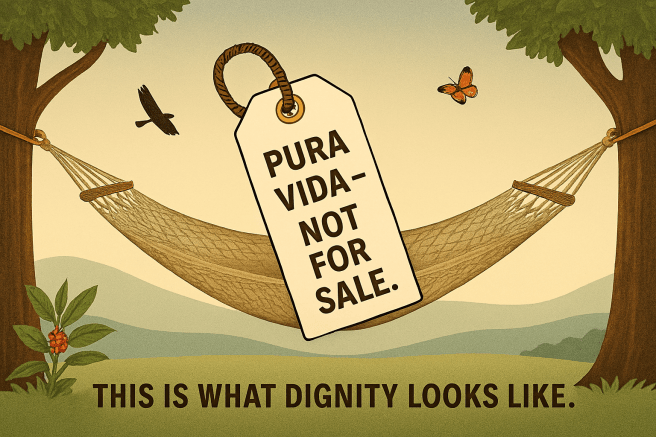
This is what dignity looks like.

⬅️ Previous Post: Language as Covenant


Pura Vida—No Se Vende: Pertenencia a Través del Compromiso

Queridos amigos, agradezco que hayan estado recibiendo estas reflexiones por WordPress. Ahora también las comparto en Substack, donde llegan como cartas a su bandeja de entrada y donde podemos reunirnos en conversación. Si desean acompañarme allí, pueden suscribirse aquí gratis: Reverend Joan M Kistler’s Reflections


Antes de poder siquiera comenzar a cruzar el puente del idioma, aprendí que la pertenencia en Costa Rica ya estaba viva en la manera en que los vecinos se apoyaban unos a otros. El pacto no esperó las palabras — comenzó con el compromiso.

A los pocos días de haber llegado a Costa Rica, se quebró una tubería principal de agua y nos quedamos sin agua por varios días. Como no podíamos hablar español, no teníamos idea de lo que estaba pasando. Ni siquiera sabíamos cómo buscar información sobre la escasez.

Podríamos haber tenido dificultades, pero nuestros vecinos ticos se aseguraron de que estuviéramos bien. Tocaron nuestra puerta y nos hicieron señas para que los siguiéramos. Los seguimos hasta la calle, donde había un camión cisterna de agua.

La gente estaba llenando recipientes con agua. Nosotros no teníamos ninguno. Pero nuestros vecinos no solo llenaron sus propios recipientes — también se aseguraron de que tuviéramos suficiente. Nos prestaron muchos de sus propios bidones. Nos preguntábamos si ellos tendrían suficiente para sí mismos.

Quedamos sorprendidos y profundamente agradecidos. Pensaron en nosotros. Se preocuparon por nosotros. Ese momento nos enseñó que la pertenencia no se trata de fluidez en el idioma ni de encajar rápidamente. Se trata de compromiso — vecinos que se apoyan mutuamente, aun cuando los recursos son escasos.

En los Estados Unidos, la pertenencia a menudo se siente como una transacción — membresías, comunidades cerradas o círculos de amigos y familiares. Si usted está fuera de esos círculos, queda por su cuenta. Los vecinos pueden saludar con cortesía, pero rara vez se aseguran de que los extraños estén bien. La pertenencia se trata como una membresía — algo que se gana o se compra — no un pacto vivo.

Por eso el cuidado de nuestros vecinos durante la escasez de agua nos conmovió tan profundamente. Apenas nos conocían — y éramos extranjeros. Sin embargo, pensaron en nosotros, nos incluyeron y compartieron lo que tenían. Su compromiso nos mostró que la pertenencia aquí no se trata de conveniencia ni de familiaridad. Se trata de pacto — vecinos que se hacen presentes, incluso para los extraños.

Esto es lo que la dignidad parece.

⬅️ Publicación anterior: El lenguaje como pacto

Pura Vida—Not For Sale: Language as Covenant

Haz clic aquí para leer esta publicación en español.

Dear friends, I’m grateful you’ve been receiving these reflections through WordPress. I’ve also begun sharing them on Substack, where they arrive like letters in your inbox and where we can gather in conversation. If you’d like to join me there, you can subscribe here for free: Rev Joan M Kistler’s Reflections


When I moved to Costa Rica, I thought learning Spanish would be mostly about vocabulary lists and verb conjugations. But language is more than words and not just a tool — it is a bridge.

A bridge connects people who might otherwise remain apart: expats and locals, strangers and neighbors. To step onto that bridge is a gesture of respect, a covenant of belonging. It says, “I honor your humanity. I want to walk toward you. I want to belong with you.”

Crossing the bridge requires humility — and sometimes the willingness to laugh at yourself. For an entire year, whenever I wanted to say I was hot, I went around declaring, “Estoy caliente.” I thought I was saying, “I’m warm.” What I was actually saying was, “I’m horny.”

Costa Ricans didn’t mock me or shut me out. They smiled, they understood what I was trying to say, and eventually someone gently explained the difference: the right phrase is “Tengo calor.” That moment taught me something deeper than vocabulary. Language is a pact not because we get it perfect, but because we’re willing to risk vulnerability, to stumble, and to be met with patience and kindness.

That is covenant. 

But not everywhere is language treated this way. In the United States, it is often seen not as a bridge but as a test of worthiness — more like a fraternity hazing ritual than a covenant. You’re expected to endure humiliation for your accent, prove yourself with perfect grammar, and only then are you “let in.” Communication becomes a gatekeeper, measuring who belongs instead of inviting belonging.

And when expats refuse to learn Spanish, they mirror that same dynamic. By expecting others to translate, accommodate, and carry the weight of the relationship, they commodify communication—turning it into a service for their comfort rather than a covenant of mutual dignity. Instead of risking vulnerability, they demand convenience.

Yet it doesn’t have to be this way. Language can be treated differently—chosen as a covenant, not a transaction; embraced as a bridge of dignity, humility, and belonging.

In Costa Rica, I have learned that the heart of communication is not perfection, but relationship. Vulnerability, patience, and respect are what make strangers into neighbors, and neighbors into community.

When we risk stumbling words, when we laugh at ourselves, when we honor another’s humanity by meeting them halfway — that is covenant. That is belonging.

This is what dignity looks like.

⬅️ Previous Post: Health as a Right, Not a Gamble


Pura Vida—No Se Vende: El lenguaje como pacto

Queridos amigos, agradezco que hayan estado recibiendo estas reflexiones por WordPress. Ahora también las comparto en Substack, donde llegan como cartas a su bandeja de entrada y donde podemos reunirnos en conversación. Si desean acompañarme allí, pueden suscribirse aquí gratis: Reverend Joan M Kistler’s Reflections


Cuando me mudé a Costa Rica, pensé que aprender español sería, sobre todo, memorizar listas de vocabulario y conjugar verbos. Pero el lenguaje es más que palabras y no es solo una herramienta: es un puente.

Un puente conecta a personas que, de otro modo, permanecerían separadas: personas extranjeras y locales, desconocidos y vecinos. Pisar ese puente es un gesto de respeto, un pacto de pertenencia. Dice: “Honro su humanidad. Quiero caminar hacia usted. Quiero pertenecer con usted.”

Cruzar el puente requiere humildad —y a veces la disposición de reírse de uno misma. Durante todo un año, cada vez que quería decir que tenía calor, andaba por ahí declarando: “Estoy caliente.” Yo creía que estaba diciendo: “Tengo calor.” En realidad estaba diciendo: “Estoy caliente… ¡sexualmente hablando!”

Las personas costarricenses no se burlaron de mí ni me cerraron las puertas. Sonreían, entendían lo que intentaba decir y, finalmente, alguien me explicó con suavidad la diferencia: la frase correcta es “Tengo calor.” Ese momento me enseñó algo más profundo que vocabulario. El lenguaje es un pacto no porque lo hagamos perfecto, sino porque estamos dispuestas a arriesgar vulnerabilidad, a tropezar, y a ser recibidas con paciencia y bondad.

Eso es pacto.

Pero no en todas partes se trata el lenguaje de esta manera. En Estados Unidos, a menudo se ve no como un puente, sino como una prueba de valía —más parecido a un ritual de iniciación de fraternidad que a un pacto. Se espera que soporte la humillación por su acento, que demuestre su valor con gramática perfecta, y solo entonces lo “dejan pasar”. La comunicación se convierte en un portero que decide quién pertenece, en lugar de invitar a la pertenencia.

Y cuando los personas extranjeras se niegan a aprender español, reflejan esa misma dinámica. Al esperar que otros traduzcan, le acomoden y carguen con el peso de la relación, volver la comunicación una mercancía—un servicio para su comodidad, en lugar de un pacto de dignidad mutua. En vez de arriesgar vulnerabilidad, exigen conveniencia.

Sin embargo, no tiene por qué ser así. El lenguaje puede tratarse de otra manera —vivido como pacto, no como transacción; abrazado como un puente de dignidad, humildad y pertenencia.

En Costa Rica he aprendido que el corazón de la comunicación no es la perfección, sino la relación. La vulnerabilidad, la paciencia y el respeto son lo que convierte a desconocidos en vecinos, y a vecinos en comunidad.

Cuando nos arriesgamos a tropezar con las palabras, cuando nos reímos de nosotras mismas, cuando honramos la humanidad de otra persona encontrándonos a mitad de camino —eso es pacto. Eso es pertenencia.

Así se ve la dignidad.

Publicación anterior: La salud como derecho, no como apuesta

Pura Vida—Not For Sale: Health as a Right, Not a Gamble

Haz clic aquí para leer esta publicación en español.

In 2019, my wife Tabatha became gravely ill. For months, she was unable to eat without severe digestive upset. Her gastroenterologist ran only the tests her health insurance covered. He diagnosed her with IBS, and told her to “clean up her diet.”

Apparently, he was not concerned that she had lost 40 pounds in only a few months. And obviously, he didn’t hear her say that her diet consisted mainly of broth and jello. Eventually, he conceded that she may have an infection and prescribed antibiotics, but they only made her condition worse.

A few weeks later, Tabatha asked me to sit beside her on the couch, as she lay there weak and emaciated. We both sobbed as we faced the possibility that she might not survive and discussed what I should do if she didn’t.

Thankfully, she decided to see a functional medicine doctor. By her first appointment, Tabatha was so malnourished and dehydrated that the doctor wouldn’t let her leave the office without giving her an IV treatment for fear she would collapse.

After he did proper tests, it was determined that she had five different types of infections in her gut, three of which were resistant to antibiotics.

Treatment saved her life. But every visit, every test, and every prescription had to be paid for out‑of‑pocket. None of it was covered by Tabatha’s health insurance policy, even though 5% of her income was being deducted from every paycheck for the coverage. If we hadn’t had the money to pay for her treatment ourselves, she would have died.

We were lucky. Many others are not.

Tabatha’s ordeal revealed the suffering millions face daily. In the United States, healthcare is commodified. It’s not a right; it’s more like a gamble. Health insurance is like a giant slot machine. Americans feed enormous amounts of money into it. When they get sick or hurt, they pull the lever, and the formulary reels spin. If they’re lucky, they land on “approved,” and they get a payout.

Health insurance companies are like casino owners keeping tight control over payouts to maximize profits. People’s lives are placed not in the hands of those who heal, but in the hands of those who wheel and deal.

Health is not meant to be a gamble. It is a covenant—a shared responsibility, a gift of mercy, a right that belongs to every soul. In Costa Rica, we discovered a culture that treasures community over competition, where access to healthcare is seen not as a privilege for the wealthy, but as a commitment to human dignity.

Here, healing is not commodified; it is honored as part of life together. All citizens and residents pay into the public healthcare system, the Caja Costarricense de Seguro Social (CCSS).

The monthly premium is 1/10 the cost of the average monthly premium for health insurance in the U.S. And the CCSS covers everything—from routine checkups to major treatments—because health care here is understood as a right, not a gamble.

For non-residents and those who want care outside the social system, there is also a private system. But even private care costs only about one‑third of what we paid in the United States.

And guess what? If you’re in Costa Rica,  and you need medical care, the CCSS will take care of you. Period. It doesn’t matter whether you’re paying into the system, it doesn’t matter if you have insurance, it doesn’t even matter if you’re in the country illegally. All that matters is that you’re a living, breathing human being.

That alone makes your care approved.
That alone makes denying you care unthinkable.

When we visit a pharmacy in Costa Rica, we can actually buy only the amount of medication we need. The first time I witnessed someone walk into a Costa Rican pharmacy and buy a single aspirin, my American-programmed mind short-circuited: “Does not compute!”

This doesn’t happen in the U.S. Ever. We are forced to buy an entire bottle or package whether we need it or not. We may use a few pills, but most of it ends up unused, sitting in our medicine cabinets until it eventually expires and gets thrown away. Because it’s not about what people need; it’s about profits.

Not in Costa Rica.
Here it is about people.
Here it is about dignity.
And this is what dignity looks like.

⬅️ Previous post: Listening to the Whisper


Pura Vida—No Se Vende: La salud como derecho, no como apuesta

En 2019, mi esposa Tabatha se enfermó gravemente. Durante meses, no pudo comer sin sufrir fuertes molestias digestivas. Su gastroenterólogo ordenó únicamente los exámenes que cubría su seguro médico. La diagnosticó con síndrome de intestino irritable y le dijo que “mejorara su dieta.” 

Aparentemente, no le preocupó que hubiera perdido 18 kilos en solo unos meses. Y, obviamente, no escuchó cuando ella le dijo que su dieta consistía principalmente en caldo y gelatina. Finalmente, admitió que quizá tenía una infección y le recetó antibióticos, pero estos solo empeoraron su condición. 

Semanas después, Tabatha me pidió que me sentara a su lado en el sofá, mientras yacía débil y demacrada. Ambos lloramos al enfrentar la posibilidad de que no sobreviviera y conversamos sobre lo que yo debería hacer si ella no lo lograba. 

Afortunadamente, decidió acudir a un médico de medicina funcional. En su primera cita, Tabatha estaba tan desnutrida y deshidratada que el doctor no le permitió salir del consultorio sin administrarle un tratamiento intravenoso, por temor a que se desplomara. 

Después de realizar los exámenes adecuados, se determinó que tenía cinco tipos diferentes de infecciones intestinales, tres de ellas resistentes a los antibióticos. 

El tratamiento le salvó la vida. Pero cada visita, cada examen y cada receta tuvieron que pagarse de su propio bolsillo. Nada estaba cubierto por la póliza de seguro médico de Tabatha, aunque el 5% de su salario se descontaba en cada cheque para esa cobertura. Si no hubiéramos tenido el dinero para pagar su tratamiento, ella habría muerto. 

Tuvimos suerte. Muchos otros no la tienen. 

La experiencia de Tabatha reveló el sufrimiento que millones enfrentan a diario. En Estados Unidos, la salud está mercantilizada. No es un derecho; es más bien una apuesta. El seguro médico funciona como una enorme máquina tragamonedas. Los estadounidenses le entregan enormes sumas de dinero. Cuando se enferman o se lastiman, tiran de la palanca y los carretes del formulario giran. Si tienen suerte, cae en “aprobado” y reciben un pago. 

Las compañías de seguros médicos son como dueños de casinos que controlan estrictamente los pagos para maximizar ganancias. La vida de las personas no está en manos de quienes sanan, sino en manos de quienes negocian y hacen tratos. 

La salud no está destinada a ser una apuesta. Es un pacto: una responsabilidad compartida, un regalo de misericordia, un derecho que pertenece a cada alma. En Costa Rica descubrimos una cultura que valora la comunidad por encima de la competencia, donde el acceso a la salud no se ve como un privilegio de los ricos, sino como un compromiso con la dignidad humana. 

Aquí, sanar no se mercantiliza; se honra como parte de la vida en común. Todos los ciudadanos y residentes aportan al sistema público de salud, la Caja Costarricense de Seguro Social (CCSS). 

La prima mensual equivale a una décima parte del costo promedio de un seguro médico en Estados Unidos. Y la CCSS cubre todo: desde chequeos rutinarios hasta tratamientos mayores, porque aquí la salud se entiende como un derecho, no como una apuesta. 

Para los no residentes y quienes desean atención fuera del sistema social, también existe un sistema privado. Pero incluso la atención privada cuesta solo alrededor de un tercio de lo que pagábamos en Estados Unidos. 

¿Y saben qué? Si está en Costa Rica y necesit atención médica, la CCSS te atenderá. Punto. No importa si estás aportando al sistema, no importa si tienes seguro, ni siquiera importa si estás en el país de manera ilegal. Lo único que importa es que eres un ser humano vivo y respirando. 

Eso, por sí solo, hace que tu atención sea aprobada. 
Eso, por sí solo, hace que negarte atención sea impensable. 

Cuando visitamos una farmacia en Costa Rica, podemos comprar únicamente la cantidad de medicamento que necesitamos. La primera vez que vi a alguien entrar a una farmacia costarricense y comprar una sola aspirina, mi mente programada en Estados Unidos tuvo un cortocircuito : “¡Error del sistema!”

Esto en Estados Unidos no sucede. Nunca. Estamos obligados a comprar un frasco o paquete entero, lo necesitemos o no. Usamos unas pocas pastillas, pero la mayoría termina sin utilizarse, acumulada en nuestros botiquines hasta que expira y se desecha. Porque allá no se trata de lo que la gente necesita; se trata de ganancias. 

No en Costa Rica.
Aquí se trata de las personas. 
Aquí se trata de la dignidad. 
Y así se ve la dignidad.

⬅️Publicación anterior: Escuchando el Susurro

Pura Vida—Not For Sale: Listening to the Whisper

Haz clic aquí para leer esta publicación en español.

We had lived through decades of struggle in the United States—fighting for dignity as lesbians, fighting for recognition as women, fighting for survival in a culture that often treated us as less than human.

And it isn’t only the LGBT community and women. Immigrants, people of color, Jews, the disabled, the poor, and the elderly also carry this heavy burden of oppression.

In the American profit‑first system, everyone’s worth is measured by money: what you have, what you earn, or how much you can be exploited for profit. Indeed, when meeting someone for the first time, Americans’ first question is, “What do you do for a living?”

People are commodified: treated as if they were products with a price tag. They are valued only for their economic utility, instead of for their humanity. The basic things that all human beings need to live with dignity—housing, healthcare, education, rest, and belonging—are products to be bought and sold, rather than human rights or shared gifts. 

This heavy yoke of commodification had left us weary. And then, one day, that still, small voice inside us whispered: “Go. Find peace. You have fought enough.

It wasn’t logical. We had never been to Costa Rica. We didn’t know the language. We didn’t know the customs. But the whisper carried a weight that logic never could. It was the voice of the soul, a Divine reminder that freedom isn’t just a pipedream—it is our birthright, a built-in longing within every soul. 

So we sold what we could, packed what we absolutely needed or couldn’t leave behind, and stepped into the unknown. Some people called us foolish. Some even called us cowards for not staying to fight. But we knew: courage takes many forms. Sometimes it’s protest. Sometimes it’s persistence. And sometimes, it is the radical act of choosing peace.  

Now, we wake to birdsong instead of sirens. We walk slowly, breathe deeply, and are greeted with warmth instead of cold indifference. Costa Rica has given us something we never knew we lacked: a culture that values community over competition, joy over performance, being over doing.

Costa Rica, you welcomed us with open arms. You gave us dignity, sanctuary, and the chance to breathe freely. This is what dignity looks like. And this is our love letter to you with a promise to honor your dignity. 

This series is born from gratitude for Costa Rica’s gift of pura vida—a way of life that treasures human dignity over commodification. Each reflection will name the ways freedom and humanity are cheapened when measured only by profit, and then turn toward hope: the covenant of living humbly, together, with mercy and joy.

Click on the links to view more posts in the series. If there is no link, the post is coming soon!

The Series
1. Listening to the Whisper (this post)
2. Health as a Right, Not a Gamble  (published 01/25/2026)
3. Language as Covenant  (published 02/07/2026)
4. Belonging Through Commitment (published 02/22/2026)
5. Living Humbly, Not Monumentally  
6. Guardians of Pura Vida  
7. Freedom’s True Cost  

I invite you to walk with me through these reflections. Together we’ll explore how Pura Vida offers a different way of seeing freedom, belonging, and hope.

Follow along as each post lifts up a facet of this covenantal life, naming what commodification distorts and celebrating what mercy restores.


Pura Vida—No Se Vende: Escuchando el Susurro

Habíamos vivido décadas de lucha en los Estados Unidos: luchando por la dignidad como lesbianas, luchando por el reconocimiento como mujeres, luchando por sobrevivir en una cultura que muchas veces nos trataba como menos que humanas. Y no es solo la comunidad LGBT y las mujeres. Inmigrantes, judíos, personas afrodescendientes, personas con discapacidad, los pobres y los adultos mayores, entre otros, también cargan con el pesado yugo de la opresión

En el sistema estadounidense el dinero es primero: el valor de cada persona se mide por el dinero que tiene, lo que gana o cuánto puede ser explotada. De hecho, al conocer a alguien, la primera pregunta suele ser: “¿A qué se dedica?”

Las personas son cosificadas—tratadas como si fueran productos con una etiqueta de precio—valoradas solo por su utilidad económica, en lugar de por su humanidad. Las cosas básicas que todo ser humano necesita para vivir con dignidad—vivienda, salud, educación, descanso y pertenencia—se convierten en productos que se compran y se venden, en vez de ser derechos humanos o regalos compartidos.

Ese pesado yugo de la mercantilización nos había dejado cansadas, y entonces, un día, esa voz pequeña y queda dentro de nosotras susurró:“Vayan. Encuentren paz. Ya han luchado suficiente.”

No era lógico porque nunca habíamos estado en Costa Rica. No sabíamos el idioma y no conocíamos las costumbres; pero el susurro llevaba un peso que la lógica nunca podría llevar. Era la voz del alma, un recordatorio Divino de que la libertad no es solo una ilusión—es nuestro derecho de nacimiento, un anhelo sembrado en cada alma.

Así que vendimos lo que pudimos, empacamos lo absolutamente necesario o lo que no podíamos dejar atrás, y dimos el paso hacia lo desconocido. Algunas personas nos llamaron imprudentes, otras incluso nos llamaron cobardes por no quedarnos a luchar, pero sabíamos que el valor toma muchas formas: a veces es protesta. A veces es persistencia. Y a veces, es el acto radical de elegir la paz.

Ahora despertamos con canto de aves en lugar de sirenas. Caminamos despacio, respiramos profundo, y somos recibidas con calidez en vez de con indiferencia fría. Costa Rica nos ha dado algo que nunca supimos que nos faltaba: una cultura que valora la comunidad sobre la competencia, la alegría sobre el rendimiento y el ser sobre el hacer.

Costa Rica nos recibió con los brazos abiertos. Nos dio dignidad, refugio y la oportunidad de respirar libremente. Así es como se ve la dignidad y ésta es nuestra carta de amor para usted, con la promesa de honrar su dignidad.

Esta serie nace de la gratitud por el regalo costarricense de la Pura Vida—una forma de vivir que atesora la dignidad humana por encima de la mercantilización. Cada reflexión nombrará las maneras en que la libertad y la humanidad se desvalorizan cuando se miden solo por la ganancia, y luego se volverá hacia la esperanza: el pacto de vivir con humildad, juntos, con misericordia y alegría.

Haz clic en los enlaces para ver más publicaciones de la serie. Si no hay enlace, ¡la publicación estará disponible próximamente!

La Serie

  1. Escuchando el Susurro (este post)
  2. La Salud como Derecho, No como Apuesta (publicado 25/01/2026)
  3. El Lenguaje como Pacto (publicado 07/02/2026)
  4. Pertenencia a través del Compromiso
  5. Vivir con Humildad, No Monumentalmente
  6. Guardianes de la Pura Vida
  7. El Verdadero Costo de la Libertad

Le invito a caminar conmigo a través de estas reflexiones. Juntos exploraremos cómo la pura vida—el regalo costarricense de dignidad y sosiego—ofrece una manera distinta de ver la libertad, la pertenencia y la esperanza.

Acompáñeme en cada publicación, donde levantaremos un aspecto de esta vida pactada, nombrando lo que la mercantilización distorsiona y celebrando lo que la misericordia restaura.