It has been two and a half years since we sold almost everything we owned, packed up the rest and moved to a country we’d never even been to. Everyone thought we were crazy. So did we. But deep down, we couldn’t ignore that still, small voice that kept whispering, “It’s time to leave.”
When we first arrived in Costa Rica, I thought I was moving. Now I know I was arriving. We left behind the familiar rhythms of the U.S. and stepped into the slower, softer beat of Costa Rica. What began as a logistical shift has become a spiritual one. This blog series I started back then, Moving to Costa Rica, was full of practical details and emotional tremors. Now, the tremors have quieted. What remains is a steady hum of gratitude.
We’ve found sanctuary here—not just in the landscape, but in the way people live. There’s a quiet dignity in the everyday: the neighbor sweeping her porch at sunrise, the farmer tending his land with reverence, the gentle greetings exchanged without hurry. Life here doesn’t rush to prove itself. It simply is. And in that simplicity, there’s a kind of wisdom I didn’t know I was seeking.
In Costa Rica we have found what many spend their lives chasing: Pura Vida. Not just the phrase, but the feeling. It’s the unspoken grace in how people show up for each other. It’s the peace that comes from living close to the land, close to family, close to what really matters.
It’s not perfection—it’s presence.
While I’ve let go of many things—urgency, income, the need to perform—I’ve gained sacred time. Time to write, to minister, to teach with tenderness. Time to create rituals that honor both sadness and joy. Time to become more fully myself.
And even as we’ve rooted here, Tabatha continues to serve across the miles. She’s still writing grants and winning funding for the homeless shelter in our former hometown. The work is rewarding for her. It nurtures her soul. It’s a quiet bridge she’s kept open—one that connects our past to our purpose, and reminds us that presence can stretch far beyond geography.
My ministry has deepened. My writing has softened. My teaching has become more attuned to the emotional and spiritual thresholds my learners are crossing. I’m no longer just helping people speak English—I’m helping them speak with clarity, confidence, and compassion.
This isn’t a grand update. It’s a quiet one. But it feels important to mark the moment, and to say this: Follow your heart. You don’t have to live in ways that make you unhappy. The Power that created the Universe holds far more strength than any earthly leader. That Power is not interested in control, but in compassion. It will always support a decision to care for your soul—and to live in ways that honor your deepest truth.
So if you’re standing at the edge of something new—wondering whether a leap of faith is worth it—this is your quiet encouragement. Sometimes the bridge appears only after you begin to walk. So make the decision. Begin the journey. Trust in the One who holds the real Power. You can step into the complete unknown and land just fine.
Actually—better than fine. You can land amazingly.
If you’d like to read more about our move to Costa Rica, below are all the links to the posts in the series.
In my last post, I wrote that the Anti-Christ is the ego. When I use the term “ego,” I’m not referring to “ego” as Sigmund Freud defined it but as defined metaphysically. Metaphysically, the ego is defined as the idea of “I” as a separate being. It is the sum of all of the beliefs we carry about ourselves. From the time we are born, we begin to collect ideas about ourselves in the form of labels, beginning with the very first label with which we are assigned: our gender.
There are many more labels to come – labels related to our race, religion, socioeconomic class as well as the labels we are given by people in authority and our peers. The more labels we take on, the smaller we become because there are behavioral expectations associated with each label. For example, if we are labeled “male,” there are societal norms around “maleness” that we must obey in order to be accepted. The same is true with race, religion, and socioeconomic class. Societal pressure to conform to the behavioral norms associated with these labels restrict our behavior and keep us in line through the fear of rejection.
As we grow up, we are offered many more labels both by people in authority and our peers. Some of the labels are positive, and some are negative. Either way, labels are burdensome because they place expectations on us. Each label is a box inside a box inside another box, and our space to be keeps getting smaller and smaller. By the time we reach adolescence, we may feel as if we are suffocating inside a very small box, especially if we have been forced to conform to many labels that just don’t fit.
Our eternal nature is carefree and limitless – full of peace, love, and joy. When we are born, we walk into a theater called “Earth” and get assigned a role (our name). Throughout the acts and scenes of our life, there are many directors working hard to mold and shape us into what they think our character should be. After many years of playing this character, we forget who we really are. This is what happens to us on micro-level as individuals and on the macro-level over the history of humankind.
We think we are only this earthly character, and we are filled with fear. Why? Because it is a work of fiction. It exists only as long as we are in this theater called Earth. The moment we exit the theater, the character ceases to exist. When we forget our true eternal identity, we have no choice but to cling to this earthly identity, a house built on sand (Matthew 7:26-27). We try to fortify the house through the accumulation of wealth and power, but no amount of wealth or power can change the truth that this “personal self” is ephemeral.
Our earthly character isn’t evil in and of itself. We are meant to live this life as a particular expression of Being, and we are born with the traits, tendencies, and talents we need to play our role gloriously. We need the ego in order for Being to experience each individual expression (or “character”). And just an author fondly remembers every character he or she created, every “character” we ever played on this stage called “Earth” is lovingly held in the memory of Being.
We are filled with joy when we are allowed “to be” – when we are playing our proper role, not the one assigned to us by humans. Labels help us to conceptualize and experience this unreal world of duality. However, since labels belong to this unreal world, they are also illusions. Male and female, white and black, Christian and Muslim, straight and gay, American and Russian – none of these labels exist in Reality. How can they when in Reality, there is only one Being?
When we are lost in our earthly identity, we forget this. We treat our labels as if they are real, and we create a hierarchy of worth based on our own judgments. Male is more worthy than female; white is more worthy than black; Christian is more worthy than Muslim, etc. At that point, we have made a god of the human ego and have broken the First Commandment: You shall have no other gods before me.
This “other god” is the anti-Christ, and it has been fortifying itself by accumulating wealth and power through its make-believe “caste system” for ages. This has created an extremely unbalanced distribution of wealth in our world, causing suffering for the majority.
The truth that Jesus was a peaceful, universalist is inconvenient for many people today just as it was in Jesus’ time. Like the Zealots 2000 years ago, there are those who want to believe in Jesus as a military leader with nationalistic values. Certainly, Jesus was loyal to his people, offering his message of salvation to the Jews first, but he didn’t exclude others because he knew that every living being is part of Life, part of the Christ, whether they know it or not.
There are also those who have created exclusive Christian religions based on rules that have no basis in what Jesus taught while they ignore his fundamental teachings, such as “Do not judge others” (Matthew 7:1-3) and “Love your neighbor as you love yourself” (Mark 12:31). In Matthew chapter 15, Jesus condemned the Pharisees for this hypocrisy. They complained to Jesus that his’ followers didn’t follow the proper handwashing traditions. Jesus responded by calling them out for breaking the fifth commandment. Instead of honoring their father and mother, the Pharisees followed their own tradition whereby they declared their possessions as “Corban” (dedicated to God). This gave them an excuse to avoid financially supporting their parents.
We are at a crossroads. We all have free will. We must each make our choice: the Christ or the anti-Christ? Unity or division? Love or hatred? Peace or war? Joy or suffering? Reality or illusion? Bonds between family and friends will be broken, for the light cannot abide the darkness, and the darkness cannot withstand the light.
Are you ready to choose? Time is running out.
Stay tuned for my next post: The End Times: The Choice
In these turbulent times, many people are wondering whether we are experiencing the End Times as prophesized. I believe we are, but in the words of the song by R E.M, “It’s the end of the world as we know it, and I feel fine.”
It’s the end of the world as we know it. In other words, the world isn’t going to end, but something major is going to change everything. You might think it’s Artificial Intelligence. Certainly, AI has the potential to change a lot, as did the computer microchip. But I believe something is coming far bigger than that.
What’s coming is a fundamental change in how we see ourselves. We think of ourselves as only human, but we are far more than that. This is what the enlightened masters have been trying to teach us for a very long time, but many have refused to accept it.
The truth is that we are Life Itself – Pure Life. The Life that animates our human body is who we really are. Life is the active, experiencing part of Being, or existence. Being has no beginning and no end. Just as Being can never cease to be, Life can never cease to live. It can never die. This same Life is in everyone and in everything that is alive.
Life can’t be separate from Being any more than the sun’s rays can be separated from the sun. As Life, we are eternally connected to Being, our Source. Therefore, in Reality, there is only one Being. There is no “other.” This is what Jesus meant when he said in John 14:11, “Believe me when I say that I am in the Father and the Father is in me; or at least believe on the evidence of the works themselves.”
Jesus was able to do the works that he did because he didn’t deny who he is. He knew that the man called “Jesus of Nazareth” was just a container for his true identity: Life (a.k.a. the Christ). He also tried to teach his disciples that this same Life is also who they are. The same Life is in every living thing just as the same light glows out of a variety of light bulbs. The container doesn’t change the nature or quality of the light at all.
Our bodies are merely temporary containers for the Life that we are. This is what Jesus tried to teach Peter when he refused to let Jesus wash his feet. He said to Peter, “Unless I wash you, you have not part with me” (John 13:8). As long as Peter viewed his fundamental nature as different from Jesus’, he wasn’t accepting his true identity. He wasn’t “joining with him in Christ.” This is what it truly means to be saved. It doesn’t mean to become part of an exclusive club. This club is all-inclusive. Anyone who sees himself or herself as either inferior or superior to others cannot join with Christ.
What does that mean? It means the absolute equality of every living thing – that every living thing is eternally part of the One Being (a.k.a. God) and equally beloved. Now, there have always been people strongly opposed to this idea. Even Jesus’ disciples struggled to accept that the Samaritans were equally beloved of God. But the Bible says, “God saw ALL that he had made, and it was very good” (Genesis 1:31).
Each human expression of Life has an individual body and a mind which provides Being with the ability to experience its infinite nature in all of its wonderful diversity. In Reality, however, this individuality doesn’t exist. How can it when there is only one Being? However, over time, human beings became lost in the illusion of individuality. We forgot about our true identity, and began to think of ourselves as only human.
This is what we call “original sin,” but it didn’t really happen. We didn’t really separate from God; we only “thought” we did. We only thought of ourselves as only human, but that thought didn’t have the power to change who we really are. This mistaken thought eventually pushed our original mind, the “Mind of Christ” into the background and allowed a different kind of mind to take over: the egoic mind.
This “takeover” is represented in the Bible as Adam and Eve taking a bite out of the apple from the forbidden “tree of knowledge.” They suddenly realized they were naked, and they were filled with fear. Fear is the base emotion of the egoic mind. When fear took over, their perspective changed. God became a harsh judge, life became a struggle, and “others” became a threat. Heaven turned into hell.
The development of the egoic mind is part of the design. It’s necessary in order for Life to become self-aware. Nothing can be experienced without its opposite. Since in Reality, all is One, an unreal world of duality was needed. Just as we can’t know hot without cold, we can’t know ourselves as Life without death. We can’t know ourselves as the Light without the darkness. We can’t know ourselves as love without fear. We can’t know ourselves as the Truth without the lie. The egoic mind contains all of the ideas about who we are not. It is the anti-Christ.
The second coming of Christ is about humanity “waking up” and remembering our true identity. Through this, we will be released from the fear of the egoic mind and return to the love and peace of the Mind of Christ. Our perspective will shift back to the Unity Consciousness of Eden, but with the added bonus of Self-Awareness.
It will change everything.
We still have free will. Each individual can choose to wake up or remain asleep, but in order to make an informed decision, we need a clear picture of each choice. Two-thousand years ago, Jesus gave us a clear picture of the Christ. Today, we are being given a clear picture of the anti-Christ.
It has been a year and a half since we sold almost everything we had, packed up the rest, and moved to Costa Rica, a place we’d never been. People post online that they are thinking about leaving the U.S. and moving to Costa Rica, and expats respond, telling them about how happy they are here – or how miserable.
So what’s the truth? Is life in Costa Rica great or not? Well, I must say that for us, the honeymoon stage has ended, slapping us in the face with the challenging reality of day-to-day life in a country with a different language and culture. Clearly, it isn’t for everyone. Americans thinking about moving to Costa Rica should be aware of who they are and what they can live with and without.
First of all, we Americans have certain tendencies hard-wired into us. The first is the tendency toward workaholism. I know some expats who came here to relax and enjoy their retirement; instead, they have found ways to keep themselves miserably busy with all their volunteer work and/or part-time online jobs. I often find myself feeling guilty and tempted to take on more online work despite our doing fine financially. I have to keep reminding myself that workaholism isn’t a thing here.
Costa Ricans (Ticos) generally don’t work so hard, and for me as an American, it is flabbergasting and maddening at times. When I go to the bank, there is often a line of people out the door and down the street. Nevertheless, the tellers take their time setting up their work stations, dealing with each customer, and even taking frequent breaks. I’ve thought to myself, “Don’t these people value quick, efficient service?” We once spent an hour with a teller who took her time making sure our issue was resolved. Quick? Not-so-much. Efficient? Highly.
On the other hand, there are a couple of Walmart-owned megastores where the Ticos do a great job being both efficient and quick. Ticos are known to be among the happiest people in the world, but the ones who work in these stores look like the most miserable people in the world.
Costa Rica isn’t for you if you’re not willing to let go of toxic capitalist baggage and start treating yourself and others like human beings, not machines.
The second American tendency is unbridled consumerism. We want what we want when we want it whether we need it or not. Many expats complain about how expensive Costa Rica is. Sales tax is 13% on everything, and the high prices of imported goods reflect the cost to get them here. So if you want to live in Costa Rica and enjoy your favorite American brands, be prepared to spend a lot of money for them. That’s if you are lucky enough to find them. There are some grocery stores that offer many American products, but you might have to travel to these stores, costing you more in travel expenses as well as time.
If you want to live affordably in Costa Rica, you have to learn to live like the Ticos and do what they do. They buy Costa Rican products from Costa Rican shops and vendors. There are many products and suppliers from which to choose, and it takes time to find the ones you like. You have to be willing to try a lot of unfamiliar products and brands. You might be surprised that they are at least as good as American brands – and sometimes even better! We found a Costa Rican brand of potato chips that blows away Lay’s.
We were surprised to learn that while some Costa Rican farmers try to grow food organically, most use chemicals freely. Luckily, we recently found a vendor who runs an organic food delivery service, and we’ve already seen improvements in the appearance of our skin and in our energy levels. We strive to eat organic as much as possible, which adds a bit to our grocery bill, but it’s still quite affordable.
Unlike in America where you often have to drive miles to get to the nearest grocery store, there are no “food deserts” here. There is a huge variety of grocery stores, green grocers, and butchers within walking distance. Most parks have fruit trees, and people can freely pick the fruit and enjoy it.
Costa Rica isn’t far you if you’re not willing to live without American products and to embrace the grand adventure of trying things you’ve never tried before.
The third American tendency is our constant high-speed mode. Our obsession with productivity infects not only our work life but also every area of our lives. Here in Costa Rica, the water, electric, and Internet go out more often than in the U.S. I’ve found myself wanting to scream when I am forced to slow down by these outages. Since we live in an more urban area, these problems are usually resolved fairly quickly. Those who choose to live in more remote areas have to live without for much longer.
We’ve learned to keep a backup supply of water, allowing us to at least wash hands, do dishes, and flush toilets when the water is out. We also have our Internet plugged into a backup battery that keeps us connected for an hour or so if the power goes out. Finally, if the Internet goes down, we have a backup wifi hotspot that usually finds a working network unless the outage is more widespread.
We are usually informed of these outages before they happen. Costa Rica works hard to maintain their infrastructures in order to prevent major problems. Only once was there a major water outage lasting a few days due to a major water main break. This happened a few days after we arrived in Costa Rica, but it hasn’t happened since. Ticos are “chill” about these outages and roll with them.
Costa Rica isn’t for you if you’re not willing to slow down, chill out, and roll with inconveniences like outages (and long lines and traffic jams 😂).
Our fourth American tendency is our linguistic prejudice. Americans living in America often get frustrated with people who can’t speak English. Some Americans living in Costa Rica still get frustrated with people who can’t speak English despite the fact that they are living in a country where the national language is Spanish! They also have no interest in learning a single word of Spanish.
Part of the problem might be due to misleading information. Before we came to Costa Rica, we read many posts stating that most Costa Ricans can speak English. Well, if you come here as a tourist and visit tourist sites, you’re going to encounter many Ticos who speak English very well. If you come here to live, you’re not going to find many people who speak English very well unless you live in a tourist area or expat community. Even in these areas, you’re going to be confronted by Spanish signs, store product labels, instructions, cable TV, radio, etc. You won’t be able to escape Spanish. It will invade every area of your life.
Costa Rica isn’t for you is you’re not willing to at least learn a little Spanish. You must also be willing to accept and respect the fact that this a county where Spanish is the national language. Just as we expect people to speak English in America, people expect you to speak Spanish in Costa Rica. Luckily, Ticos are very patient, and they are delighted to hear gringos speaking their language even if we do it very badly.
You will always be an American; you can’t change that. But to really enjoy life in Costa Rica, you have to be willing to drop the American baggage and embrace the “Pura Vida” lifestyle.
That’s what we’ve chosen to do, and we are enjoying the best that Costa Rica has to offer: people who mind their own business and treat others with respect whether they like them or not, the absence of random violence, a working democratic government with a strong commitment to civil rights, and an affordable health care system that really takes care of people. Even our old dog Jackson is well cared for by our Costa Rican vet who makes house calls.
If you’d like to know more about living in Costa Rica, feel free to post your questions in the comments.
Last fall, when we were planning our relocation to Costa Rica, my brother said to me, “You’re coming back for Josh’s wedding, right?” I replied, “Of course! I can’t miss my only nephew’s wedding!” As a result, on October 3rd, Tabatha and I boarded a plane in San José bound for Miami. A couple of hours later, we boarded another plane to Philadelphia.
I can’t say I was looking forward to returning to the U.S. To be honest, I was dreading it.
The energy in Costa Rica is so peaceful, laid-back, and friendly. The energy in the United States is the opposite. I didn’t want to be immersed in that energy again. As we were preparing for the trip, I had said more than once to Tabatha, “I don’t want to go back.”
I had to go back. I truly couldn’t miss my only nephew’s wedding, so I psyched myself up for trip. Tabatha, the master planner, had put together a nice itinerary for the week-long sojourn: visiting friends and family, going shopping, enjoying favorite restaurants, and of course, attending the wedding. I kept telling myself that I would enjoy these things.
Well, after only two days in the U.S., I got sick. The night before the wedding, I felt so lousy that I took a COVID test and prayed. We had already visited several friends by that time, and a positive result would mean that we had not only exposed these friends but also that we weren’t going to my nephew’s wedding – the main reason for the trip.
Thankfully, the COVID test turned out negative.
We attended the wedding and the reception dinner. We did a little dancing, but with my being sick and Tabatha’s knee still on the mend, we didn’t do any serious boogeying. After dinner, I’d had enough, so we decided to go back to the hotel room. We missed the fun of them cutting the cake and feeding it to each other; nevertheless, we so thankful we made it. I saw people I hadn’t seen in ages. Tabatha finally got to meet my nephew and his family. Best of all, we got to enjoy watching my brother, the father of the groom, have a total blast!
The day after the wedding, I noticed the tell-tale signs of a sinus infection. I had forgotten all about my fall allergies. When I lived in northeast PA, I started taking Allegra in August to prepare for them. I have gotten sinus infections and bronchitis in October more than once over the years. I didn’t think about the fact that we were returning to the U.S. during the worst time for my allergies. I was unprepared, and my sinuses were like, “What the …?”
A trip to one of those ready care places confirmed my suspicions, and I was prescribed antibiotics.
There were only a couple of rough days. Once, we were having lunch with friends at our favorite diner. I didn’t feel like eating. That’s how lousy I felt. Ask anyone – I always want to eat. I felt so lousy that I excused myself to take a nap in the rental car. Another day, we had a reservation for our favorite seafood restaurant. I wanted to go, but Tabatha correctly pointed out that people might not enjoy eating dinner with my sniffly-sneezy-snotty self sitting nearby, so we got our meal to go. We ate in the hotel room while watching the Eagles football game on TV.
We were really enjoying ourselves. The food was good. The Eagles were winning. Then there was a special news report about the Hamas attack in the Gaza Strip, with images of dead bodies lying in the streets. It was truly terrible, and our hearts go out to those who are suffering in the Gaza Strip.
We weren’t prepared to see those disturbing images during our dinner time. It was prime-time TV. Children could have been watching. There was no warning, so even parents weren’t even given the opportunity to shield their children’s eyes from those images. There was no choice. Yes, we need to know what’s going on, but do we really need to see the graphic details? If we’re that emotionally numb, it’s the media’s fault for feeding us a steady diet of violence and gore.
Truly, the American news media seems to have lost all discretion.
Going back to the U.S. caused some conflicting emotions within me. It was very comforting to once again see and hear English everywhere I went. My brain didn’t have to work so hard to translate. And it was very comforting to enjoy American food. My taste buds didn’t have to acclimate to different flavors and textures. I enjoyed my nephew’s wedding, visiting family and friends, shopping, and eating some of my favorite foods. There was certainly some comfort in being in familiar surroundings again.
It was truly wonderful to see familiar faces in familiar places.
But there was a high price to pay to enjoy those old comforts, and not only for my sinuses. It wasn’t comforting to be bombarded by the media’s fear and negativity. It also wasn’t comforting to have that familiar on-the-road experience of someone obnoxiously beeping their horn and yelling at us for causing them a nanosecond delay. And no matter where we went, there was always the fear in the back of our minds that someone might start shooting.
I concluded that the U.S. is a nice place to visit, but I wouldn’t want to live there again.
When my wife Tabatha and I decided to move out of the United States a year ago, we first thought about Canada. We thought about the weather there. It would be cold, and there would probably be lots of snow. Then we thought about Canada’s official languages: English and French. I took French in high school, but you know what happens to the language we learn in high school after so many years of never needing to use it.
When I moved to Easton PA in 2016, I noticed there were many Spanish speakers in the city. That inspired me to start learning Spanish. So I downloaded Duolingo and played around on it off and on for a few years. About a year prior to our decision to move, I felt inspired to get more serious about learning Spanish, so I started using Rosetta Stone.
I didn’t want to move someplace where I would have to start learning another language. I wanted to use the Spanish I had learned, and neither Tabatha nor I wanted anything more to do with the cold and snow. We wanted someplace warm where I could speak Spanish.
Tabatha had been ill for a long time. She needed to retire early. The pandemic helped her a great deal because she was able to work from home for a while. Soon, everyone was forced back into the office, but that environment was too stressful for her. All around her, people were working well past their retirement ages for fear of not having enough money or health insurance benefits to live well in retirement. Tabatha decided that she wasn’t going to destroy her health for fear of not having enough.
Tabatha knew that she would need to continue working part-time and that I would need to work nearly full-time in order for us to make ends meet. Before she retired, Tabatha set herself up with meaningful part-time work as a grant writer for the local homeless shelter. I had been working a part-time job. After Tabatha retired, we realized that even though we had a small mortgage and no other debt, the cost of health insurance, utilities, and home maintenance could quickly deplete our savings unless we continued working – most likely well into our old age.
However, in order to obtain affordable (government-subsidized) health insurance, our income couldn’t exceed a certain threshold. If our income exceeded it, we would have to pay back the subsidy in full. We seriously doubted we would be able to live off the limited income necessary to avoid having to pay back thousands of dollars in taxes. Our income wasn’t enough to pay for health insurance coverage without a subsidy. With a subsidy, our allowable income wouldn’t be enough for us to survive.
We felt stuck. Suddenly, we were inspired to think outside-the-box. Most Americans never think about the fact that there might be better places to live than in America. We hear so much talk about “the American dream” – people coming to America in search of a better life. Our “American dream” turned out to be leaving America. We decided on a place where we could live well enough on Tabatha’s pension alone, and by working a little on the side, travel and play.
Costa Rica was the place, but working a little on the side would be problematic. We would seek residency through Tabatha’s pension, but as “pensionados,” we are not allowed to get a Costa Rican job. Tabatha has been lucky enough to be able to continue working remotely as a grant writer for the homeless shelter. But what work would I be able to do?
Anyone in Costa Rica is allowed to work for themselves. I am a minister and a teacher. Would I be able to continue working as a minister in Costa Rica? Costa Rica is mostly Catholic and therefore fairly conservative. That’s definitely not me, so I didn’t count on finding many ministry opportunities. However, I could see myself having plenty of teaching opportunities, especially if I moved into the realm of TEFL (Teaching English as a Foreign Language).
About four months prior to our move, I got onto TEFL.org and started training to become a TEFL instructor. I took the general 120-hour TEFL training course. After that, I took a 40-hour Teaching English Online course since I knew I wanted to teach online. I started thinking about the competitiveness of the TEFL instructor market. There are many TEFL instructors out there. I may have almost 30 years of teaching experience, but I don’t have any TEFL experience.
How was I going to leverage the experience I do have to market myself? I was advised to find my TEFL-teaching niche. Do I want to teach kids? No. Do I want be a pronunciation expert? No. Do I want to teach Business English? No. Do I want to focus on a specific nationality? Perhaps. It may be beneficial to teach Central American students since I would be living in Central America and learning Spanish. Do I want to teach proficiency test preparation?
BAM! There’s my niche! I had been teaching GED test preparation for as long as I’ve been a teacher. I know how to prepare people for testing, and I love helping people pass whatever test they need to pass to move onto bigger and better things. A month after we arrived in Costa Rica, I took a 40-hour Exam Preparation course, and I started figuring out how to market myself as a TEFL Exam Preparation instructor.
Acorn Test Prep was born. I created a website and a Facebook page. I’ve written some blogs, made and shared some posts, made a video and Facebook reel, and shared my expertise on an IELTS test prep group and on Quora. I’ve spent money on advertisements on both Facebook and Quora. I’ve grown my Facebook page to 23 followers, and I have had a bunch of people contact me who are interested in my business.
I have yet to earn a single dollar as a TEFL Test Prep instructor. 😊 It’s okay. I know it takes time to built a business especially in a competitive market. I’m optimistic. I believe that with continued work marketing myself, I will eventually start attracting students. You all can help me out by liking and following my Facebook page and sharing my website with anyone you think might need at TEFL instructor.
My promised next post was supposed to be “Moving to Costa Rica: Figuring Out Work.” Since we’re still figuring out work, that post will have to wait. For this post, I’ve decided to come clean. I’ve been posting all good stuff about our move to Costa Rica, but the truth is it hasn’t been all good.
Believe me.
When we first got here, the weather was perfect. The temperature was always between the mid-sixties and low eighties. Now, it’s not-so-perfect. The end of the dry season brings higher temperatures, and the beginning of the rainy season brings higher humidity. The intersection has resulted in the middle of the day being unbearably hot and humid. That’s how we discovered the brilliance of “la siesta.” It’s just too dang sweltering to do anything but nap.
It’s peaceful here, but that doesn’t mean it’s quiet. The neighbor behind us has a chicken coop. I thought that roosters crow only at sunrise. Nope, they crow whenever they feel like it even if it’s 3 AM. They are just like barking dogs. Speaking of barking dogs, one of our neighbors has a yippy little dog that yips incessantly. It yips at every little sound. It starts yipping when it hears the little squeak the gate makes when I open it to take Jackson for a walk.
So far, I’ve resisted the urge to yell, “Oh shut up, will you?”
Trash is picked up every night, but recycling is picked up only once per month. Sadly, bags that are left out for trash are often thrown out into the middle of the street, torn open, and inspected for anything useful. Once we found our recycling bag torn open and its contents scattered about in a nearby park. Many of the Ticos are very poor, and this is how they survive, but it makes a disgusting mess. To deal with this issue, we hired someone to pick up our recycling and take it to the recycling center every couple of weeks. We take only a small bag of trash out every night, and if our street is a mess, I go out with a broom and bucket and clean it up.
There are often homeless people napping on the sidewalks, and when we go downtown, we are panhandled most of the time. In the grocery store, women have asked us to buy them a few necessities, and on the street, we are often asked for coins. Yesterday, one guy was pretty persistent. I don’t think he knew any English except for “One dollar!” So, I gave him one dollar (a 500-colone coin). The locals see dollar signs when they see Americans and Europeans, and they aren’t wrong. Tabatha and I aren’t rich, but compared to what many Ticos have – we are. We don’t mind helping people out, but being frequently panhandled can be a bit unsettling.
We were delighted with the supersized avocados, but not so delighted with the supersized rats. One rat decided to mosey into our house through our front gate while we were eating lunch. We swear, it looked right at Tabatha as if to say, “Hola! Que hay de comer?” (Hello! What’s to eat?). First, we screamed like a couple of frightened children. Then, we chased it around the house. It left droppings everywhere. The poor thing was obviously terrified. We trapped it in the bathroom and enlisted the help of our neighbor Mayela. She arrived with her specialist equipment for rat elimination: a broom. Unfortunately, she couldn’t save us. The rat was hiding inside a hole it dug in the wall.
I deduced that it was far better to let the rat come out of hiding and find its way out of the house. I didn’t want it to starve to death inside our wall because then we’d have to deal with the distinctive aroma known as “rotting rat carcass.” First, I created a barrier so that the only way the rat could go was out. Then I opened the bathroom door and waited. Eventually the rat came out, but when I saw it, I gasped. That spooked it, so it ran back into hiding. It came back out a few minutes later, and I held my breath while it scampered around, eventually discovering the way out.
It didn’t take long- thank goodness.
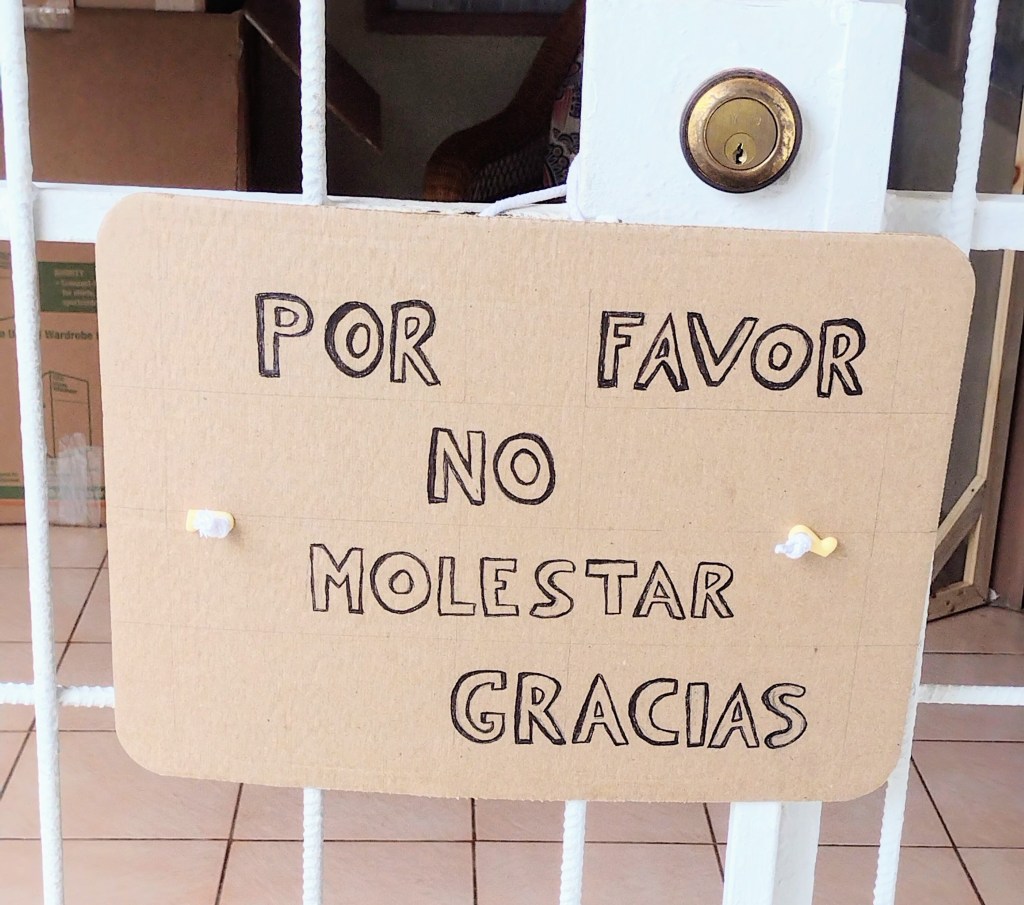
Speaking of our neighbor Mayela, she is a gem. We love her. She is like our “mom away from home.” But just like a next-door mom, she can be a bit intrusive. She regularly rings our doorbell, or stands at our gate yelling, “¡Upe!” (Yoo-hoo!). It causes quite a commotion because the dog starts crazy barking and bolting to the gate. It’s quite disruptive when we’re in the middle of an online Spanish lesson, or talking to someone on WhatsApp, or in the bathroom. To deal with this issue, Tabatha and I devised an ingenious plan. We created a “Do not Disturb” sign (post image). We explained to Mayela that when this sign is on the door, we are working, so we can’t come to the door. We plan to use this sign not only when working, but also whenever we want some privacy.
Two days after we got here, a water main break disrupted the water supply for the entire city for a couple of days, and the water supply is sometimes cut off for maintenance. The electricity blips off and back on regularly, so the electric company occasionally turns off the electricity in sectors for a couple of hours to prevent brownouts. We’ve learned to invest in a surge protector with battery backup. And the plumbing in our house? Not-so-good. We’ve had a major sewage back-up into our shower. It was so gross. We’ve learned to use the smallest amount of toilet paper necessary and to use drain cleaner monthly to avoid clogs.
The truth is that no matter where you go, a city is a city and people are people and life is life. The problems we may hope to escape in one place often show up in the new place, and/or we may end up with new problems to replace the old ones. To live here more happily and healthily, we’ve needed to make some attitude adjustments and lifestyle changes.
That’s not easy, and we’re just getting started.
Do we regret moving to Costa Rica? No, we don’t regret it. To be happy anywhere is a choice and that choice often involves hard work. We have chosen to be happy here, and we will do the hard work that requires.
Six months ago, when we were back in the States thinking about our move to Costa Rica, we knew we would be faced with language challenges. Tabatha had been studying Spanish for only a couple of months, and although I had been studying for a couple of years, I was still only a beginner. There was no way for us to know what it would be like.
It didn’t take long for us to find out. From the moment we stepped out of the plane, Spanish was everywhere.
We read all kinds of reassurances online about how we didn’t have to worry about not knowing how to speak Spanish because you can always just use Google Translate. Google Translate is great! It quickly became our best friend. It helps us translate signs, grocery store labels, ingredients, and product descriptions. It helps us figure out how to ask for what we want or need, and if our pronunciation is so bad that we get confused looks, it will even speak for us.
I found that to be very useful one day when I asked a grocery store clerk where I could find yeast. The Spanish word for yeast is “levadura.” It’s pronounced leh-vah-doo-rah. Now, I thought that’s how I pronounced it, but apparently I pronounced it “lav-ah-dor-ah.” The clerk was quite confused. You see, “lavadora” is the Spanish word for a washing machine. He might have thought, “Why the heck is she looking for a washing machine in a grocery store?”
I have found another Spanish word that can get you misunderstood if you fail to pronounce it precisely. The word for hair is “cabello,” pronounced “kah-bay-yoh.” It’s very easy to mistakenly pronounce it “kah-bye-yoh.” You might think you’re asking the hairdresser to wash your hair, but what you’re really asking her to do is wash your horse (caballo).
Google Translate also has this wonderful feature called “Conversation” that can automatically translate between two people. Theoretically, that is. If you’ve ever heard a native Spanish speaker, you know that they seem to speak very fast. That’s because the words flow into each other, making it difficult to pick out the individual words unless you have a trained ear. You can ask the person, “Por favor, hable más despacio” (speak more slowly please), but I’ve found that most can’t because it’s just not natural for them. Google’s “ear” may be better trained than mine, but it is still no match for my next-door neighbor’s or the handyman’s thoroughbred pace.
Google also does not translate local slang accurately, so the translation doesn’t always make sense. For example, in Costa Rica, there’s the saying, “¡Que torta!” It means, “What a mess!” A Costa Rican “torta” is like an omelet or a quiche – a mess of ingredients thrown together and then cooked. Google translates “¡Que torta!” as “What a cake!” According to my Costa Rican Spanish teacher, the word for cake is “queque,” which Google translates as “what what.” Another Costa Rican saying is “¡Que chicha!” This is an expression of anger that often follows an unexpected and unwelcome surprise. Google translates that as “What a girl!”
“¡Que torta!”
We read all kinds of reassurances online about how we don’t have to worry about not knowing how to speak Spanish because many Costa Ricans speak English, and they will often switch from Spanish to English if it appears you are struggling to understand. We’ve been here over a month, and I can count the number of times that has happened on the fingers of one hand. It has happened most often with key service providers such as doctors, lawyers, and bankers. I learned not to bother asking the guy behind the meat counter “¿Habla usted inglés?” (Do you speak English?). No, I’ve learned how to say, “Quisiera un kilo de carne molida por favor” (I’d like a kilo of ground beef please).
There are more bilinguals in tourist areas, but we are not living on the beach. We are living in the Central Valley in the city of San Ramón. Here, it seems, most people don’t speak English even though Costa Ricans learn English in school. I learned French in school. Guess how much French I remember today? The other day, my neighbor introduced her eleven-year-old “nieto” to me. When I looked confused, the kid said, “grandson.”
Yes, Costa Ricans learn English in school, but just like with the French I learned, if you don’t use it, you lose it. Some do remember a little bit of English from school, and they like to use it. Occasionally, we say “Buenos días” to someone on the street, and we get a “Good morning!” in response. And sometimes, we get a “thank you” in response. We can’t help but grin. We all love to hear our own language – even if it isn’t quite right.
I guess we can’t hide it. We are obviously English-speaking gringos. But we are living in a Spanish-speaking country now, so I feel it is my responsibility to learn how to speak the language. The Spanish phrase that comes out of my mouth most frequently is an apology: “Lo siento. Mi español no es muy bueno” (I’m sorry. My Spanish isn’t very good).
There are many other English-speakers who live here, some for many years, who haven’t bothered to learn Spanish. I don’t blame them. It takes a ton of time and hard work. I believe that not knowing the language puts you at a serious disadvantage, and I’m not willing to accept living that way. Admittedly, the choice to learn was easy for me because I’m a language geek. Tabatha isn’t, but she has become fascinated by the structure of the Spanish langue.
When I first got here, I was afraid to try to communicate in Spanish. When listening, I was so focused on translating the words that I would miss the obvious meaning from the context and the person’s body language. Tabatha was much better at this because she didn’t even try to translate the words. When speaking, I was too afraid of making mistakes: using the wrong part of speech or conjugating a verb incorrectly.
I was too focused on vocabulary and grammar. Yes, being a language geek was getting in my way. I’m now finding that I can speak Spanish better than I think. Many people have said, “Habla usted español muy bien” (You speak Spanish very well). Of course, taking Spanish classes four days a week for the past month has helped a lot! There are times when I feel great – like “Yeah, I can do this! Look at me! I’m speaking Spanish!”
Still there are also plenty of times when I fall flat on my face. I feel dumb – a lot. Many times, all I can say at the end of a conversation is, “Gracias por su paciencia” (Thank you for your patience).
People are people wherever you go. Some are more patient than others, but I’d have to say most people here are patient and really appreciate people’s attempts to speak their language. I think my fears of their impatience and intolerance are mostly in my head. It takes a lot longer to communicate here. Perhaps I’m projecting my own impatience and intolerance onto them. Yes, I’m the one who is impatient and too hard on myself.
Truly, I have never experienced anything more humbling.
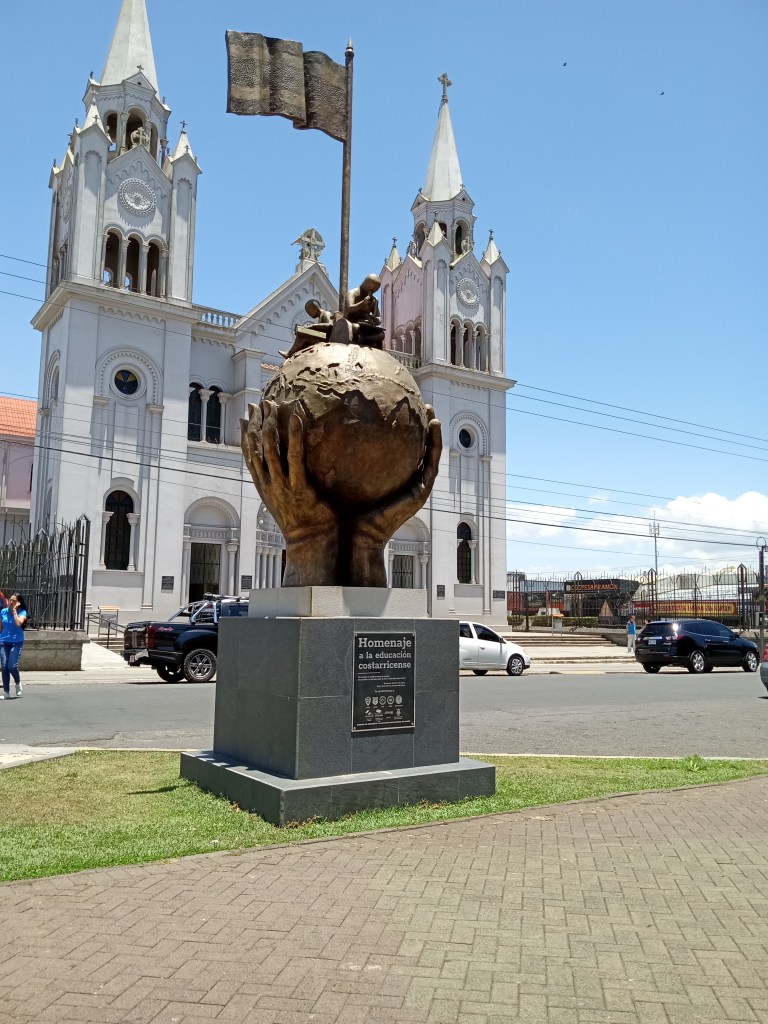
Photo by Joan Kistler – Tribute to Costa Rican Education (San Ramón)
We arrived in Costa Rica on March 21, 2023 early in the morning on a beautiful day and began our new lives in a country we have never visited – not even once. We anticipated that we would experience a culture different from that of the United States, but we couldn’t have imagined what it would be like. Now that we have been here for over three weeks, we are beginning to get a taste of culture shock . In some ways it has been bitter and in other ways sweet.
I will start with the bitter. First of all, in Costa Rica, the traffic is horrible. We chose not to drive in Costa Rica, and we are so glad we made that choice. We hired drivers for two trips from San Ramón to San José and back, and both times, the hour-long drive took more than two hours. On the second trip, the driver attempted to avoid the traffic by taking death-defying cliff-hanging back roads that made us seriously doubt if we would survive. The reward for our near heart failure was that we got to see some fantastic views. We certainly didn’t get to San Ramón any faster.
Second, I thought the sidewalks in Easton, PA were bad. Not compared to the sidewalks in San Ramón. You need to pay attention when walking, or you could easily step into one of many holes, trip over a sudden rise or fall in the sidewalk, or fall into the deep drainage ditches (our poor dog has done that a few times). Just today, while walking downtown, I looked over the edge of the sidewalk, and there must have been a four-foot drop onto the street. I felt like I was walking along a cliff with no railing. In Easton, I saw people with disabilities riding around in powered wheelchairs or scooters all the time. I haven’t seen anyone doing that here. They would have to be loco.
Why are Costa Rica’s roads and sidewalks so bad? Because they don’t prioritize infrastructure issues. They expect people to be aware of traffic and infrastructure issues, take responsibility, and act like rational adults. Costa Rica spends most of its money on three things: education, social services, and healthcare. Knowing this, I can forgive the horrible traffic and horrendous sidewalks.
Now for the sweet. The park is always full of people of all ages enjoying recreational activities, whether they are working out with the provided fitness equipment, walking or running around the field, playing on the playground, or playing a game on the basketball court or soccer field. Their faces are all brimming with sheer pleasure and relaxing enjoyment. Whenever I saw the few people in U.S. parks engaging in recreational activities, they didn’t appear to be enjoying it so much. They appear to be trying get fit for some big event or engaging in serious competition. That kind of pressure doesn’t seem to exist in Costa Rica. Apparently, it isn’t necessary. Costa Ricans are generally healthy and fit.
Some of the conveniences I enjoyed in the U.S. are non-existent here. I wanted to buy a mop with a disposable head – like a Swiffer. No such thing here. The way you mop in Costa Rica is by clipping a rag to the end of a pole. You wring it out by hand, and if you want it clean, you have to rinse it out or wash it. Why do I consider that sweet? In the U.S. there are many products that make life more convenient, but we don’t think its impact on the environment. For example, when we were living in the U.S., we were using a Brita pitcher, and we had over two dozen filters that we needed to recycle. Unfortunately, the company had dissolved their recycling program, so all those filters sadly ended up going in the trash. Many U.S. companies refuse to take responsibility for recycling the products they sell, and the environment suffers. The Costa Ricans don’t sacrifice the environment for convenience.
The sweetest thing of all is that in Costa Rica, you get treated like a real person who matters. More than once, I received a hug and kiss on the cheek simply for introducing myself. The sincere hospitality and generosity of our neighbors has also been a shock. We are foreigners, but we are treated like friends. Our neighbor has brought us wonderful tortillas and custards and complete plates of food. When there was a water main break, they took care of us, taking us in their car to the water truck and giving us containers so that we could collect water for ourselves. In the U.S., foreigners are treated with cold indifference at best.
In the U.S., when people meet for business purposes, they immediately get down to business. In Costa Rica, before business is conducted, people talk to each other. They actually take the time to check in on each other’s wellbeing and to get to know each other. When they say, “Cómo está usted?” (How are you?), they genuinely want to know how you are. There is about ten minutes of chatting before they actually get down to business. This has been extremely enlightening for me. I didn’t realize this before, but the message we Americans send in getting right down to business is this: “I don’t care who you are. I care only about what you can do for me.”
In America, the focus is on business. In Costa Rica, the focus is on relationships: relationships between people and the relationship between the people and the earth. In America, it’s all about money. In Costa Rica, it’s all about community.
That may be why Costa Ricans are among the happiest people on earth, and we are very happy to be living among them.
We have finally arrived, and we’re settling in. The worst part is over: sixteen days on the road from the closing on our home in Easton, PA to the day we flew into San Jose, Costa Rica. Throughout those sixteen days, we posted pictures and stories on Facebook documenting our journey, We looked so happy, right?
Well … to be perfectly honest, I had more than one emotional meltdown. At times, the small part of me that was scared to death overwhelmed me completely, and I ended up sobbing. The worst episode was the night before we flew. I hadn’t flown in an airplane since I was seventeen years old. It wasn’t the flight that scared me; it was the airport. There were too many unknowns. How would we get from the rental car return to the airport? It looked like it was a least a half-mile walk on the map. Could we get an Uber or taxi at 5 AM? Would anyone be there at that hour to help us figure it out? In my head were visions of us lugging two carry-ones and two suitcases each the entire distance and missing our flight. My head couldn’t accept my heart’s reassurances that said, “Just wait until you get there. You’ll figure it out.”
Of course, I didn’t have to figure anything out because the airport already had it all figured out. There was a skytrain that transported people to the airport from the rental car return. There were plenty of people around to help and signs everywhere. The airport wasn’t nearly as complicated as my fearful self imagined. We boarded our plan on time, and I thoroughly enjoyed the flight – especially the glorious sights from the airplane window.
The part of me that is fearful is an expert at taking the unknown, spinning a catastrophe, and then giving me crappy advice as to how to avoid it. There was no reason to feel so fearful. So much of this journey has worked out beautifully. Certainly, there have been challenges, like cockroaches in our hotel room and a lost phone, but there have also been surprises, like the wonderful recreation park near our new home and the NFL Network included with our cable TV.
The biggest challenge is the fact that English is a foreign language here, and I don’t know Spanish very well. Everything is in Spanish, and not everything is translated into English for people like me. I now have tremendous respect for native Spanish-speakers who were brave enough to relocate to the United States without knowing how to speak English. I am experiencing first-hand how difficult it is to be in another country and not know the language. Even though our new home is not located in an English-friendly tourist area, the Costa Ricans are so patient and helpful and kind as I struggle to speak Spanish. They genuinely appreciate the fact that I am trying to speak their language. I know that most Americans are not that way toward those in their country who do not speak English.
The next biggest challenge is the currency, which is also like another language. I love their money: it is as colorful as their country. The Costa Rican currency is the colone. Larger businesses might take American dollars and credit cards, but local small business typically take only colones. When they tell me how much I need to pay, I must look shocked and confused. “Dos mil trescientos veintisiete colones, por favor” (two thousand three-hundred twenty-seven colones please). Eh? All that for a few groceries?
That’s actually only a little more than four dollars.
But there is some real sticker shock. We wanted to buy a small microwave in Walmart. It was $176.00 for one that costs about $60.00 in the States. Familiar American products are very expensive. Foreign products are much cheaper, but … well … foreign. Figuring out what things are and how to use them isn’t easy because product names, descriptions, ingredients, and instructions are all in Spanish. And some products have proven very difficult to find – like decaf coffee. I’m seriously wondering if decaf coffee is a sacrilege in this country.
It’s been great to have a fresh vegetable vendor right next door to us – a very nice young woman named Janneth. She sells tomatoes, bananas, onions, cabbage, carrots, cucumbers, and different kinds of squashes that we’ve never seen before in our lives. We don’t have to go far to stock up on veggies, and it’s very cheap. And our next-door neighbors, Magella and Andres, were very happy to sell us a really cool couch. We were lucky enough find someone bilingual to translate for us in order to do business with them.
Our really cool couch (Photo by Joan Kistler)
Our new home doesn’t have a hot water heater. That’s right, no hot water. The coldest water is cool and the hottest is lukewarm. Now, at first this really upset us because we thought to ourselves, “Oh God. No hot showers.” But we figured out that we can take hot showers through an ingenious invention – electrical wires around the shower pipe that heats the water. Now, seeing electrical wires in a shower is very disconcerting to those not used to seeing something like that. For that reason, this contraption is affectionately known as “the gringo killer.”
The Gringo-Killer (Photo by Joan Kistler)
All I have to say is, in the words of Dorothy, “We are not in Kansas anymore.” It has been only five days since we arrived, and we have found that our greatest survival tactic when it comes to settling in is PATIENCE. It is taking so much longer to accomplish the simplest things, which is aggravating every impatient molecule in my American body. I am finding that I can relax and enjoy myself much more when I focus not on the destination, but on the journey.









 Rev. Joan M. Kistler