

Calming Storms

Karemin1094, CC BY-SA 4.0 https://creativecommons.org/licenses/by-sa/4.0, via Wikimedia Commons

Synopsis: When faced with challenges, the human default is to fearfully resist what is happening and angrily look for someone to blame – not an effective strategy. When we put on the Mind of Christ, however, we peacefully accept the challenge, trusting that that help is always available and that every challenge helps us grow spiritually.

Scriptures: Mark 4:35-41

In 1951, comedian Red Skelton and a party of friends flew to Europe, where Skelton was to appear at the London Palladium. As they were flying over the Swiss Alps, three of the airplane’s engines failed. The situation looked very grave, and the passengers began to pray.

Skelton went into one of his best comic routines to distract them from the emergency as the plane lost height, coming closer and closer to the ominous-looking mountains. At the last moment the pilot spied a large field among the slopes and made a perfect landing. Skelton broke the relieved silence by saying, “Now, ladies and gentlemen, you may return to the evil habits you gave up 20 minutes ago.”

Skelton’s joking advice underscored the truth that whatever religious “commitments” those terrified passengers may have made were strictly temporary. The minute they stepped safely out of that aircraft, all deals with God were off.

But for the disciples of Jesus, there were no temporary commitments or cancellations. Once they got into that boat with Him, they were on board for the duration. There were times when the disciples wondered what they had gotten themselves into with Jesus. Today’s story was one of those occasions.

We are continuing with the Gospel of Mark, the most chronological of the four gospels, meaning that the events in Jesus’ life are laid out in the order in which they actually occurred. Two Sundays ago, we looked at an event early in Jesus’ ministry, where he was accused of being demon-possessed by not only the religious leaders but also by his own family because they couldn’t understand why he treated the perfect strangers who came to him for Torah learning and/or healing with family-level devotion.

Jesus continued his ministry of teaching and healing beside the Sea of Galilee. His favorite way of teaching the people was to tell them parables, but he explained the meaning of the parables to the disciples in private. On this particular day, he taught what the kingdom of God is like using several parables: the sower, the lamp under the bushel backet, the growing seed, and the mustard seed.

He used the parables to help the listeners imagine the tremendous potential within the kingdom of God. The smallest of actions may not seem like much, but under the right conditions, those actions can yield tremendous benefits not only for us personally, but for everyone. With God, all things are possible.

And that brings us to our scripture reading for today. It had gotten late, and Jesus was tired. He was human after all. He needed to get away from the crowd and get some rest, so he asked his disciples to take him over to the eastern side of the sea. Even then, he couldn’t totally escape because some other boats followed.

I’m sure Jesus fully intended for them to reach the other side without incident, but the Sea of Galilee can be treacherous. The valley where it is located is more like a tunnel with hills and mountains on both sides, so if the wind is blowing through there, it creates a wind tunnel that can cause the sea to become a churning nightmare.

In that case, riding in a boat is a lot like trying to ride on the back of a bucking bronco. That is what Jesus and his disciples experienced. Now, did Jesus do anything wrong? No. Did his disciples do anything wrong? No. No one did anything wrong. That’s just life.

But how did the disciples respond? They woke Jesus up saying, “Teacher, do you not care that we are perishing?” They were afraid, and they were angry, and it was Jesus’ fault because how could he possibly be asleep at a time like this?

You see, when life doesn’t go our way, we tend to take it personally. Very personally. We have this attitude that says, “Stuff doesn’t just happen. Someone has to be at fault, and that someone has to pay!” Then we try to figure out who is to blame, so they can pay us whatever it is we think we’re entitled to.

We’re like little children that way, aren’t we? We want life be like an overindulgent parent and spoil us rotten. We want life to say, “Aww, did I make you feel bad? Here … have a cookie.”

But that’s just the mind of me, right? It’s just the part of our mind that believes that life is supposed to revolve all around us because we are the star of this show – the MVP. That’s why we resist life so much because the truth is life doesn’t revolve around us.

Storms happen. Accidents happen. Pandemics happen. That’s life. Many Christians mistakenly believe that following the Lord will spare them from life’s storms; however, following the Lord often leads us into more storms, more challenges. The disciples learned that lesson early in their walk with Jesus.

In contrast to the mind of me, the Mind of Christ doesn’t resist life. It doesn’t resist life’s challenges. It accepts challenges as part of life. It accepts the way God designed life, and God designed life to be challenging. God wisely and thoughtfully designed life to be challenging in order to help us grow spiritually – not to spoil us rotten.

As parents, it is never your intention to spoil your kids rotten, right? You also want to provide the best conditions for them to learn and grow into mature, responsible, productive, and happy members of society. God wants the same for his children, but we’re learning to become mature, responsible, productive, and happy members of not just a national or even a global society but of a universal society.

So, when we are faced with storms, we need to awaken the Mind of Christ within us to help us deal with them because the mind of me will only scream and whine. When we put on the Mind of Christ, our perspective changes, and that change in perspective gives us peace even while the storm is still raging.

How does putting on the Mind of Christ help calm the storms in our lives? It helps to calm the reactionary emotional wind and waves generated by the mind of me so that we can deal with the situation with the wisdom and strength of the Mind of Christ.

First, putting on the Mind of Christ helps us take life’s challenges less personally. I learned a wonderful proverb from an unlikely source – some smart aleck boy I knew from high school but would have never thought in a million years that he would grow up to be a “wise guy.”

Sorry … I couldn’t resist that play on words.

Anyway, years ago, I was working down at the corner mini-mart, and Wayne Dunlap was going through a tough time. I mean, he was really going through quite a storm. Everything in his life was going wrong, and I felt really bad for him. I told him that I was sorry he was having such a tough time, and he said, “Well (shrug shoulders), it is what it is.”

It is what it is. What a great attitude! That attitude comes from the Mind of Christ. When we accept life as it is, we stop getting so angry and looking for someone to blame. We stop taking our anger out on ourselves and others. We stop expecting life to make it up to us somehow and holding onto bitterness until it does.

Putting on the Mind of Christ restores our faith. Jesus asked his disciples, Why are you afraid? Have you still no faith?” The disciples had just spent all that time with Jesus. They heard his teachings. They witnessed his healing powers. Yet they still had no faith.

If Jesus were alive today during this storm, and we lacked faith, he would have every right to say to us, “You come to church every Sunday. You study the Bible. You learn about me, both my words and my works. And yet you still have no faith?”

“You still think that you are in complete control of life, that you can handle life’s storms, that you have the wisdom and the strength and the power to handle them all by yourself? But then when you realize the truth, you cry out to me in anger and blame? You cry, ‘Don’t you care about me, Lord?’”

Where is my faith? That is a great question to ask ourselves when we are experiencing the mind of me’s emotional reactivity to life’s storms.

But what is faith really? Faith is a loaded word these days. Some people believe faith is belief in specific church doctrines or stances on certain political or social issues, but our faith in these things will do absolutely nothing for us when faced with life’s storms.

Faith is what we believe about God and our relationship with him. If we truly believe that we have eternal life in Christ, then we will not fear death. Our bodies can die, but we can’t die. Our consciousness lives on as part of the image of God, a thread interwoven into the eternal fabric of Life.

Those of us who are not afraid of death may still be afraid of pain. I get that. I don’t like pain either. No one likes pain, but just as with all challenges, pain is greatly increased by our reactivity and resistance to it. If we can peacefully accept the pain, then our suffering isn’t as bad. Our experience of it changes.

Faith is also believing that we are God’s child – God’s beloved child – really believing that God loves us. If God is for us, then who or what can be against us? No one and nothing. In fact, did you realize that God created an entire army of angels to be at our beck-and-call. Yes, he did! He created them specifically to help us. That’s how much he loves us.

The angels love us too, but we must ask them for help because they can’t violate our free will. We feel so alone in the world because often we’re too proud to ask for help. The angels would love to help us, so don’t feel silly about asking Archangel Michael for strength and protection or Archangel Raphael for healing or Archangel Gabriel for help with communication. And the Lord is always with us and more than willing to help if we call on Him. He was right there the whole time in that boat with the disciples.

But what do you think the disciples were doing before, in their extreme desperation, they finally decided to wake Jesus up? I mean, these guys were seasoned fisherman, so I’m sure this wasn’t the first time they experienced rough seas. Maybe they tried to turn the sail and catch the wind to outrun the storm. Maybe they tried to row through the waves, but they were too high. Maybe they tried to bail the water out of the boat, but the water was coming in faster than they could bail it out.

They were all too busy feeling afraid and trying to save themselves to let go of control. When we have faith in God, then we know there is nothing to be afraid of. And we know that whenever we are in trouble, we can always ask for help, and it will be granted. Jesus demonstrated this faith when he calmed the storm. He said, “Peace, be still!” and it was done.

The disciples were in awe of this, but Jesus was human just like us. The only difference is that he had tremendous faith. He taught us that if we had enough faith, we could move mountains just as he could calm storms.

Putting on the Mind of Christ restores our trust. Another great question to ask ourselves during life’s storms is, “Do I know the Lord in theory, or do I know the Lord in trust?” This personal self with its mind of me doesn’t trust anything or anyone. It is an incorrigible cynic. That is a very dysfunctional attitude to have toward life. It closes us down, and that only hurts us.

We are here to learn, so there is no shame in actually learning even if we need to do it the hard way. There is a lot we don’t know until we do, and no one is going to judge us for that. God designed this world to help us grow spiritually, and everyone grows spiritually here – some more gracefully than others.

We can trust that whatever personal challenges we face have a purpose. Our life is in the hands of our Higher Self, and we can trust that it will bring us exactly the lessons we need to grow spiritually at exactly the pace we need. Our life is in very good hands.

Because you see, it is our Higher Self’s intention to free us from everything that keeps us enslaved by the personal self and the mind of me – everything that causes us to distrust and everything that makes us feel small, fearful, lacking, and unworthy.

So, when storms happen, we need to accept what is, trust God, and learn whatever it is we need to learn as gracefully as we can knowing that it’s all for our good.

You are not this small self that you see. You are an eternal being, and the total expanse of your life is far vaster than the one you’re experiencing right now. Actually, it is as infinite as God. This life is the blink of an eye compared to your whole life in Christ.

When you can view the challenges you face in this fleeting life through the broader lens of your eternal soul, and your soul’s development throughout all the eons of time, they don’t seem nearly as big a deal.

The challenges you face may not make sense in the context of this nanosecond of your life at this place and time, but our personal self isn’t supposed to know – and really can’t know – what the soul is up to. That work is sacred and therefore beyond its understanding. So, you must simply trust that every experience, every challenge serves your soul’s growth in some way.

The same is true for all humanity, so we can trust that the soul of all of humanity is in the good, loving hands of Spirit and is growing spiritually through the challenges we are facing today. Knowing this truth stills all storms and gives us peace.

Let’s pray together: Lord, we are in awe of the power of your faith, and it is our greatest desire to have the kind of faith that can move mountains and calm storms. When we are faced with storms in our lives, help us to release control and awaken the Mind of Christ within us. AMEN.

Resources

Admin. “Mark 4: 35-41.” Bible.org, 2 Feb. 2009, bible.org/illustration/mark-435-41.

Lawrence, Bill. “1. Stormology 101: From Theory to Trust through Life’s Storms” Bible.org, 2 Apr. 2008, bible.org/seriespage/1-stormology-101-theory-trust-through-lifes-storms-mark-435-41.
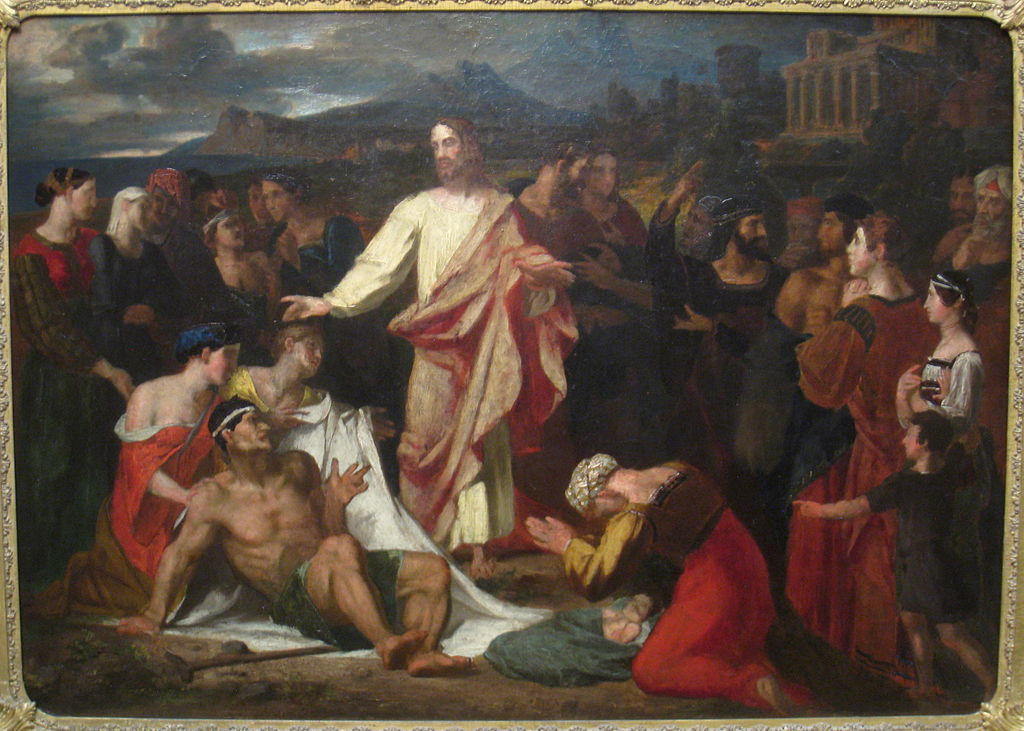
The Perils of Blind Faith

Washington Allston, Public domain, via Wikimedia Commons

Synopsis: Jesus never condoned blind faith. He advised people to believe in him based upon the evidence of his works. When Jesus is accused of being demon-possessed by both the religious leaders and his own family, he warns us of the perils of making such quick black-and-white judgments.

Scripture Reading: Mark 3: 20-35

Steven Sample, the former president of the University of Southern California, wrote a book called The Contrarian’s Guide to Leadership. In his book, he writes about a critical skill leaders must possess in order to make good judgments: thinking gray. Thinking grey is an uncommon characteristic because it requires a lot of effort to develop. But it is one of the most important leadership skills.

Most people immediately label things as good or bad, true or false, black or white, friend or foe. But an effective leader must be able to see the shades of gray in a situation in order to make wise decisions. The essence of thinking gray is to not form a judgement about an important matter until you’ve heard all the relevant facts.

There are many who believe that blind faith is what we are called to as Christians. Therefore, they make quick black-and-white judgments without having sought out the facts and often solely based on what they believe the Bible says. In our scripture reading for today, the perils of blind faith are not only put on display, but also Jesus gives us a very clear warning about making such quick judgments.

Of the four gospels, Mark’s is the most chronological – meaning that the stories about Jesus’ life are told in the order that they actually occurred. Mark’s gospel is also action-packed, especially around the actions of Jesus, the servant.

Here is what has happened in Jesus’ life up to our scripture reading. First, he was baptized by John, and he began his ministry in Galilee. He called his first four disciples: two sets of brothers – Simon and Andrew and James and John.

Next, Jesus began to teach in the synagogue at Capernaum, which would become his home base in Galilee. People were amazed at the authority with which Jesus not only taught the Scriptures but also cast out demons. He performed many other healing miracles: healing Peter’s mom, a man with leprosy, and a paralyzed man.

Jesus then ate with the tax collector Matthew, whom he called to be his disciple. That’s when the religious leaders started asking questions. They asked why he was eating with sinners, why his disciples were not fasting with John’s disciples and the Pharisees, and why he and his disciples were picking and eating wheat on the Sabbath.

News about Jesus’ healing abilities spread so quickly throughout the region of Galilee that soon, huge crowds of people were coming to him for Torah education and healing. It was so crazy that he had to go up a mountainside to escape from people so that he could call the rest of his disciples.

And that brings us to our scripture reading for today. Jesus and his disciples come down from the mountainside and enter a house. The crowd quickly grows, and Jesus is so busy teaching and healing that he doesn’t take the time to eat. He came to serve humanity – and serve he did – with a level of commitment that no one had ever seen before.

So, Jesus’ family shows up to “take charge of him.” They are basically staging an intervention because as far as they are concerned, he’s out of his mind, and they need to take care of him until he regains his sanity. Maybe they thought, “Who does he think he is? The Messiah?”

Granted, there are people even today who suffer from delusions of grandeur, who think that they are the savior of the world, but that wasn’t Jesus’ problem. Perhaps he was temporarily ignoring his need for food to take care of others, but that didn’t mean he was insane.

So, Jesus’ own family is accusing him of being demon-possessed because they don’t understand his behavior. Back in those days, people didn’t have an understanding of mental illness like we do today. If someone was acting out-of-the-ordinary, people assumed the cause was demons, and Jesus certainly was not acting like a normal person.

Jesus was not like most human beings in those days – or even today. Yes, he was a human being just like us, but he was also enlightened. I believe he was born enlightened, and the temptation in the wilderness failed to cause him to fall into identification with the personal self and the mind of me.

He was operating from his Self (with a capital S) and the Mind of Christ, but the personal self and the mind of me in everyone else saw what he was doing and said, “He’s insane!” The truth was that he was perfectly sane. When people came to him with needs that he could take care of, he took care of them. That’s a perfectly rational thing to do, isn’t it?

The Jewish people have always believed service to others to be a key component of their faith, but Jesus was going way too far in their judgment. All he was doing was demonstrating what it really means to be of service, and they didn’t like it – especially the religious leaders.

He was making them look bad, so they said, “He has Beelzebul, and by the ruler of the demons he casts out demons.” Jesus immediately called them on the silliness of that conclusion. What possible advantage would the devil gain in giving Jesus the authority to cast out his minions? Jesus explains that it must be God who is giving him the power to tie up the strongman (or the devil) and drive out the evil influences within the minds of the afflicted.

Jesus never condoned blind faith. In fact, in John chapter 10, when the religious leaders were attempting to arrest him for blasphemy for claiming to be God’s Son, he said in verses 37-38, “If I am not doing the works of my Father, then do not believe me. But if I do them, even though you do not believe me, believe the works, so that you may know and understand that the Father is in me, and I am in the Father.”

He’s saying, “Fine – don’t just take my word for it when I say, ‘I am the Son of God.’ Look at the evidence. Look at the works I have done. What do they tell you?”

The Pharisees had a “spiritual scientific method” – so to speak. When Jesus visited the Pharisee Nicodemus in John chapter 3, Nicodemus said to Jesus, “Rabbi, we know that you are a teacher who has come from God; for no one can do these signs that you do apart from the presence of God.” Nicodemus had applied the spiritual scientific method of the Pharisees and came to this logical conclusion.

Along with the Mind and Christ and the Mind of Me, we also have another type of mind: the rational mind. This is our intelligence. We use the rational mind for reasoning, problem-solving, learning, and planning. If you are working on solving a math problem or putting together a recipe, for example, you are using your rational mind.

Why would God give us a rational mind and then forbid us to use it? We’re not supposed to leave our intelligence at home when we come to church on Sunday morning. Yet this is what some Christian denominations expect. That is not faith. Faith isn’t about our belief in specific doctrines or stances on political or social issues. Our faith may inform our decisions about these things, but they are not what faith is all about.

Faith is simply our beliefs about God. Do you truly believe he loves us? That he can be trusted? That he has your best interests at heart? If you say “Yes” to those questions, then you have faith, but you didn’t come to that faith blindly, did you? God must have proven it to you through his works in your life.

What did Jesus mean when he said verses 28-29, “Truly I tell you, people will be forgiven for their sins and whatever blasphemies they utter; but whoever blasphemes against the Holy Spirit can never have forgiveness, but is guilty of an eternal sin.”

I believe that he is warning us about one of the perils of blind faith. When we refuse to change our minds when the evidence to the contrary is clear, then we are choosing to be blind, and that can cause us to misjudge a person or event that might be coming from God. 

Jesus was filled with the Holy Spirit and following its promptings, so for anyone to say that he had an “unclean spirit” was to call the Holy Spirit “unclean,” which is, of course, blasphemy. People tend to call “evil” what they don’t understand – or don’t want to.

I recently had a Facebook discussion with a high school friend who happens to be an evangelical Christian. She posted something about how the United States needs to return to God instead of overlooking sin. She listed certain issues, including the greater societal acceptance of gay, lesbian, bisexual, and transgender identities.

What she sees as evil, I see as the Holy Spirit working to open the hearts of humanity. We can certainly have our opinions about things, but we have to be careful who and what we judge to be “evil.” First, we must never judge a person to be “evil” no matter what they do. That is blasphemy. Every person has a spark of the divine within them, part of the image of God, so to judge them evil is to judge God evil.

Behavior can be evil, but the most important indicator of whether a behavior is truly evil is the motivation behind the act. We often don’t know for sure what people’s motives are when they behave in certain ways. We can only guess, and we love to do that. We love to make assumptions, but the truth is we can’t be certain. Only God can look inside people’s hearts and know for certain.

So, we need to be careful what we call “evil.” We need to be absolutely certain, and there’s not much we can be that certain about. Life is not so black and white; much is grey. It is complicated and messy.

God created life to be challenging and unpredictable, but he didn’t design it that way to make it dangerous; he designed it that way to make it fun. Yes, our spiritual growth is supposed to be fun.

So … why isn’t it more fun?

Because the mind of me doesn’t like life as God created it. It has a problem with not knowing exactly what’s going on and what’s going to happen because it views life as a threat. Remember that the mind of me is the part of the mind where our identification with the personal self resides. It holds and maintains the false programming that causes us to experience ourselves as separate. It’s also where all our worries about our life come from.

When it comes to not understanding something or not knowing something, the mind of me will jump to a conclusion as quickly as possible to get rid of the discomfort of not knowing, and then it will hang onto that conclusion no matter what evidence it is presented with that might clearly prove it to be wrong. The mind of me will never admit it’s wrong for fear that you will find out the truth: that it doesn’t really know much of what it pretends to know.

We can see this phenomenon occurring within some of the Pharisees of Jesus time. Not all of the Pharisees, but many of them, refused to believe that Jesus’ power was from God even when their own spiritual scientific method proved it. The mind of me within them had already drawn a hasty conclusion, and it was sticking to it.

That leads me to another peril of blind faith related to an issue that has come up more in society recently: conspiracy theories. Many very spiritual people are falling for these – even I have at times. They are often impossible to disprove and so easily spread with the many forms of media today.

Allow me to bring up a wonderful little proverb I learned from cognitive behavioral therapy. The proverb is this: Anything is possible, but not probable. In other words, the mind of me can come up with an infinite number of possible scenarios as “problems” to worry about, but how many of them are probable? How many actually happen?

When the mind of me hears, “This is what’s going on behind the scenes,” and/or “This is what’s going to happen in the future,” it’s all ears. It wants so badly to be “in the know.” It believes it reduces anxiety, but what it really does is temporarily cover it over with a feeling of specialness. “I know something you don’t know. I have inside information.”

If the mind of me is like a fish, then conspiracy theories are like big fat juicy worms. It gets so easily hooked, and the more these conspiracy theories are repeated, the more that hook is swallowed and the more pain we feel.

Think about this: What is the probability that people who are that ego-centric will be able to put aside their extreme self-interest long enough to cooperate with others – to play nice – to the degree that would be required to pull off such elaborate schemes?

The probability of these conspiracy theories happening in reality is small. There might be some truth to them, which makes them seem more probable, but that is just another hooking tactic – to mix up some truth with the lies. They are often “based on a true story.” Just like with TV shows and the movies that are based on a true story, elements of fiction are added to make it more dramatic, and the mind of me craves drama!

Chances are better that those who come up with conspiracy theories are simply aware of our human vulnerability: the extreme gullibility of the mind of me. So they use conspiracy theories to try to influence people’s behavior or just for fun – to see how far it goes. It makes them feel powerful.

But what does believing these theories do to us? Usually, it just ramps up our fear and/or disgust with the world, and it may cause us to make irrational decisions that are harmful to us.

So, if we believe something that causes us to feel extreme negativity about life, we can be sure it’s not the truth – at least not the whole truth and therefore – a lie. What helps to catch the mind of me in the act of assuming it knows what it doesn’t really know is to regularly ask ourselves, “Do I really know that?”

To avoid the perils of blind faith, it is truly wise not to place our faith in anything without evidence – real, verifiable evidence. Of course, the mind of me will tell you that the evidence out there is all lies. Only it knows the truth. That’s just another one if its tactics.

Your Self (with a capital S) knows what the truth is, and it will let you know by how you feel. If you are confused, you can always ask for clarity, and the Holy Spirit will provide. If you feel peace, then you can trust what you have received.

The most important thing to remember is what Jesus said at the end of this scripture reading: “Who are my mother and my brothers? Here are my mother and my brothers! Whoever does the will of God is my brother and sister and mother.” He wasn’t saying that those who don’t do the will of God can be ostracized. That misinterpretation occurs when the verse is taken out of context.

He was simply answering the question that was probably on the minds of many of those who were judging him to be insane. “Why he going so far out of his way for these people he doesn’t even know?”

“Who are they to him?”

The people who were coming to him to hear him teach the Scriptures and for healing were demonstrating faith in God and were doing the Will of God. They were just as important to him as his own family, and just as he would temporarily neglect his own needs to take care of his own family members in their dire need, he would do the same for these people.

Because all of them are part of his spiritual family: the family of God. They are his brothers and sisters in Christ, and because of that, they deserve compassion and understanding, not judgment. When we spend less time judging our brothers and sisters, then we have far more time to actually care for them.

Let’s pray together: Lord, we are grateful for having been given not only a rational mind but also the Holy Spirit to help us to discern the truth from lies. Help us to shun blind faith and to refrain from judgments unless we have all the facts. Let us focus instead of kindly serving our brothers and sisters. Amen.

Resources

Life Application Study Bible. Zondervan, 2011.

Sample, Steven B. The Contrarian’s Guide to Leadership (San Francisco: Jossey-Bass, 2002), p. 7